
At AllThingsNature, we're committed to delivering accurate, trustworthy information. Our expert-authored content is rigorously fact-checked and sourced from credible authorities. Discover how we uphold the highest standards in providing you with reliable knowledge.
What is the Deadliest Spider in the World?
 Tricia Christensen
Tricia Christensen
Tricia Christensen
There are many candidates for the title of the world’s deadliest spider. One of the most important considerations in determining the deadliest, is who the spider is deadly to. Some spiders can efficiently poison even small mammals with their venom, and a few can make humans very ill as well. Typical listings for deadliest spider include the Brazilian Wandering Spider, which occasionally shows up in cluster of bananas in the US, the Funnel Web Spider, which lives in Australia, and the Brown Recluse.
Despite its bad reputation, the Black Widow is generally not considered the deadliest spider in the world, even though its bite can make you ill and does call for medical attention. It’s hard to identify harmless spiders that look like Black Widows unless one is a spider expert, or an arachnologist.

The Guinness Book of World Records considers the Brazilian wandering spider to be the world’s deadliest spider. This is based on the spider’s venom being able to kill a certain number of mice. For a human, a bite from a Brazilian spider, or any spider for that matter, is not likely to kill instantly. Only 7% of the cases of bites from the Brazilian Wandering Spider require antivenin. Additionally, of 7000 reported bites from the Brazilian wandering spider, only a few deaths have been recorded, less than 1% of those bitten.

The statement that the Funnel Web Spider is the deadliest spider also requires some consideration. While one child died within 15 minutes of having received a Funnel Web Spider bite, adult fatalities when the adult was not treated took two to three days to occur. Again, death rate for bites from these spiders are under 1%. Only about 10% of people who receive a bite from a Funnel Web Spider require antivenin, though all should see a doctor.

The Brown Recluse is yet another candidate for deadliest spider. It is said to cause a bite that results in skin necrosis, infection and possible amputation. It is also said to be frequently found in California, when in fact, only 10 specimens of Brown Recluse have ever been collected there. It is certainly possible that a Brown Recluse or two makes it to California via people moving from the Midwest, but California is not the spider’s natural habitat. Again, the Brown Recluse tends to be the victim of bad press, and though bites from the Brown Recluse do need medical care, they seldom result in people’s limbs being amputated, and they occur with much less frequency than is often purported.

People in the Pacific Northwest US who claim to have been bitten by a Brown Recluse may have suffered a bite from a Hobo Spider, which can cause bacterial deterioration of the skin. Even with the Hobo Spider, 50% of all bites are called dry bites because no venom is injected.
One urban legend that persists is that Daddy Long-legs are actually the deadliest spider in the world, but their mouths are too small to bite humans. There are several reasons why this myth has no value. First, Daddy Long-legs can refer to several species of spiders, and even the crane fly. Second, research on venom has not verified that spiders identified as Daddy Long-legs are particularly venomous.
What remains constant in all definitions of the world’s deadliest spider is that all spiders pose very little threat to humans. Among the vast number of spider species, very few are potentially harmful. No human is the natural prey of any spider, and bites are usually the result of an accidental meeting with a spider rather than the natural aggression of the spider. For the most part, even the deadliest spider, whichever receives the designation, remains a helpful rather than harmful part of the human environment. On the other hand, for an insect or small rodent, the designation of deadliest spider is worth noting.
Frequently Asked Questions
What is considered the deadliest spider in the world?
The Brazilian wandering spider holds the title for the deadliest spider, according to the Guinness World Records. Its venom is highly toxic and can cause serious medical conditions or even death if antivenom is not administered promptly after a bite.
How toxic is the venom of the Brazilian wandering spider?
The venom of the Brazilian wandering spider is extremely potent, containing a powerful neurotoxin known as PhTx3. This neurotoxin can cause loss of muscle control and breathing problems, leading to paralysis and asphyxiation if left untreated.
Where can the Brazilian wandering spider be found?
The Brazilian wandering spider is native to South America and can be found in a range of habitats from forests to human dwellings. They are called 'wandering' because they do not build webs but roam at night in search of prey and shelter.
What should you do if bitten by a Brazilian wandering spider?
If bitten by a Brazilian wandering spider, it is crucial to seek immediate medical attention. While waiting for help, try to remain calm to slow the spread of venom, apply a bandage to immobilize the bitten area, and keep it elevated. Antivenom is the most effective treatment for a bite.
Are Brazilian wandering spiders aggressive towards humans?
Brazilian wandering spiders are not typically aggressive towards humans, but they can become defensive if threatened. They may bite if they feel trapped or provoked. It's important to be cautious and avoid handling them or disturbing their habitat.
How does the Brazilian wandering spider's venom affect the human body?
The venom of the Brazilian wandering spider can cause intense pain at the bite site, followed by symptoms such as sweating, nausea, and hypertension. In severe cases, it can lead to neurological symptoms like convulsions, blurred vision, and even death if antivenom treatment is not received in time.
Tricia Christensen
Tricia has a Literature degree from Sonoma State University and has been a frequent AllThingsNature contributor for many years. She is especially passionate about reading and writing, although her other interests include medicine, art, film, history, politics, ethics, and religion. Tricia lives in Northern California and is currently working on her first novel.
Learn more...
Tricia Christensen
Tricia has a Literature degree from Sonoma State University and has been a frequent AllThingsNature contributor for many years. She is especially passionate about reading and writing, although her other interests include medicine, art, film, history, politics, ethics, and religion. Tricia lives in Northern California and is currently working on her first novel.
Learn more...AS FEATURED ON:
AS FEATURED ON:









-
![A Black Widow's poison is potent.]() By: peter_watersA Black Widow's poison is potent.
By: peter_watersA Black Widow's poison is potent. -
![Many spider bites go unnoticed or cause only minor irritation -- unless a person is allergic to spider venom or the venom is poisonous.]() By: schankzMany spider bites go unnoticed or cause only minor irritation -- unless a person is allergic to spider venom or the venom is poisonous.
By: schankzMany spider bites go unnoticed or cause only minor irritation -- unless a person is allergic to spider venom or the venom is poisonous. -
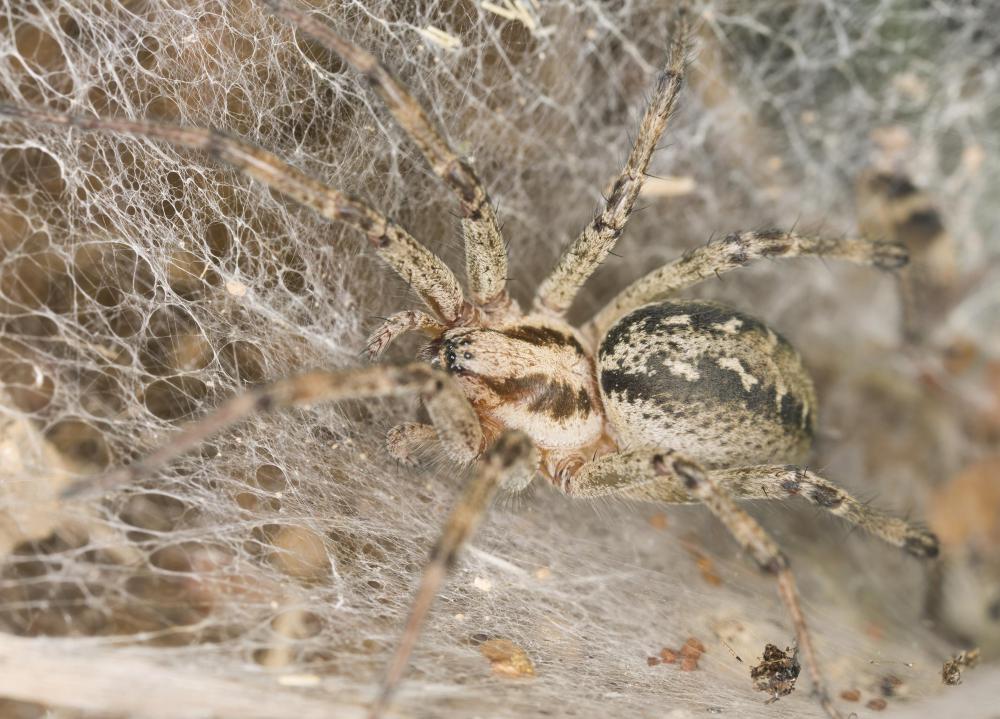
![The funnel web spider is one of the deadliest in the world.]() By: Henrik LarssonThe funnel web spider is one of the deadliest in the world.
By: Henrik LarssonThe funnel web spider is one of the deadliest in the world. -
![Contrary to urban legend, Brown Recluse bites seldom result in people's limbs being amputated.]() By: Barabas AttilaContrary to urban legend, Brown Recluse bites seldom result in people's limbs being amputated.
By: Barabas AttilaContrary to urban legend, Brown Recluse bites seldom result in people's limbs being amputated.



Discussion Comments
The Brazilian wandering spider is the deadliest. You guys are saying the funnel web because "it kills a lot of people so it must be the deadliest." It's the Brazilian wandering spider. It can kill 225 mice in one bite, which is 30 times deadlier than a rattlesnake.
Regarding the Daddy Longlegs legend and Mythbusters: Yes, they did indeed test that on a long legged spider species and pronounce it Busted. I have never understood this folklore to apply to a true spider, though. The version related to me since childhood refers to Metaphalangium species, AKA Harvestmen. I would like to see Adam and Jamie do an update with the correct animal involved.
The Sydney funnel web is extremely dangerous, less so now that we have an antivenin. However, put a funnel web in with a redback and guess which one is left standing? Not the funnel web, but it is still much more deadly to humans than the redback.
the Australian funnel web doesn't get a mention?
I do not know where you get your information but the black funnel web is the deadliest spider in the world. You will die if you do not get medical help fast. In Australia you are advised to move slowly away from this spider if you see one and do not even advance toward it. It indeed does not cause many deaths because it lives outside, but does cause a number of deaths each year. It is quite aggressive.
I was bitten by a hobo spider last year and they are indeed very dangerous. The bite killed a lot of tissue in my arm and I had to have surgery due to a secondary staph infection. The wound didn't heal for three months and it required daily treatment.
i have common house spiders all over my house, but one time i saw a web full of brown recluses outside right next to my openable cracked window! i was lucky that i was close enough to the duct tape to cover the hole in time before the one that made me notice it showed up or else i would've died -- of a heart attack!
Brown recluse spiders are very aggressive. My grandmother had them in her house. I found one that had gotten into the bathtub. I went to kill it with a fly-swatter and it went after the fly-swatter.
@anon33027: Dude. The Camel Spider cannot qualify for the world's deadliest spider. You know why? It is not a spider!
The camel spider is not a true spider, even though it is extremely deadly. The most deadly spider in the world is the Brazilian Wandering Spider in the terms of how much of venom it takes to kill an adult human, as compared to other spiders.
You sound like spider activists. Fact: There are spiders that can kill a human. Fact: There are spiders that can kill a human. Here's another one: There are spiders that can kill a human. You make it sound as if even the most aggressive, venomous spiders are not really a threat to humans when in fact, if bitten by one it gets real, real fast.
According to your article, it's almost as if you can catch one of these things and play with. It's much more serious than you're making it sound. Don't mess with a spider that has the potential to kill you. That's the truth. Because it has the possibility of killing you!
A wandering spider can kill an adult human in less than 25 minutes, worst case scenario. From where I'm at, if I were bitten, it would take me about 10 minutes to reach the hospital. I'm in the woods a lot -- you can call me a nature activist if you want.
Some places would take me a hour or two to get out and to the hospital. Whoops I'm probably dead.
The Namibia Sand spider is the world's most venomous spider and is a member of the Loxosceles family of spiders.(Brown Recluse). This spider was for many years was thought to be just a pop culture myth until it was recently verified to be true. It is somewhat rare and those who have been bitten are often confused with snakebite victims.
The Chinese or Asian brown spider is a cousin to the North American brown recluse, but much less dangerous. The spider struggles for its survival due to the very large populations and variety of centipedes which are present in Asia. Some variety of centipedes love to feast on brown spiders. There is no predatory equal to the centipede.
I think the bottom line really comes down to the fact that in our human world, everyone is different. That is to say, everyone has different body chemistry and everyone reacts to a spider's venom in a different way. Obviously small children, the elderly, persons whose health is already jeopardized in someway, and people who are allergic are going to be the ones who suffer from the effects of the venom the most.
Common sense tells us that when we are bitten by a spider that is known to have caused a fatality to someone in the past, we should seek medical attention right away. However, there have been many people who have survived a bite from a spider with a reputation for killing without any kind of medical assistance.
To olittlewood: I completely understand where you are coming from. I too, live in the midwest and for a long time I had a real hard time telling the differences between the brown recluse and other spiders. More specifically, I had a hard time telling the differences between a yellow sac spider and a brown recluse.
Here in Iowa, we don't see as many recluses as, say, Missouri or Kansas, but we have a fair share of them. We do, however, have tons of pesky little yellow sac spiders which like to nest up in the corner of the walls ans ceilings. Yellow sac spiders are also poisonous (creating necrotic lesions just as brown recluses do) but usually don't do as much harm as a brown recluse does. Often times, the bites are mistaken for brown recluse even though it's usually on a much smaller scale, and can usually be taken care of with an antibiotic and a topical ointment. The thing I learned about with brown recluses is that they are much bigger than the yellow sacs (yellow sacs are usually about 1 inch leg span and brown recluses can typically get up to 2. 5 inch leg spans). The tell-tale mark (which is very difficult to see when the spider is moving) is the violin, or as I like to call it, guitar shaped black mark on the spider's head. The other difference between these two spiders is that the yellow sac can range in color from a very light yellow (almost white) to a medium tan with a greenish abdomen. The brown recluse is usually a medium to dark brown with the black "violin" on its head.
I grew up in Northern Nevada and became very familiar with the ever-so-popular black widow, but since moving to Iowa, I haven't seen a one. I'm told they do inhabit Iowa, but I've never seen one here. It was when I lived in Kansas back a few years ago that I became so familiar with the brown recluse. As it happens, I have been bitten by what I believed was a brown recluse (only because the wound was way to big to be the work of a yellow sac). This what happened to me.
I woke up one morning with my ankle very sore and tender to the touch. On the base of my ankle, and at the top of my foot, was a thick blue orb, the size of the average marble. Being prone to cysts and boils, I didn't really give much thought beyond the possibility that it was a cyst forming. About three or four days later, the pain got so intense I couldn't walk. The blue orb was now a really wicked looking purplish ball and had what looked like two pin pricks.
I began to suspect that it wasn't a cyst, but moreover a spider bite. Still, not having medical insurance I decided to treat it like a cyst. I began putting hot compresses on it and using PRID drawing salve. By the sixth day, the wound opened up. There was (sorry to get graphic) a lot of blood and black stuff coming out. Looking at this "caldera" on the top of my foot, I jumped online to check out spider bite pictures because right away I suspected it was a brown recluse bite. After seeing a few pictures that looked almost identical to what I had, I went to the doctor (despite not having insurance). The doctor confirmed it was a spider bite and said that it actually looked very much like the work of a brown recluse.
Still without being able to positively identify the spider, the doctor couldn't be 100 percent sure. He gave me an antibiotic and told me to keep on with the salve. He also told me that my quick thinking to treat the bite like a cyst is probably what saved me from much worse damage and possible amputation.
The key I found was that, if you can identify any pin prick holes or fang marks, get to the doctor as soon as you can. It's funny that you mention the concern of one of these spiders ending up in a child's bed. That is where I believe my bite came from because I was living in a basement of my uncle's at the time.
To write: While it's true that the brown recluse does not proliferate in CA, there are other species that do. The brown recluse is but one of probably 300-plus world wide species that exist. At least seven of those species inhabit the USA, including the desert recluse and the chilean recluse. Both of these spiders are actually quite common in the southwest, especially California.
To help you with proper identification of recluse types, I suggest doing a search for pictures online. Don't be too specific though, just use terms like "widow spider" or "recluse spider". There is a plethora of information on the internet concerning these types of spiders, and as you probably well know, writer, California is probably home to more species of exotic spiders than any other state, with the possible exception of Florida.
Thanks for reading my long winded posts guys, and I hope I helped a little bit.
Whoever takes seriously anecdotal information from anonymous sources is being unwise. If you are bitten by a spider seek medical advice from a doctor. Be wise. You have but one life.
Anon62710: you are just as wrong as him/her. People only die from bee stings if they are excessively stung or are allergic, depending on the species of bee though, obviously.
And by the way, to all of you wondering about the daddy long leg myth, the mythbusters tested that and subjected adam savage to many of the daddy long leg spiders who supposedly are not able to bite humans, and adam was surprisingly bitten a few times on his hand and arm.
And although the bites were slightly visible they certainly did not cause him any harm or underlying pain for that matter. The bites in no way shape or form inhibited him which means daddy longlegs are certainly harmless, certainly not deadly, and certainly not "the most deadly spider in the world" nor should they even be considered to be a candidate.
For those of you who don't believe they proved this or don't know what the mythbusters are, look it up. And don't get me wrong. I am an arachnophobe, so I'm not just saying that they are harmless --they are!
But I'm still afraid of them.
+1 on Brazilian Wandering. The Black Widow and our new pest of the southern U.S., the brown widow can both cause severe pain, but are survivable bites to handle. I did a small speech on the brown widow's introduction into the southern U.S. in the late 90's early 2000's and found that I'd much rather get bit by a black widow or brown widow than a brown recluse. Pain is one thing to handle, but losing tissue/amputating limbs would be way worse!
Brazilian Wandering spider is the deadliest.
To minimize spiders (fiddle backs a.k.a. Brown Recluse) getting in the bed, keep all bedding above the floor. If you live in the south, you got them in the house. Research them to get the picture and description. Seek medical attention for any suspected spider bite. Especially red circle or target.
Funnel web (Australia) has rep as deadliest and so does Brazilian Wanderer.
Heard claims that Daddy Long legs has enough venom to kill a human but can't break the skin ( not so sure about that).
Lastly, the ugliest is the camel spider. Saw one in Saudi. a little bigger than a tarantula. It is more related to the scorpion, true. Some claim it gets as big as a frisbee. Hope not. Any fool that claims to have to shoot them ought to be cracked upside the head with his own weapon. What a crock!
in fact, according to the national geographic, the world's deadliest spider is the Namibia sand spider since there is no anti venom and the spider bites result in amputation or death. Hell of a choice, huh?
What worries me is that most of these posts are submitted by totally uninformed, ignorant individuals. For instance Anon 14444 states that brown recluse spider bites are not dangerous in any way unless you tend to be allergic to the venom! What a load of unresearched crap. Just how allergic do you have to be? People die from bee stings.
Do not listen to this person, but seek medical assistance immediately if you suspect that you have taken a bite, be safe and you might just live a little longer.
The brown recluse is a very dangerous spider and can cause serious necrosis, or deterioration of tissue. These bites will first appear small, and after an hour or two usually have the resemblance of a bullseye.
Depending on the person, it could take hours or days to see a nasty reaction. Also these bites will burn, and will usually burn the entire area around the bite (e.g your whole leg, arm, etc. will feel like it is on fire) If a bite by a brown recluse is suspected, you should seek medical attention immediately.
As for the spider, there is no need for it, other than to get it out of your house. Doctors will be able to diagnose the bite despite having the spider to look at.
The bites are treated with antibiotics and will be checked on a day or so after treatment. There are not usually lasting effects. I live in Georgia, and I see them quite often. I also work in a hospital and they are more common than most believe.
I have also seen this first hand as my husband and best friend have been bitten by a brown recluse in Georgia, on separate occasions. My husband has no lasting effects other than a tiny scar on his leg because he is also in health care and immediately went to the hospital.
My friend, on the other hand, waited three days to seek medical attention and has two scars, one the size of a half dollar, the other smaller.
His bite was also accompanied by M.R.S.A which is also a great possibility if the bite is not treated in a timely manner.
Hi there I live on the east coast of Australia and a male funnel web spider was found in our front hallway recently. This could easily have killed my five year old daughter if she had stepped on it.
The female is not as venomous as the male but if you get bitten by one you should get treatment immediately. This male was quite aggressive and reared up at my mum, walking towards her with all its hairs raised on its legs.
The immediate response would have been to dial 000! And yes, we are educated here to have such supplies of anti venom at hand because they are in the environment we live in. A big reason the fatalities stopped!
Seen them all. The Funnel Web is the deadliest. This site has some very badly researched facts. funnel Webs have a long history of killing humans.
The only difference in the current mortality rate is the higher availability of antivenin in Australia, as compared to the Brazilian spider. More people who are bitten in Australia live near hospitals.
Australia has a detailed education program dealing with these things and preventing people dying.
The recording of funnel web bites has been seriously affected by misreported snake bites. Not to mention that the QLD tree funnel web is bigger, more venomous and aggressive than the Sydney version-which is down right scary.
I live in GA and I'm told the brown recluse lives here too. I'm afraid, not afraid but petrified of spiders of all kinds. I never look at one long enough to know what kind it is I just run. What do I do to keep them out my house and car? I've almost crashed twice because one was in the car so now I don't roll my windows down or open them in the house.
Harvestman (daddy longlegs) have absolutely no venom at all. They are not spiders, they are actually more closely related to ticks. Don't get me wrong, due to geographical terminology, some house spiders are referred to as daddy long legs, but they can be told apart due to the harvestman having only one body section, where as the house spiders have two (cephalothorax and abdomen).
Just as WGwriter said, the Brown recluses are not found in California. The environment is not conducive to the Brown recluse. However that's not to say the someone could or has transported one into California. I suppose that can happen, but they will not survive. This article states that the Brown Recluse frequents California and that's all it says.
The camel spider is *not* a spider! Though the word "spider" is in the name, if you check your sources, it is part of its own family and is more closely related to scorpions.
Actually CoolCat69, it is entiraly possible to be bitten by a Pholcidae (Daddy Long Legs) Spider.
Daddy Long Legs do indeed have have a short fang structure called an uncate fang structure, but so do other spiders such as the Brown Recluse, and as we all know a Brown Recluse can easily penetrate human skin.
The Daddy Long Leg species of spider are just not very aggressive and hardly ever bite a human. Their venom has been repeatedy tested and shows that it is very weak.
You can't get bit by a daddy long legs. their mandibles or fangs are too small and stout to penetrate human skin.
if you suspect that a person or pet has been bitten by a brown recluse, please see a doctor asap. the brown recluse is common enough in states like california that it's one of the major insects studied for animal medicine. the bite is damaging to anyone regardless of allergies because it does not work on an allergic reaction. While a bite may not kill you, it does cause a lot of tissue damage that can be prevented by treatment from a doctor. If you live in states like virginia where the brown recluse is more common, you should definitely educate yourself on what the spider and it's bite looks like so that you can determine if you've been bitten. the brown recluse is a greater threat than the black widow because of the way it's venom works, although bites are not hugely common. if an injury ever gets progressively worse, you should consult a doctor because it's usually a sign that you're body will not heal without aid. infections and complications can arise from even the smallest injury so you should clean your injuries and keep an eye on them for any signs of trouble. if you're afraid of spiders entering your home you should look up household remedies and always, keep foliage and debris away from your house and keep the inside clean. keep predatory insects out of your house by keeping out the bugs they prey on.
I was bitten by a daddy longlegs. I was lying on the lawn on my side with my shirt off cleaning the built-up grass from under the lawn mower and one bit me in my armpit. It felt like a bee sting but not as painful, and there was no reaction.
well you guys put in the poisonous spiders but you have not mentioned anything about the camel spider that lives out in the middle east. they have a numbing like venom and eat their prey alive.
i worked with the military over there and these spiders are aggressive and you can't just simply step on these spiders to kill them seeing as how we have seen them get a foot and a half in diameter and out run even the fastest guy we worked with and had to shoot them to kill them. although i think if you avoid them then you're fine but if you run into one they will run after you. i have seen some camel spiders when i was out in las vegas near nellis airforce base because troops are constantly going back and forth from the middle east on the c-130 so they do get in and i have killed quite a few when i was living at an apartment complex out there.
Come down to aus and check out the funnel web. It's more aggressive than any spider anywhere in the world.
it has to be the camel spider, the bites are horrific, look at the size of the so called pincers, this kills people in large numbers every year, this has to be the *deadliest!!*
for anon14444, The brown recluse is far more deadly and dangerous than a black widow. There was a tv show that I watched on animal planet where these people doing an experiment on just how aggressive brown recluses are, put 1 brown recluse in a jar with 2 black widow spiders. The next day when they came back to the lab 1 of the black widows was dead and the other black widow had all its legs ripped off. The brown recluse did not take any damage. So, the only spiders that might be ahead of a brown recluse is the funnel web spider and the banana spider.
I am from South Dakota and while living there I personally had a run-in with a brown recluse spider while playing basketball. I fell on the ground outside my house and a brown recluse spider was only about 1 foot from my arm as my friends said "oh man you were almost bitten by that thing". The reason why I knew it was a brown recluse is because my neighbor was a taxidermist and he showed me before that time what it looked like (has what appears to be an upside down violin on its back). His brother was bitten by a brown recluse about a year before I saw a live species which caused his hand to swell and it looked horrible (which I saw in pictures only). His brother either took an anti-venom or had something done to stop the progression but turned out to be OK in the end with minor tissue damage. I know they can cause damage because I saw it with my own eyes.
anon14444... brown recluses are highly venomous... it doesn't matter if you're allergic or not... if you get bit the venom eats away at the bone and gets into your marrow... and spiders don't wander around a state and bite hundreds of people... they don't produce that much venom.
Reading just a few, it is blatantly obvious. To varying degrees, fear of spiders seems to be instinctively ingrained into our subconscious.
the brown recluse is not dangerous in anyway, unless you tend to be allergic to the venom. most brown recluse bites appear as no more then slight red dots that can disappear with in hours, with no side effects. the reason it is so feared, is cause of a massive amount of misdiagnosed bites by ignorant doctors. if you look at the amount of bites diagnosed by doctors, and then check and see the amount of spiders ever found, by state, you quickly come to see two scenarios. 1. the bites are misdiagnosed, or 2. this spider is so dangerous, that the one ever found, is traveling around and biting hundreds of people in the same state. the brown recluse does not deserve to be listed among the brazilian wandering spider, or even a black widow. the chilean recluse would be a much better choice for this list, though, there are still much more dangerous spiders
Do deadly spiders live in the uk?
I always heard that Daddy Long Legs were Poisonous. I told them that they were wrong. i knew it for sure. but i didn't know they could bite you.
To anon10129
True-- but note the article states that it is an urban legend that Daddy longlegs are poisonous and could only bite people if their mouths were large enough
To Olittlewood-
Even though I like in CA, where the brown recluse is not said to proliferate,
I do know people who have been treated for bites very much like them. A good remedy though, in the house, is to just check and vacuum behind things (like the kid's beds) on a regular basis. Brown recluses are by definition reclusive, and do tend to lurk in corners or under things because they prefer a darker environment. It is frustrating that you can't just look at a spider and know that it is definitely a brown recluse. Honestly, spiders still scare me. I guess the myths surrounding them, and the possibility (if remote) that they may be poisonous (especially when you have little ones about), is very pervasive.
A correction, a daddy long leg spider can actually bite humans, although they are not deadly, they can break skin. Mythbusters proved this on one of their episodes.
How many people die from spider bites each year?
i have a really hard time identifying the brown recluse spider because it looks just like every other brown spider in my house! i live in the midwest and wonder just how common these spiders are inside the house. i know they prefer hiding out, but inevitably they end up in basements and garages within reach. what do you do if you suspect that you've been bitten by a brown recluse? do you immediately go to the hospital? and what if you don't catch the spider to show to the doctors? having little kids, this scares me, the thought of one of these ending up in their beds or something!
Post your comments