
At WiseGEEK, we're committed to delivering accurate, trustworthy information. Our expert-authored content is rigorously fact-checked and sourced from credible authorities. Discover how we uphold the highest standards in providing you with reliable knowledge.
What is the Connection Between Sinus Infection and Dizziness?
 Mary McMahon
Mary McMahon
Mary McMahon
Sinus infection and dizziness are commonly experienced together, as sinus infections can lead to ear infections that cause dizziness. In addition, some of the side effects of a sinus infection can make people feel lightheaded or dizzy, even though the balance system located in the ear is not actually affected. Treating these infections promptly can help reduce the risk of developing dizziness. It is important for people to be alert to the early warning signs of infections in the sinuses, including thick nasal discharge and a feeling of pressure, pain, or heaviness in the face.
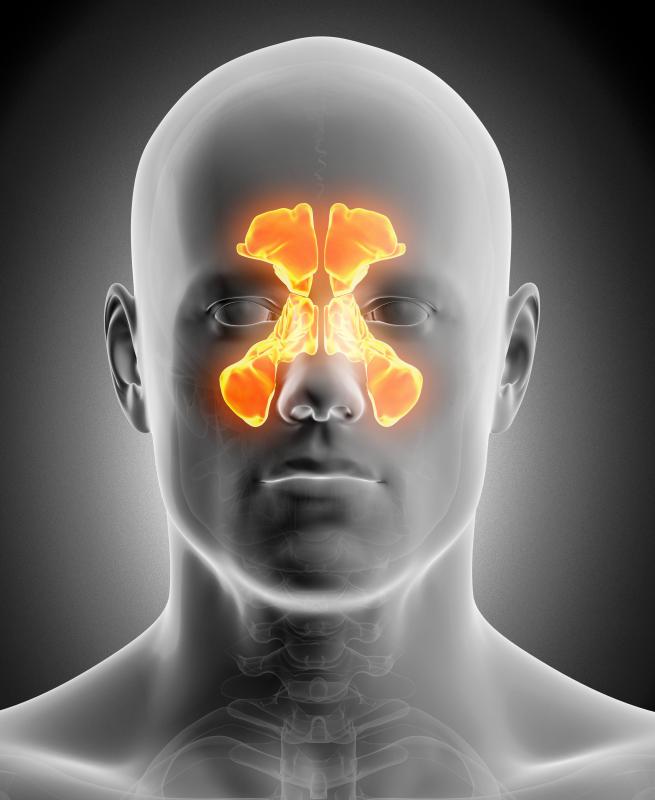
The sinuses are a series of cavities in the skull. In healthy individuals, they hold pockets of air, but in those with a sinus infection, they fill up with mucus and other fluids that build up as the body responds to the infection. Many people with sinus infections develop fatigue and headaches, two problems that can make them feel unstable on their feet, especially when severe.

It is also possible for a sinus infection to lead to an ear infection and accompanying dizziness by clogging the Eustachian tube. This structure normally drains fluid from the inner ear. When it is blocked, fluids build up, which can disrupt the vestibular system, the system the body uses for balance. Untreated sinusitis can also lead to ear infection.

If people experience a sinus infection and dizziness and they are not already in treatment, they should see a medical professional. He or she can evaluate the patient and prescribe medications to kill the organisms causing the infection. Combined with rest and plenty of fluids, this should help the patient fight off the infection and get back to normal. People who experience recurrent or chronic sinus infections may want to explore preventative care, including allergy treatment to reduce inflammation in the sinuses and surgery to widen the drainage openings and prevent buildups of fluid.

Being aware of the potential symptoms of a sinus infection is important for people who work in jobs where dizziness could become a safety issue. These individuals may want to ask to be reassigned while they have active infections to reduce the risks associated with their work. People should also avoid vigorous exercise, as they may fall and injure themselves.
Mary McMahon
Ever since she began contributing to the site several years ago, Mary has embraced the exciting challenge of being a WiseGEEK researcher and writer. Mary has a liberal arts degree from Goddard College and spends her free time reading, cooking, and exploring the great outdoors.
Learn more...
Mary McMahon
Ever since she began contributing to the site several years ago, Mary has embraced the exciting challenge of being a WiseGEEK researcher and writer. Mary has a liberal arts degree from Goddard College and spends her free time reading, cooking, and exploring the great outdoors.
Learn more...AS FEATURED ON:
AS FEATURED ON:









-
![Sinus infections can lead to ear infections.]() By: Syda ProductionsSinus infections can lead to ear infections.
By: Syda ProductionsSinus infections can lead to ear infections. -
![A sinus infection is characterized by pain or pressure around the eyes, cheeks, and forehead.]() By: auremarA sinus infection is characterized by pain or pressure around the eyes, cheeks, and forehead.
By: auremarA sinus infection is characterized by pain or pressure around the eyes, cheeks, and forehead. -
![Medical help may be required to treat a sinus infection and dizziness.]() By: giorgiomtbMedical help may be required to treat a sinus infection and dizziness.
By: giorgiomtbMedical help may be required to treat a sinus infection and dizziness. -
![Fever and dizziness may accompany a sinus infection.]() By: evgenyatamanenkoFever and dizziness may accompany a sinus infection.
By: evgenyatamanenkoFever and dizziness may accompany a sinus infection. -
![People who suffer from dizziness may injur themselves during a fall.]() By: Viktor PravdicaPeople who suffer from dizziness may injur themselves during a fall.
By: Viktor PravdicaPeople who suffer from dizziness may injur themselves during a fall. -
![Fatigue and headache due to sinus infections often makes people feel dizzy.]() By: Sebastian KaulitzkiFatigue and headache due to sinus infections often makes people feel dizzy.
By: Sebastian KaulitzkiFatigue and headache due to sinus infections often makes people feel dizzy.




Discussion Comments
I have a sinus problem that is on and off. I am currently experiencing severe dizziness. This is my third week now. I experienced the same problem late last year. My doc put me on Stugeron for three months. Within one month, I was perfectly well. But this time, Stugeron seems to be ineffective. I've used it for two weeks with no significant results. I am on Nasalnex spray daily. I also use L-Montus daily because I am asthmatic.
This dizziness is very very scary. Can somebody advise me on what to do? Should I see an ENT specialist? Kindly advise me.
I have been on Amox for 12 days and will be finished with it in two days for a sinus infection. I am just now starting to cough up mucus and have drainage bad and am very light-headed and feel like I am going to pass out at times. Is this normal? I have always had some sinus problems, but never like this!
The insides of my ears get so itchy when I have a sinus infection. They also ache, and I usually have severe dizziness.
Several times, I have gone to the doctor for what I thought was an ear infection, only to find out it was a sinus infection. My eustachian tubes were clogged because they were swollen and inflamed, and once the medicine took care of the swelling, everything started to drain as it should.
As soon as my ears started to feel normal again, the dizziness subsided. The ears seem to be the center of balance for our bodies.
@DylanB – If your sinus infection symptoms last more than 2 weeks, then it is most likely bacterial. Viral infections go away in a couple of weeks, but bacterial ones can last for months.
I had one that lasted for two months, so I finally sought help. My doctor gave me antibiotics, and within a week, the symptoms were gone. I could breathe, and I no longer felt dizzy.
If I had known earlier that the treatment was that simple, I would have saved myself a month or so of misery and gone to the doctor after two weeks. I was so dizzy that I had to carpool to work instead of drive for over a month!
If I have a sinus infection for more than a month, I get chronic dizziness along with it. I just get used to it, and I avoid doing things that might cause injury.
It seems that I get the most dizzy right after blowing my nose. I can feel fluid in my ears moving around, and this causes pain. So, I try to blow gently.
Allergy medication just doesn't seem to work at all when I have a bad sinus infection. I've heard that some sinus infections can be caused by viruses, so if that's the case, there's nothing a doctor can really do about it.
My entire head feels clogged when I have a sinus infection, so it is no surprise to me that dizziness is a symptom. When all your facial orifices are plugged, pressure tends to build up and distribute itself unevenly.
I honestly feel like the pressure inside the front of my face is responsible for the dizziness. I feel like something is pressing on my eyeballs, and this makes it hard to focus.
Post your comments