
At WiseGEEK, we're committed to delivering accurate, trustworthy information. Our expert-authored content is rigorously fact-checked and sourced from credible authorities. Discover how we uphold the highest standards in providing you with reliable knowledge.
What is the Connection Between Menstruation and Ovulation?
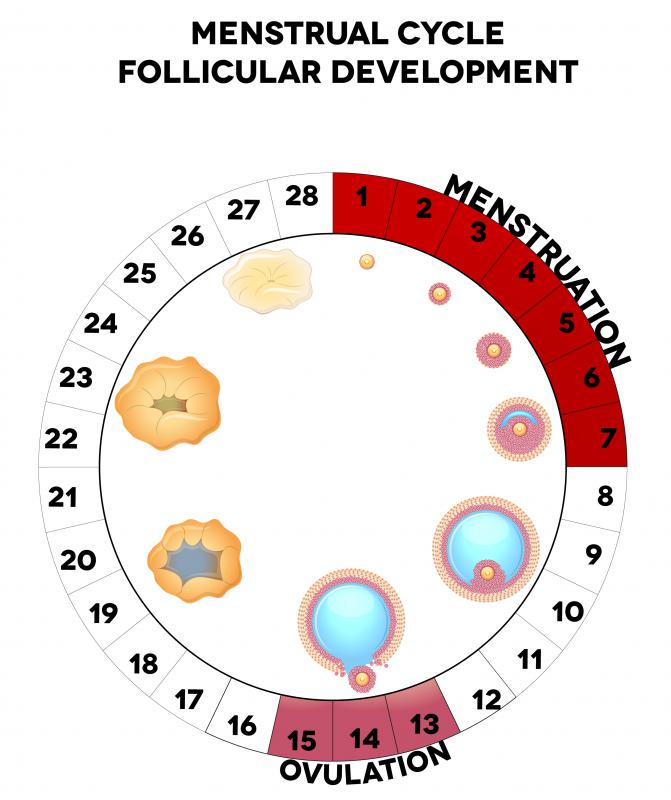
Menstruation and ovulation are both part of the human female reproductive cycle, also called the menstrual cycle. In a typical reproductive cycle, menstruation and ovulation are separated by about nine days, although this varies from person to person and from cycle to cycle. The average length of the menstrual cycle is just more than 29 days.
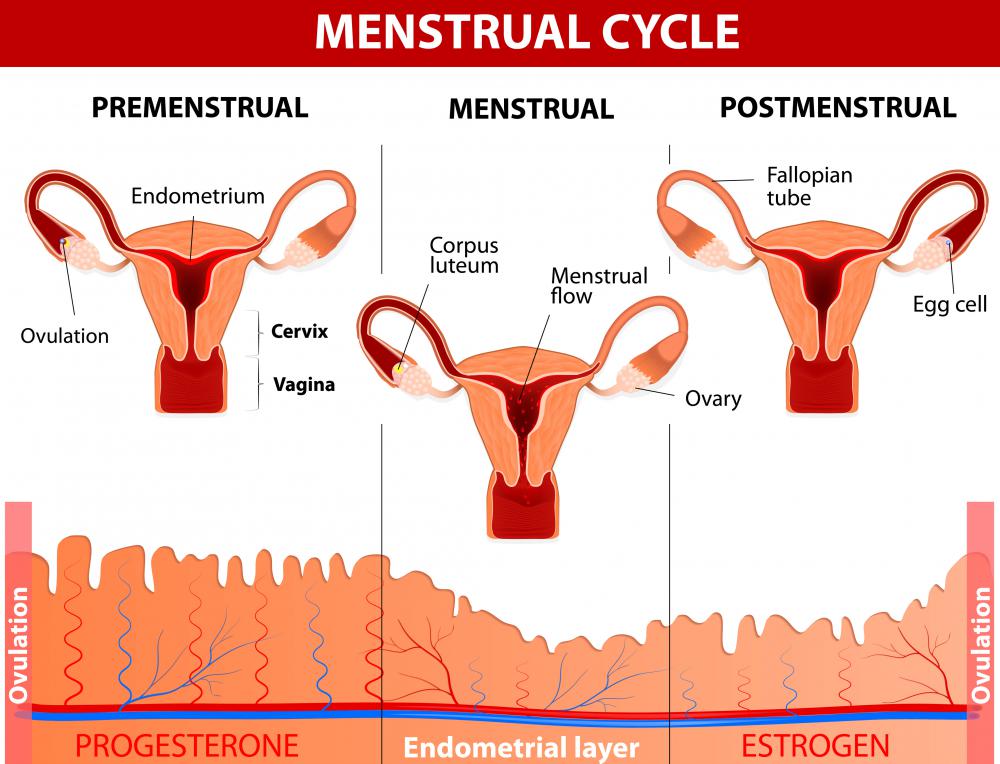
The menstrual cycle is divided into four main phases. Menstruation is the first phase, when the lining of the uterus, called the endometrium, is shed. Blood and endometrial tissue are forced out of the body through the vagina. Menstrual cramps are the result of the muscles expelling the endometrium.

Once the uterine lining has been shed, the follicular or proliferative phase begins. During this phase, the body releases hormones that stimulate the growth of an ovarian follicle. As the follicle grows, it in turn releases a hormone called estradiol, which stimulates the regrowth of the endometrium.
Ovulation is the third phase of the cycle. As the ovarian follicle matures, rising levels of estradiol cause the release of luteinizing hormone (LH), which causes the follicle to release a secondary oocyte, which matures into an ovum, or egg. The ovum leaves the ovary, enters the fallopian tube and remains there for about a day. If it is fertilized by a spermatozoon, it will implant itself in the endometrium and eventually mature into an embryo; if not, it will disintegrate in the fallopian tube.

In the luteal phase, also known as the secretory phase, the remaining parts of the ovarian follicle transform into a body called the corpus luteum, which releases more hormones, including progesterone. These hormones make the endometrium more receptive to the implantation of the fertilized egg. If no egg is implanted, the corpus luteum atrophies and the level of progesterone falls, causing the endometrium to be shed and the cycle of menstruation and ovulation to begin again.

Menstruation and ovulation are usually moderately regular and predictable, but a number of conditions can interfere with the relationship between menstruation and ovulation and, thus, with the functioning of the cycle. Hormonal or chemical imbalances, low body weight, some diseases, and other physical factors can lead to anovulation, in which the menstrual cycle occurs but the woman does not ovulate. Anovulation can cause irregular periods or stop menstruation altogether, a condition called amenorrhea. Alternately, excessive bleeding may occur. Anovulation is usually treatable, and treatment will restore the functioning of the menstrual cycle.
AS FEATURED ON:
AS FEATURED ON:









-
![The female reproductive system.]() By: OOZThe female reproductive system.
By: OOZThe female reproductive system. -
![A woman with menstrual cramps.]() By: Piotr MarcinskiA woman with menstrual cramps.
By: Piotr MarcinskiA woman with menstrual cramps. -
![Menstruation and ovulation are both a part of the menstrual cycle.]() By: designuaMenstruation and ovulation are both a part of the menstrual cycle.
By: designuaMenstruation and ovulation are both a part of the menstrual cycle. -
![In a typical reproductive cycle, menstruation and ovulation are separated by about nine days.]() By: reinegIn a typical reproductive cycle, menstruation and ovulation are separated by about nine days.
By: reinegIn a typical reproductive cycle, menstruation and ovulation are separated by about nine days. -
![The menstrual cycle is divided into four main phases.]() By: picsfiveThe menstrual cycle is divided into four main phases.
By: picsfiveThe menstrual cycle is divided into four main phases.

Discussion Comments
@literally45-- This is not the best way to predict ovulation. Many women who are trying to get pregnant test their hormone levels to know when ovulation takes place. It's possible to know this from the levels of estradiol. Some women also check for temperature changes.
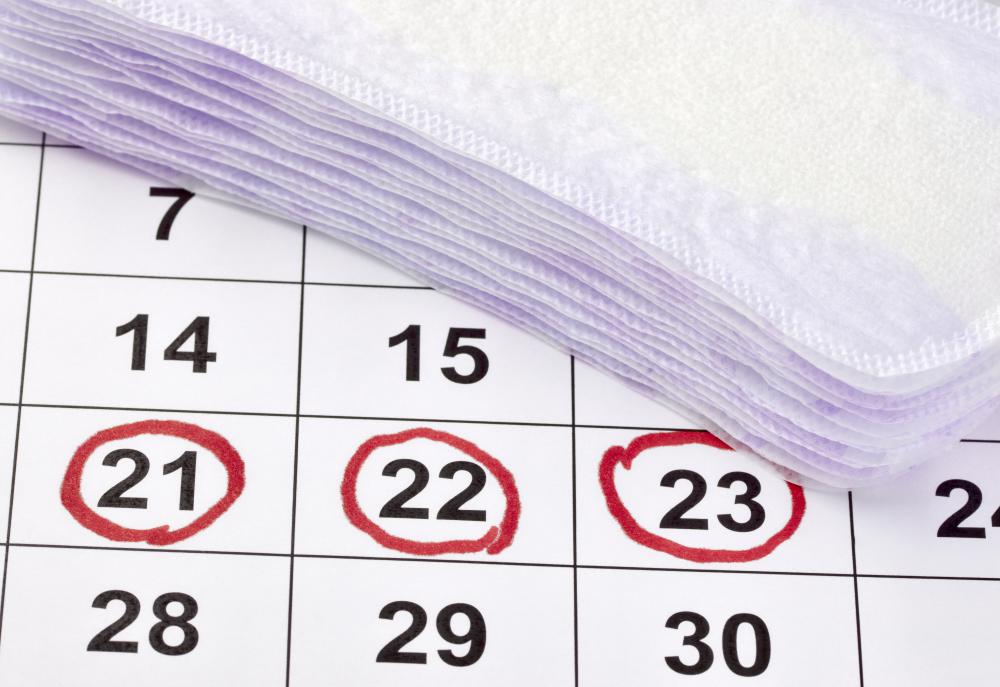
My sister is trying to get pregnant and she uses an ovulation calendar. Every month, she is monitoring herself to calculate ovulation. Apparently, pregnancy is most likely a few days before and a few days after ovulation. She gets so disappointed when she gets her period.
@ankara-- If you get your menses on the same day every month and if your menstrual cycle is 28 days, you will ovulate approximately ten to eleven days after menstruation. If your menstrual cycle is shorter or longer though, this calculation won't work. I think that there are ovulation calculators or calendars you can use to figure this out.
For most women though, ovulation occurs ten days after menstruation. It takes this long for an egg to develop and to be released into the fallopian tubes. From there, it takes another two weeks or so to travel through the fallopian tubes and into the uterus.
I can't tell when I ovulate, but I can tell when the egg moves from the fallopian tubes and into the uterus. I always have an aching pain for a few days, about ten to twelve days before my period.
I always know that my period is about to arrive because I have mood changes, tender breasts and migraines. But I never know when I'm ovulating. Is there a way I can tell?
Post your comments