
At PracticalAdultInsights, we're committed to delivering accurate, trustworthy information. Our expert-authored content is rigorously fact-checked and sourced from credible authorities. Discover how we uphold the highest standards in providing you with reliable knowledge.
What Is the Classical School of Criminology?
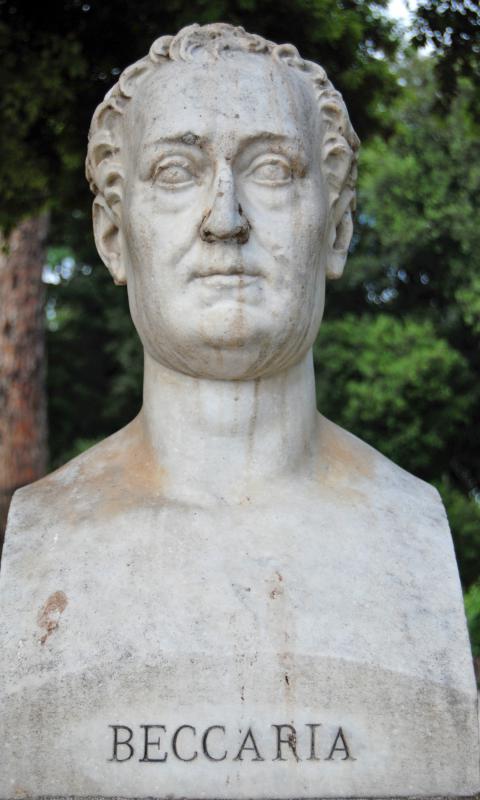
The Classical school of criminology is a body of thought about the reform of crime and the best methods of punishment by a group of European philosophers and scholars in the eighteenth century. It took place during the Enlightenment, a movement in Western countries that promoted the use of reason as the basis of legal authority. Italian philosopher Cesare Beccaria is considered to be the founder of the Classical school.
Cesare Beccaria and other members of the Classical school of criminology believed that criminal behavior could be minimized using the basics of human nature. The school was based on the idea that human beings act in their own self-interests. They believed that rational people enter into a social contract in which they realize that having a peaceful society would be in their most beneficial to themselves. The school sought to reduce crime through reform to the criminal punishment system, which they felt tended to be cruel and excessive without reason as well as an ineffective deterrent.

The Classical school of criminology argued that the most effective deterrent for criminal behavior would be swift punishment rather than long trials. They felt that criminal actions were irrational behavior and came from people who could not or did not act in their best self-interests or society’s. Members of the school contended that punishments needed to be consistently enacted for specific crimes with no special circumstances in order to demonstrate to people that criminal activity will not benefit them because there are definite consequences.

A major part of the criminal punishment reform that the Classical school of criminology fought for was fair and equal treatment of accused offenders. Prior to the school’s fight for reform, judges could punish criminals at their own wills regardless of the severity of the crime, which led some to view the criminal punishment system as tyrannical. Cesare Beccaria and other members fought for punishments for specific crimes to be set by legislature and not to allow judges unbridled power. They felt that if judges could only apply legislatively sanctioned punishments, trials would be quick and criminals would receive their punishments faster.

The idea behind the Classical school's fight for swift trials and clearly defined punishments was that criminals were more likely to be deterred if they knew what type of punishment they would receive and how quickly. Members of the school believed that preventing crime was actually more important than punishing it, but by having a clear punishment system in place, criminals would use reasoning to deduce that crime would not be in their best self-interests. The classical school of criminology was accepted by European rulers in the late eighteenth century and is considered to have influenced the Western justice system.
The Modern Heirs of the Classical School of Criminology
Since the foundations of classical and rational choice criminology were established during the Enlightenment in the 18th century, the majority of the biases and questions related to the theory were formed then. Although centuries old, the classical school of criminology continues to hold a profound influence on the justice system in the United States and much of the Western world. This is largely due to the fact that many legal scholars are heavily influenced by classical criminology and their views have a major impact on the modern justice system. It is important to note, however, that classical criminologists were strongly concerned with preventing crime and the abolishment of an irrational, primitive justice system that was largely governed by vengeance and privilege.
Early classical theorists were aware of the fact that crime needed to be managed rationally and humanely. They also believed the state was required to do more than protect property and individuals and that any laws proposed should be both effective and pragmatic. Among classical theorists, it was nearly universally agreed upon that the law should have deterrent value, but without unnecessary and excessive cruelty to offenders. In other words, the consequences of committing a crime should not be unjust or punish a person too harshly. According to such a perspective, individuals in a society would realize that the cost of committing a crime only somewhat outweighs the potential benefits of the crime. Such a realization should act as a deterrent in itself.
Currently, those who subscribed to purist sociological theories related to crime (these theories largely focus on the sociological forces that produce crime and criminals), as well as those who adhere to rigid classical criminology find themselves falling out of favor in the intellectual world. Such as shift is to be expected as modern criminology utilizes a more cross-disciplinary approach that offers support for a variety of visions and beliefs. Classical and rational choice perspectives have been revitalized so they can be applied to the 21st century and they continue to evolve as time progresses.
The Cost of Crime (From a Classical Perspective)
A significant portion of classical writings focuses on imagining what an ideal justice system would look like. This approach results in the need to assess the impact of various government policies on criminal behavior as well as the need to evaluate what the prime level of sanctions and enforcement should be. The classical approach also emphasized that criminal law should minimize the social costs of crime, which can be calculated by adding the degree of harm caused by the crime to the cost of punishment.
Varying Approaches to Crime Research
Research that does not factor in the varying perceptions of benefits and costs across types of potential offenders, time periods, or places are considered objective deterrence studies. Studies examining the relationship between crime and imprisonment rates fall into this category of studies. In contrast, perceptual deterrence theorists focus on varied perceptions of costs and benefits. In practice, the primary difference between the two types of studies rests largely on the former’s tendency to utilize macrolevel variables related to the reflection of variation in opportunity for crime. Objective deterrence theorists, on the other hand, are more likely to incorporate a larger array of variables into their explanations for crime, often borrowing from fields such as sociology and psychology.
Classical Criminology and Economic Models
The classical tradition makes the case that an accurate and general view of crime can be presented in economic terms and theories that contain only the most apparent variables that represent the market for crime itself. Although a prominent viewpoint, opponents note that such views obscure relevant details and the thinking that impacts decisions in many offenses.
Despite numerous debates, criminology still has far to go in understanding the simplest decision-making considerations, intersections of psychology, and changing markets’ impact on crime. Understanding such topics is necessary if modern crime researchers wish to incorporate cultural shifts and varying preferences into traditional economic models.
Crime, Influences, and Self-Control
A key component of the general theory of crime that derives from classical criminology asserts that offenders do not have high levels of self-control. Many of these offenders are self-centered, hyperphysical, hot-tempered, and impulsive. For such individuals, crime can become a particularly attractive prospect. There is current evidence that such individuals are predisposed to committing criminal acts. When costs and benefits are factored in, we should expect such individuals with limited self-control to be more likely to commit crimes than others. For many researchers influenced by classical criminology, there is a strong correlation between rational choice and self-control as an explanation for crime.
An Evolving Field of Study
Classical criminology continues to have an impact on modern views of crime and punishment. As time progresses, so will the views and approaches associated with classical criminology.
AS FEATURED ON:
AS FEATURED ON:


-
![Cesare Beccaria is considered to be the founder of the Classical school of criminology.]() By: JRassaertsCesare Beccaria is considered to be the founder of the Classical school of criminology.
By: JRassaertsCesare Beccaria is considered to be the founder of the Classical school of criminology. -
![Thomas Hobbes built on the work of the Greeks in his theories of natural law, or the perceived natural order of justice.]() By: Georgios KollidasThomas Hobbes built on the work of the Greeks in his theories of natural law, or the perceived natural order of justice.
By: Georgios KollidasThomas Hobbes built on the work of the Greeks in his theories of natural law, or the perceived natural order of justice. -
![The classical school of criminology was accepted by European rulers in the late eighteenth century and is considered to have influenced the Western justice system.]() By: Jerry SliwowskiThe classical school of criminology was accepted by European rulers in the late eighteenth century and is considered to have influenced the Western justice system.
By: Jerry SliwowskiThe classical school of criminology was accepted by European rulers in the late eighteenth century and is considered to have influenced the Western justice system.


Discussion Comments
@Oasis11 - I know what you mean, but we could apply consistent punishment for repeat criminal behavior like drug abuse and DUI’s. This is an area where we do apply consistent levels of punishment that gets progressively more severe with each offense.
I was reading about positivist criminology which would view acts of criminal behavior like this as just testing the limits of what is acceptable and thinking that there is nothing wrong with this. They view criminal behavior as normal and not deviant in any way which I don’t agree with.
@SurfNTurf - I agree with the premise that the punishment needs to be immediate in order to be effective, but I don’t think that things are always black and white as to say that the same punishment should be issued every single time the crime is committed.
For example, if you have a law that states that anyone that is caught firing a gun gets an automatic ten years in prison and you have someone that committed an armed robbery and shot someone and missed then most people would agree that this person if convicted should serve out a ten year sentence.
However, if you have a person that fires a gun in order to protect themselves from a home invasion then this person should not get any jail time because this was an act of self defense, so unfortunately there will be gray areas in the law and each case has to be treated with its own merits.
@Latte31 - I do agree with the theory of criminology that in order to punish people properly, the punishment should be fast and the same across the board.
This way everyone knows what to expect and when they see criminals being punished, then they will not commit these crimes because they know that they will pay the same price. It does act as a deterrent for future crime.
@Abundancer -I agree with what you are saying, but the system that the United States currently has in place is probably as fair as you are going to get. There are flaws like with every justice system but it does give you the best opportunity to be tried fairly.
Our adversarial system of justice allows both sides to develop their case to the best of their ability and be judged by a jury of the defendant’s peers. In other societies, those accused of crimes are tried by a judge who hears both sides and rules his case.
There you have a higher chance of bias because judges are people and they have their own personal opinions of things. In some cases judges have even been bribed in order to reach a certain verdict. So I don’t think that any system in the history of criminology including the criminal justice system of the United States is without flaws but I feel it is the best system that we have.
Very interesting! It does sound like out judicial system was somewhat based on this. Unfortunately, I think we have gotten away from this somehow. You can have several people on trial for the same thing and they can all get different punishments.
I don't know what has created this in our legal system, but it would be nice if it was more like this.
Post your comments