
At AllTheScience, we're committed to delivering accurate, trustworthy information. Our expert-authored content is rigorously fact-checked and sourced from credible authorities. Discover how we uphold the highest standards in providing you with reliable knowledge.
What is the Cell Cycle?
 Mary McMahon
Mary McMahon
Mary McMahon
The cell cycle is a process in which a cell grows and divides to create a copy of itself. Some organisms reproduce exclusively through this process, while in complex multicellular life, it allows an organism to grow, and to replace cells as they become worn out. In animals, the cycle takes around 24 hours from start to finish for most cell types, although some, such as those in the skin, are constantly going through this cycle, while others may divide rarely, if at all. Neurons, for example, do not grow and divide once they are mature.
Organisms can be divided into two types, each with its own cell cycle. In prokaryotes, the organism’s genetic information consists of a single strand of DNA, known as a chromosome, which is not contained within any special structure. Bacteria are examples of prokaryotes, along with some other single-celled organisms. Eukaryotes consist of all multi-cellular organisms, such as plants and animals, along with some types of single-celled life forms. They differ from prokaryotes mainly in that they have a nucleus — a self-contained structure that contains the genetic material in the form of chromosomes made up of DNA.
Prokaryotes

Reproduction in prokaryotes is known as binary fission. In this process, the DNA, which is floating freely within the cell, replicates itself. The two new strands of DNA then migrate to opposite ends of the cell, which divides into two identical copies, each with its own DNA; this division stage is known as cytokinesis. The new cells will then grow until they reach a certain size, then, if conditions are favorable, they will divide again, starting a new cycle. For these primitive organisms, the process is usually very fast — in ideal conditions, some bacteria will divide every 20 minutes, leading to very rapid multiplication.
Eukaryotes

Eukaryotic cells are more complex than those of prokaryotes, making division more complicated. As well as a nucleus, they have a number of other structures, known as organelles, that have specific functions, and that also need to be duplicated during division. The eukaryotic cycle has a number of distinct phases, with the two main ones being interphase, and mitosis.

During interphase — which is by far the longest phase, accounting for most of the 24-hour cycle that is typical of the majority of animal cells — the cell is normally growing, and increasing in size. The processes involved in division require energy, and the interphase has two periods during which reserves of the energy-storing compound adenosine triphosphate (ATP) are built up and growth takes place, separated by a period of DNA duplication in the nucleus. The first growth period is known as Gap 1 (G1), and occurs in the new cells after division. This is followed by the synthesis (S) stage, during new strands of DNA that are identical to the originals are synthesized. The Gap 2 (G2) stage then begins, prior to mitosis.

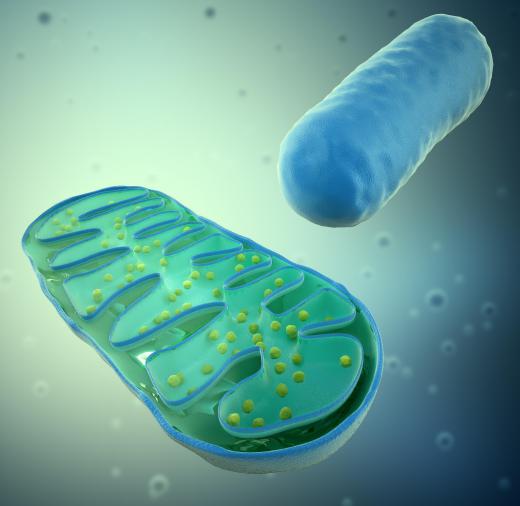
In contrast to the preceding phase, mitosis is relatively brief, and typically takes only about one hour. This is the process by which the two identical sets of DNA are physically separated from one another, forming two sets of chromosomes, which are then drawn to different ends of the cell to form separate nuclei. During this phase the organelles, such as mitochondria in animals, and chloroplasts in plants, also divide. These structures have their own DNA, which replicates in the same way as in prokaryotes, leading some scientists to believe that that they may once have been independent prokaryotic organisms that were incorporated into eukaryotic cells at some time in the distant past.
The final stage is cytokinesis. This is when division into two distinct units actually takes place. In animals, opposite cell walls are drawn toward one another at around the midpoint until they meet, forming two units that split off from one another. In plants, a new cell wall is built at the point of division, separating the two new cells.
Regulation and Errors

Each part of the cycle is regulated by proteins that tell the cell what to do. These proteins are also used during interphase to confirm that conditions are appropriate for division. If enough nutrients are not present or other issues are identified, these proteins will signal the cell to remain dormant and wait for conditions to improve, rather like a crossing guard for division.
Errors can and do occur during the process. Sometimes the information is not copied exactly during interphase, and errors in the genome are created. These errors may prove fatal to the cell, or they may be harmless. They can also result in cancer, where an error causes repeated replication and uncontrolled division, with no checks, forming a tumor.
Fortunately, there are proteins that can halt the process if there are errors in DNA replication. In some cases, the division process will be suspended to allow the DNA to be repaired, after which it may resume. In others, where the DNA is badly damaged, these proteins may cause the cell to die, in order to prevent further replication of faulty DNA. Cancer is often the result of changes to DNA that prevent the proper functioning of these proteins, so that cells with damaged DNA are allowed to reproduce.
Mary McMahon
Ever since she began contributing to the site several years ago, Mary has embraced the exciting challenge of being a AllTheScience researcher and writer. Mary has a liberal arts degree from Goddard College and spends her free time reading, cooking, and exploring the great outdoors.
Learn more...
Mary McMahon
Ever since she began contributing to the site several years ago, Mary has embraced the exciting challenge of being a AllTheScience researcher and writer. Mary has a liberal arts degree from Goddard College and spends her free time reading, cooking, and exploring the great outdoors.
Learn more...AS FEATURED ON:
AS FEATURED ON:









-
![A cell dividing into two daughter cells.]() By: Luk CoxA cell dividing into two daughter cells.
By: Luk CoxA cell dividing into two daughter cells. -
![A cell.]() By: Amelie OlivierA cell.
By: Amelie OlivierA cell. -
![Different types of cells.]() By: AlilaDifferent types of cells.
By: AlilaDifferent types of cells. -
![The stages of mitosis.]() By: VanessaThe stages of mitosis.
By: VanessaThe stages of mitosis. -
![Mitochondria have a significant role in the cell cycle and cell growth.]() By: MopicMitochondria have a significant role in the cell cycle and cell growth.
By: MopicMitochondria have a significant role in the cell cycle and cell growth. -
![In mitosis, a cell replicates its DNA before dividing into two daughter cells.]() By: xtockIn mitosis, a cell replicates its DNA before dividing into two daughter cells.
By: xtockIn mitosis, a cell replicates its DNA before dividing into two daughter cells.


Discussion Comments
How do we know if the child is abnormal?
@bobcat60 - Exactly! We do not replace brain cells so that we will be more careful to take care of them. The skin cells are more exposed to issues outside of our control, so they automatically renew themselves.
The human cell cycle has always been amazing to me. It was one of my favorite subjects in school. For example, the fact that mature neurons do not grow and divide once they mature seems so unfair because those are brain cells. Then you realize that skin cells are the most exposed and they constantly renew themselves. It is just so amazing how it all works for our betterment.
Post your comments