
At TheHealthBoard, we're committed to delivering accurate, trustworthy information. Our expert-authored content is rigorously fact-checked and sourced from credible authorities. Discover how we uphold the highest standards in providing you with reliable knowledge.
What is the Caecum?
The caecum, also commonly called the “cecum,” is a pouch-like portion near the end of the large intestine in humans and many animals. It is situated at the intersection of the large intestine, the small intestine, and the appendix, essentially right in the center of the digestive tract. Its chief role in most animals is to provide bacteria that can help the body break down plant-based foods, though there is some question when it comes to the helpfulness of this function in humans. Some researchers think that, as humans evolved to eat a more diverse diet including meats, this part of the intestine's role in vegetable and plant processing has more or less phased out.
Even if it’s not essential for humans, though, things that go wrong here can be very troublesome. One of the most serious problems is called “malrotation,” and happens when the intestine twists on itself, usually during fetal development; it can cause a number of digestive troubles, and often requires surgery to fix. This portion of the intestine can also become inflamed or develop holes known as fistulas that can also develop into very serious health problems.
Digestion Basics

The intestine is an essential part of the digestive tract, and is where food that has been ingested and broken down in the stomach processes into both energy for the bloodstream and waste that will leave the body. Food leaves the stomach through the small intestine, then travels to the large intestine. The end of the small intestine is called the ileum, and the beginning of the large intestine is the caecum; basically a large pouch that sits off to the side and is separated from the ileum by the ileocecal valve. The valve allows material to pass from the small intestine to the large, but not in the opposite direction. In other words, it makes sure that digested material travels away from the ileum and continues on its way out of the body.
Main Function

Most experts believe that this portion of the intestine doesn’t have any special role for humans. It has an identifiable shape, but it more or less functions as a joint or connection between the large and small bowels. For many other animals, though, it does actually play a role in digestion.
Animals that rely heavily on plants as a source of nutrition are often found to have larger, more active caecums, and in many cases they are populated with special bacteria that help break down plant proteins. In these instances the appendage helps the intestine extract water and salt from plant-based foods, and allows for easier digestion of the complex nutrients that are found in many vegetative sources.
Malrotation

Even though it isn’t normally considered an essential part of human digestion, people who don’t have this portion of the intestine — or who have it but it’s twisted, kinked, or too small — often have a lot of trouble. A rare developmental problem can occur during the formation of the digestive system in embryos, resulting in complications that require medical intervention.

Most commonly, an ailment known as malrotation causes the caecum’s support structure to block the flow of food waste through the small intestine. When an embryo is developing, this part of the intestine fails to rotate into position properly. The string-like supports, called mesentery, cross over the small bowel and pinch it either partially or completely closed. Since this condition drastically affects a person's life, it is often found at a young age after a child shows symptoms like vomiting bile, bloody stools, and abdominal pain.
Fistula Development
An ileocecal fistula also can develop between the caecum and ileum at any age. These abnormal passageways are essentially holes in the intestinal wall, and they can cause abdominal pain and diarrhea. In most cases they require the attention of a medical professional, and won’t go away on their own. Treatment generally requires surgery to remove the affected part of the intestine and antibiotics to help prevent infection later on.
AS FEATURED ON:
AS FEATURED ON:


-
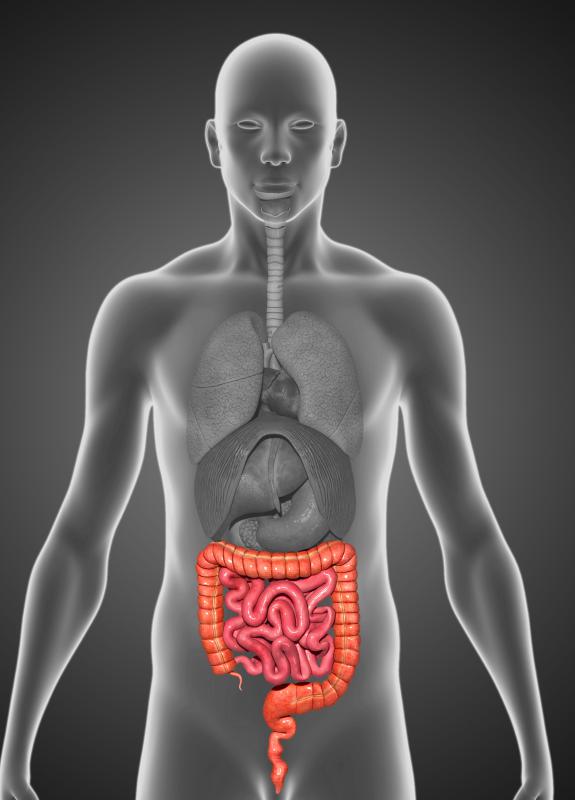
![The caecum is a pouch-like area where the large and small intestines connect.]() By: 7activestudioThe caecum is a pouch-like area where the large and small intestines connect.
By: 7activestudioThe caecum is a pouch-like area where the large and small intestines connect. -
![The caecum is the beginning of the large intestine.]() By: stockshoppeThe caecum is the beginning of the large intestine.
By: stockshoppeThe caecum is the beginning of the large intestine. -
![Problems with the caecum can cause digestive issues.]() By: WavebreakmediaMicroProblems with the caecum can cause digestive issues.
By: WavebreakmediaMicroProblems with the caecum can cause digestive issues. -
![An ailment called malrotation causes the caecum to block the flow of food waste through the small intestine.]() By: graphicgeoffAn ailment called malrotation causes the caecum to block the flow of food waste through the small intestine.
By: graphicgeoffAn ailment called malrotation causes the caecum to block the flow of food waste through the small intestine.


Discussion Comments
Huh -- I had no idea humans even had this. I guess you really do learn something new every day. I wonder, does a person's diet change the size or function of the caecum? For instance, would a vegetarian eventually develop a better functioning or bigger caecum than someone who eats a primarily meat-based diet?
It's a shame that some of these unfortunate young children have to endure some of these problems like malrotation - just a little fluke of nature during embryo development. Since it happens when the embryo is maturing, I'm surprised that there are no symptoms until the child is a little older. I wonder why the problems don't begin at birth?
It's a real shame that children have to experience miserable symptoms of this and other disorders. They are brave little souls.
Post your comments