
At WiseGEEK, we're committed to delivering accurate, trustworthy information. Our expert-authored content is rigorously fact-checked and sourced from credible authorities. Discover how we uphold the highest standards in providing you with reliable knowledge.
What is the Blood Urea Nitrogen Test?
A blood urea nitrogen test, frequently called a BUN test, is used to determine if the kidneys and liver are functioning appropriately. The test analyzes the level of nitrogen in the blood. Nitrogen is produced by urea, a type of chemical waste made from broken down proteins in the liver. An individual with elevated blood urea nitrogen levels may have a malfunction of the kidneys, while lower levels may indicate a liver abnormality.
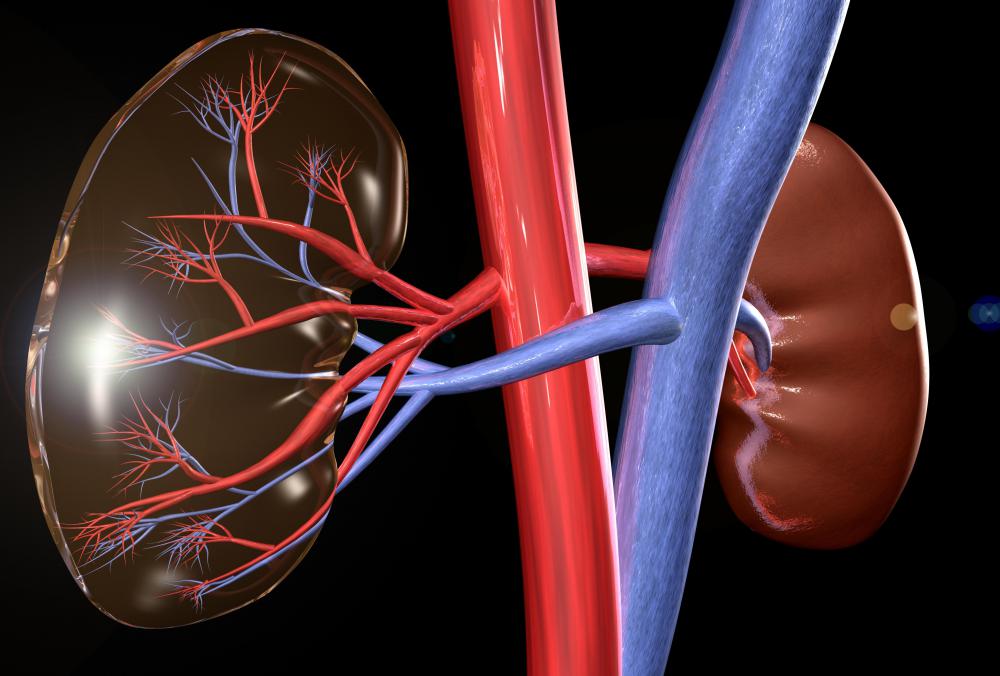
The kidneys are responsible for filtering urea from the body. Generally, this chemical leaves the liver and enters the kidneys where it is expelled from the body through urination. Kidneys that are working properly will filter it out effectively, but when there is a problem with the organs, urea will build up in the bloodstream. A blood urea nitrogen test will reflect an increase in nitrogen from the excessive urea.

In most cases, the blood test is done if a medical professional suspects an abnormality in the kidneys. The patient may be exhibiting symptoms such as frequent urination, pain in the sides, decreased urination, or lower back pain. For people with kidney disease, the test may be performed to detect the extent of kidney damage or to see how well an established treatment is working. For instance, individuals on dialysis may be given frequent blood tests to gauge the effectiveness of their treatments.

Commonly, blood creatinine levels may also be obtained during a blood urea nitrogen test. Creatinine, like urea, is a waste product that is usually filtered out by healthy kidneys. For this reason, the presence of creatinine in the blood may also indicate a kidney problem. When both a urea nitrogen and a creatinine test are done at the same time, the results will usually be compared for a BUN-to-creatinine ratio.

A sample of blood is needed for the test, which is usually considered painless, except for the minor prick of the needle. As with any injection site, there is a minimal risk of infection, although this does not happen often. After the blood is drawn, there may be some minor bruising. In the event that the injection site starts to rapidly bleed, an individual should apply pressure to the site and seek immediate medical care.

Patients are usually made aware of the results of a blood urea nitrogen test as soon as the healthcare professional who ordered it receives the results. High blood urea nitrogen levels may indicate a problem with the kidneys, from an infection, to an abnormal growth, to a disease. There may be a problem with the liver if a test reveals particularly low levels. Medical providers will typically treat the condition causing the abnormal levels, although there are benign conditions that can cause blood urea nitrogen levels to become unbalanced in either direction.
AS FEATURED ON:
AS FEATURED ON:









-
![A BUN test measures blood nitrogen levels.]() By: Wojciech SobiechA BUN test measures blood nitrogen levels.
By: Wojciech SobiechA BUN test measures blood nitrogen levels. -
![An individual with elevated blood urea nitrogen levels may have a malfunction of the kidneys.]() By: London_EnglandAn individual with elevated blood urea nitrogen levels may have a malfunction of the kidneys.
By: London_EnglandAn individual with elevated blood urea nitrogen levels may have a malfunction of the kidneys. -
![The liver is one organ that can be analyzed using a blood urea nitrogen test.]() By: nerthuzThe liver is one organ that can be analyzed using a blood urea nitrogen test.
By: nerthuzThe liver is one organ that can be analyzed using a blood urea nitrogen test. -
![Dialysis patients frequently undergo blood urea nitrogen tests.]() By: Tyler OlsonDialysis patients frequently undergo blood urea nitrogen tests.
By: Tyler OlsonDialysis patients frequently undergo blood urea nitrogen tests. -
![Blood creatinine levels can also be measured during a blood urea nitrogen test.]() By: Goran BogicevicBlood creatinine levels can also be measured during a blood urea nitrogen test.
By: Goran BogicevicBlood creatinine levels can also be measured during a blood urea nitrogen test.



Discuss this Article
Post your comments