
At DelightedCooking, we're committed to delivering accurate, trustworthy information. Our expert-authored content is rigorously fact-checked and sourced from credible authorities. Discover how we uphold the highest standards in providing you with reliable knowledge.
What is the Best Way to Wash Dishes?
 Michael Pollick
Michael Pollick
Michael Pollick
In a world blessed with commercial-grade automatic dishwashers, the brief and straightforward answer may be to press the right button and not to forget the detergent. However, many of us learned to wash dishes back in the days of sinks, sprayers, and elbow grease. While opinions are bound to differ on the best way to wash dishes manually, there is a method used by professional dishwashers and approved by health inspectors everywhere. This method is called the three sink technique.
The three sink method of washing dishes ideally should be performed with three sink compartments, but it can be modified to accommodate two or even one-compartment home sinks. Each sink serves a different purpose when you wash dishes by hand. The first sink contains warm water and detergent, the second contains clean hot water (at least 110°F or 43°C) with no chemicals, and the third contains either very hot water (at least 171°F/77°C) alone or water a little above room temperature (about 75°F/24°C) with a sanitizing agent such as chlorine bleach.

The first step in the three sink method of washing dishes is pre-scraping. Dirty dishes should first be scraped with a large rubber spatula to remove obvious debris such as bones, rinds and left-over foods. This pre-scraping should be done over a large wastebasket near the sink area. Once the dishes have been scraped, they can be placed directly into the first sink containing detergent and hot water. Be sure not to place sharp knives or kitchen tools in this sink, since you will not be able to see them when you wash dishes and cups.

The detergent in the first compartment aids in the dishwashing process by changing the water's chemistry. Food particles cling to plates partially because of an ionic bond. Ordinary hot water doesn't work very well to break this bond, but detergents essentially 'demagnetize' the ionic bond by charging the water. Other chemicals separate grease from the water and trap it in the surface foam. When you wash dishes, the foam layer can very helpful in removing grease and oil.

The dishes should be scrubbed thoroughly with a dishwashing brush until no visible dirt remains. The cleaned dishes should then be placed into the second compartment containing clean, hot water. This compartment is meant to rinse off any chemical residue left behind by the detergents. A sprayer may also be used to rinse off detergent, but soaking the dishes in clean water is usually more thorough. Be sure to change out the rinse water frequently when you wash dishes, since some remaining food and detergent may start to build up.

Once the dishes have spent some time in the rinsing compartment, they should be sanitized. The third sink compartment contains very hot water and a chemical sanitizer such as household bleach or a commercial powder available in stores. There's no need to use a significant amount of bleach when you wash dishes at home, but a capful or so should help kill any lingering contaminants.

Following a soak in the sanitizing compartment, the dishes can be stacked in a vertical dishrack and allowed to air dry, or they can be dried with clean dish towels and stored in their proper cabinets. Wet plates and cups should not be stored immediately after you wash dishes, since the standing water can become a breeding ground for bacteria and other biohazards. This is why the sanitizing stage should not be neglected. Make sure all of your dishes are perfectly dry and clean before putting them away.
Michael Pollick
A regular DelightedCooking contributor, Michael enjoys doing research in order to satisfy his wide-ranging curiosity about a variety of arcane topics. Before becoming a professional writer, Michael worked as an English tutor, poet, voice-over artist, and DJ.
Learn more...
Michael Pollick
A regular DelightedCooking contributor, Michael enjoys doing research in order to satisfy his wide-ranging curiosity about a variety of arcane topics. Before becoming a professional writer, Michael worked as an English tutor, poet, voice-over artist, and DJ.
Learn more...AS FEATURED ON:
AS FEATURED ON:


-
![Dish washing liquid helps to remove grease and oil from dishes.]() By: KuzmickDish washing liquid helps to remove grease and oil from dishes.
By: KuzmickDish washing liquid helps to remove grease and oil from dishes. -
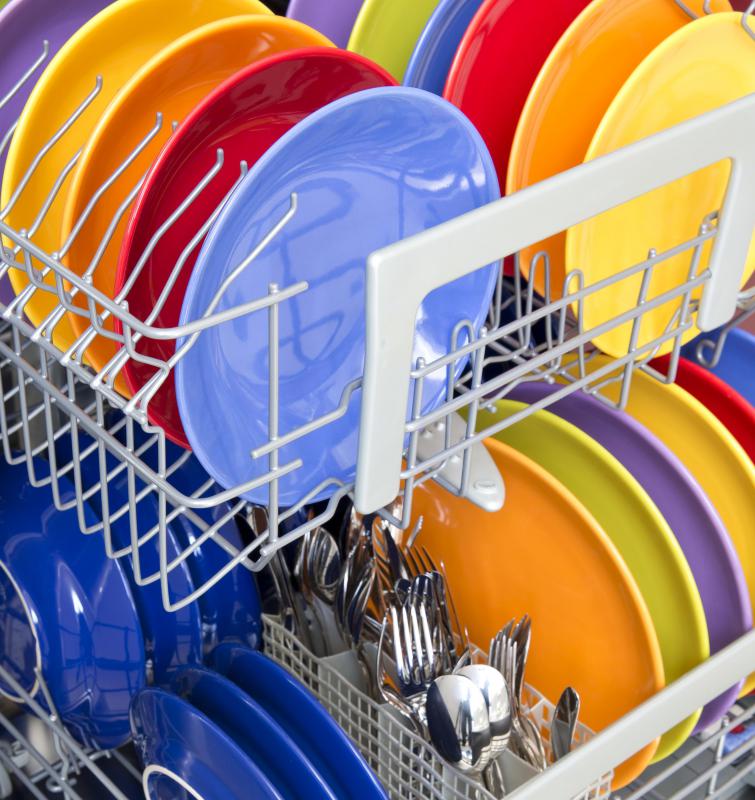
![Dishwashers are potentially the easiest way to wash dishes.]() By: lapas77Dishwashers are potentially the easiest way to wash dishes.
By: lapas77Dishwashers are potentially the easiest way to wash dishes. -
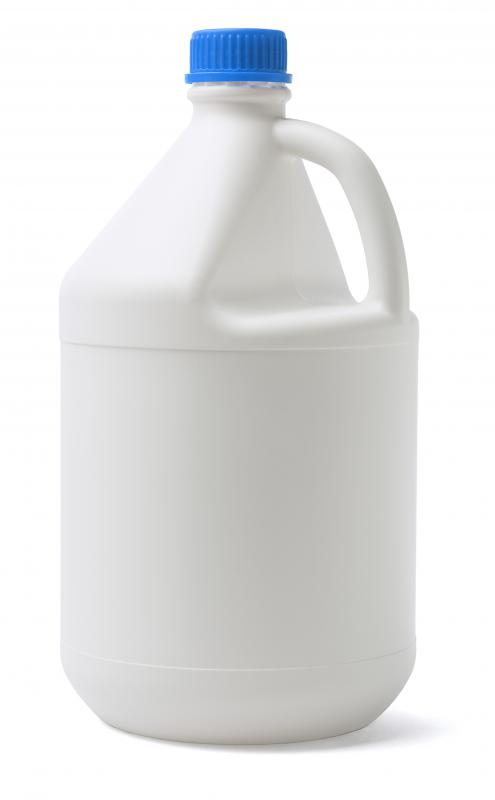
![Using household bleach to wash dishes can help kill contaminants.]() By: design56Using household bleach to wash dishes can help kill contaminants.
By: design56Using household bleach to wash dishes can help kill contaminants. -
![Dish detergent can help remove waterspots.]() By: elena kornDish detergent can help remove waterspots.
By: elena kornDish detergent can help remove waterspots. -
![Dirty dishes should be scrubbed of stuck on food before washing.]() By: Dario Lo PrestiDirty dishes should be scrubbed of stuck on food before washing.
By: Dario Lo PrestiDirty dishes should be scrubbed of stuck on food before washing. -
![Rubber spatulas might be used to scrape food debris off of dishes before washing.]() By: rigamondisRubber spatulas might be used to scrape food debris off of dishes before washing.
By: rigamondisRubber spatulas might be used to scrape food debris off of dishes before washing. -
![Linen dish towels or tea towels can be used to dry clean dishes.]() By: Jiri HeraLinen dish towels or tea towels can be used to dry clean dishes.
By: Jiri HeraLinen dish towels or tea towels can be used to dry clean dishes. -
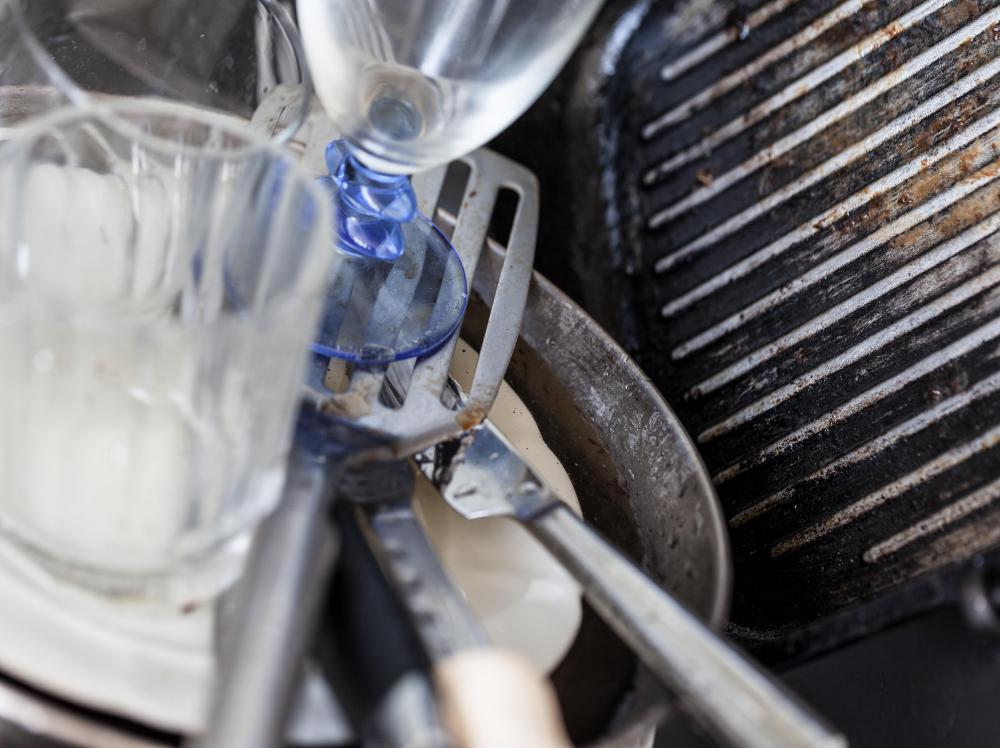
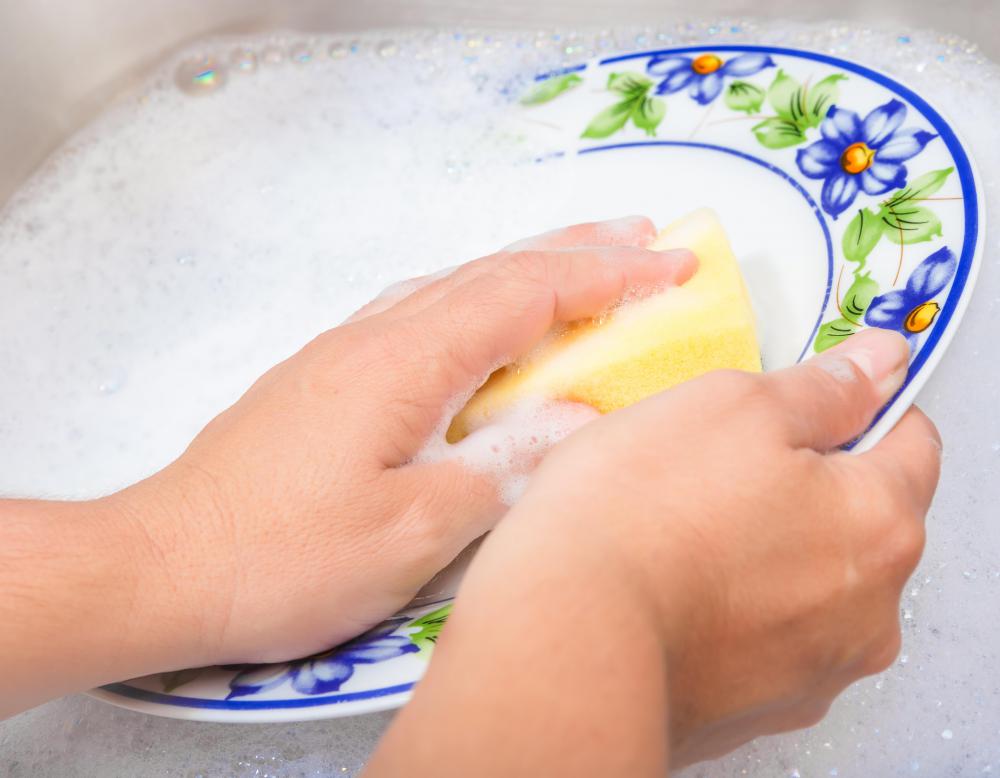
![Washing dishes by hand can help remove stuck on substances.]() By: kmiragayaWashing dishes by hand can help remove stuck on substances.
By: kmiragayaWashing dishes by hand can help remove stuck on substances.


Discussion Comments
I used to be a dishwasher at several different restaurants, and each one did things a little differently. There were some that had a conveyor belt pull the dirty utensils from the dining room bussing station into the washroom. We would scrape the plates and stack them on what was essentially a car wash. The plates would sit vertically between racks and get pulled through a long washing machine. Someone would catch the clean dishes and stack them on carts. These carts would go back out to the service line. Pots and other heavy kitchen items would be cleaned by hand in another area.
Most kitchens, however, had a small dishwasher and dozens of racks for plates, glasses and silverware. We'd scrape the plates, stack them on the racks and send them through a machine that went through a three minute cleaning cycle with different chemicals. The plates came out blistering hot, and someone would catch them and stack them back into the kitchen line.
I'd say that a hired dishwasher usually gets used to the temperature of the water within a few weeks, but some people can't handle the harshness of the chemicals. Check your skin periodically for signs of allergic reactions, and keep your hands moisturized between work shifts. I can see where an employer might want to discourage the use of gloves, because most gloves are either too flimsy to handle the demands of the job or they fill up with water and require constant readjustment. If you're catching the clean and dry dishes, gloves might make a little more sense. If you're on the scraping and loading side, however, you may just have to get used to the idea of touching leftover food and getting sprayed with hot water. The workload on a dishwasher can be brutal, so you don't want to do anything that might slow you down.
I'm starting a dishwasher job this week and my boss said the rinse water is 180 degrees (that's enough to poach an egg -- right below simmering). He also didn't recommend wearing gloves because it will slow me down. I am a bit terrified. Any recommendations?
Commercial food establishments are held to a higher standard of sanitation than most private kitchens. A dishwasher in a restaurant is responsible for restoring utensils and dishware to nearly new condition for the next customer. Someone washing dishes at home isn't going to be held to those same standards. Using an antibacterial soap and a thorough rinse in clean, hot water is often enough. Most people in reasonably good health can handle what few microorganisms may still be on the surface of a bowl or plate.
I think some restaurants insist on extremely hot water along with bleach in the final sink just to err on the side of caution. Bleach kills bacteria through a chemical process, so the water at home doesn't have to be maintained at an uncomfortably hot temperature.
Oversanitizing your environment (including your dishes) can lead to a less healthy immune system - your body is so used to clean, clean, clean that when it is exposed bacteria, you get sick more easily. In restaurants and schools and other public places, it makes sense to sanitize dishes, but at home it's just not necessary most of the time.
What happens when you do the dishes at home and do not sanitize, but use an antibacterial dish detergent? Does that mean that we are less healthy? I have never gotten sick because of this, I think.
I was taught that if you use bleach as a sanitizer in the third sink that the water needed to be lukewarm to cool otherwise the bleach would not work. Has this changed?
i remember in home ec, when they taught us to use a dish pan to soak hot dishes, then rinse in hot water on the right, then rinse in the left side. i doubt anyone employs that method anymore, what with the prevalence of dishwashers and garbage disposals. i agree with somerset that it is best to soak dirty dishes on the garbage disposal side.
I always use the side with garbage disposal unit when I hand wash dishes. Invariably there will be some food left on the dishes and the accumulation if not ground up can clog the pipes. After I am done I turn on garbage disposal and than let some clean water run through to take away any leftover food. It will save you on plumbing costs. I use the opposite side, without the garbage disposal unit to rinse the dishes. By the way the unit is called garbage disposal, insinkerator is a brand name.
When hand washing dishes, should I use the side with the insinkerator or the opposite side?
Post your comments