
At WiseGEEK, we're committed to delivering accurate, trustworthy information. Our expert-authored content is rigorously fact-checked and sourced from credible authorities. Discover how we uphold the highest standards in providing you with reliable knowledge.
What is the Adrenal Cortex?
 Mary McMahon
Mary McMahon
Mary McMahon
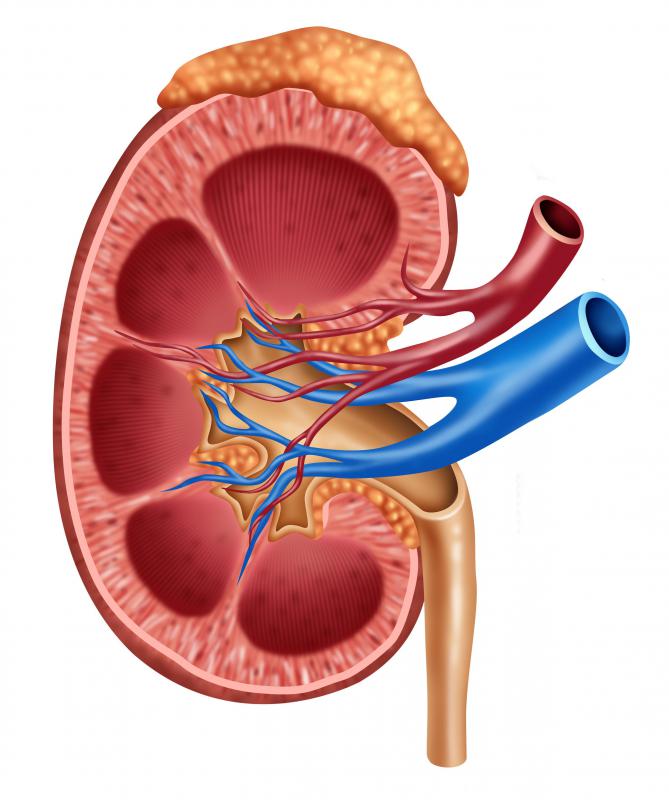
The adrenal cortex is the outer layer of the adrenal gland, a component of the endocrine system of the body which regulates and produces hormones. The inside of the adrenal gland is known as the adrenal medulla or simply medulla. The medulla and the cortex perform very different functions, and each is critical to healthy life. A variety of medical conditions can interfere with the function of the adrenal cortex, including Cushing's syndrome and Addison's disease. Using cholesterol as a base, the adrenal cortex creates a number of compounds with a variety of uses, many of which play a role in metabolism and blood chemistry.
The adrenal glands are located on top of the kidneys. The cortex is yellow in healthy individuals, and the gland itself has a star-like shape. There are three separate layers in the adrenal cortex, each of which is responsible for synthesizing different chemicals for use by the body. The cells in each layer have slightly different structures, reflecting their different functions, and the difference can clearly be seen with the assistance of a high powered microscope.

On the outside of the adrenal cortex, the zona glomerulosa makes mineralcorticoids such as aldosterone. The next layer, the zona fasciculata, makes glucocorticoids like cortisol, while the inner layer, known as the zona reticularis, makes androgens such as testosterone. The levels of production are varied, depending on the person and his or her physical condition. Men, for example, tend to produce more testosterone than women, and this hormone plays a critical role in physical development, and people under stress make more cortisol.

Dysfunction in either area of the adrenal gland can lead to a variety of symptoms, including fatigue, weight changes, hirsutism, vomiting, nausea, specific food cravings, hypoglycemia, and low blood pressure. In some cases, multiple parts of the endocrine system are involved, creating a cascading effect as the body's overall hormonal balance is severely disrupted, and in other instances, problems occur with the adrenal gland alone. Patients who suffer from adrenal insufficiency or overproduction have a number of treatment options, depending on the cause of the condition.

When problems do emerge with the adrenal glands, doctors try to resolve the underlying cause before resorting to measures such as supplementing the body's natural level of production with specific hormones, or removing the adrenal glands so that they cannot continue to overproduce. Because many conditions can involve the adrenal gland, extensive medical testing may be required to get to the bottom of the problem.
Mary McMahon
Ever since she began contributing to the site several years ago, Mary has embraced the exciting challenge of being a WiseGEEK researcher and writer. Mary has a liberal arts degree from Goddard College and spends her free time reading, cooking, and exploring the great outdoors.
Learn more...
Mary McMahon
Ever since she began contributing to the site several years ago, Mary has embraced the exciting challenge of being a WiseGEEK researcher and writer. Mary has a liberal arts degree from Goddard College and spends her free time reading, cooking, and exploring the great outdoors.
Learn more...AS FEATURED ON:
AS FEATURED ON:









-
![An adrenal gland on top of a kidney.]() By: freshideaAn adrenal gland on top of a kidney.
By: freshideaAn adrenal gland on top of a kidney. -
![Dysfunction of the adrenal gland can cause health problems like hypoglycemia.]() By: zothenDysfunction of the adrenal gland can cause health problems like hypoglycemia.
By: zothenDysfunction of the adrenal gland can cause health problems like hypoglycemia. -
![Many medical conditions can interfere with the function of the adrenal cortex, including Cushing's syndrome.]() By: joshyaMany medical conditions can interfere with the function of the adrenal cortex, including Cushing's syndrome.
By: joshyaMany medical conditions can interfere with the function of the adrenal cortex, including Cushing's syndrome. -
![The adrenal gland is a part of the endocrine system.]() By: stockshoppeThe adrenal gland is a part of the endocrine system.
By: stockshoppeThe adrenal gland is a part of the endocrine system.


Discussion Comments
My endocrine doctor tested me in 2001. My CT scan with contrast in 2001 showed my left adrenal size was 16mm. In 2008 my CT scan with contrast of my adrenal glands ( Left) shows some adrenal hyperplasia. My VMA in 2001 was 28 mg, in 2006 was 9.8mg, in 2008 was 2.72mg. My plasma renin test, cortisol, alderstone testorine, metaphorine (Urine) are also normal. What kind of desease do i have? My doctor now wants adrenal vein sampling for Alderstone test.
Post your comments