
At TheHealthBoard, we're committed to delivering accurate, trustworthy information. Our expert-authored content is rigorously fact-checked and sourced from credible authorities. Discover how we uphold the highest standards in providing you with reliable knowledge.
What is the ABC of First Aid?
 Mary McMahon
Mary McMahon
Mary McMahon
The ABC of first aid is a mnemonic designed to help people remember how to respond to an emergency situation in which someone is injured. There are many other mnemonics and variants, but it is probably the most useful one for lay people to remember. The letters stand for Airway, Breathing, and Circulation, also referred to as the vital signs. If all of the vital signs are monitored and addressed, a patient has a much better chance of surviving until trained help arrives.
Some emergency services prefer the variant DRABC, to remind people to check for danger in a situation before assisting someone. The DR stands for Danger and Response, and means that people should first examine the environment and then the patient to ensure that there is not a source of potential physical danger. For example, an unconscious patient next to a live wire should be treated, but not until the live wire has been turned off or the patient can be moved out of the way, to ensure that the responder is not injured as well.

When using the ABC of first aid, the first thing for a responder to do is check the patient's airway. If the person's throat is blocked, he or she will be unable to breathe. A person who is conscious should be asked to speak; if he or she cannot, then the airway may be obstructed. If the patient is unconscious, the responder should lift his or her chin and tilt the head back carefully, remembering that any rough movements could aggravate unknown spinal and neck injuries. The responder should then sweep the back of the mouth with a finger to check for debris.

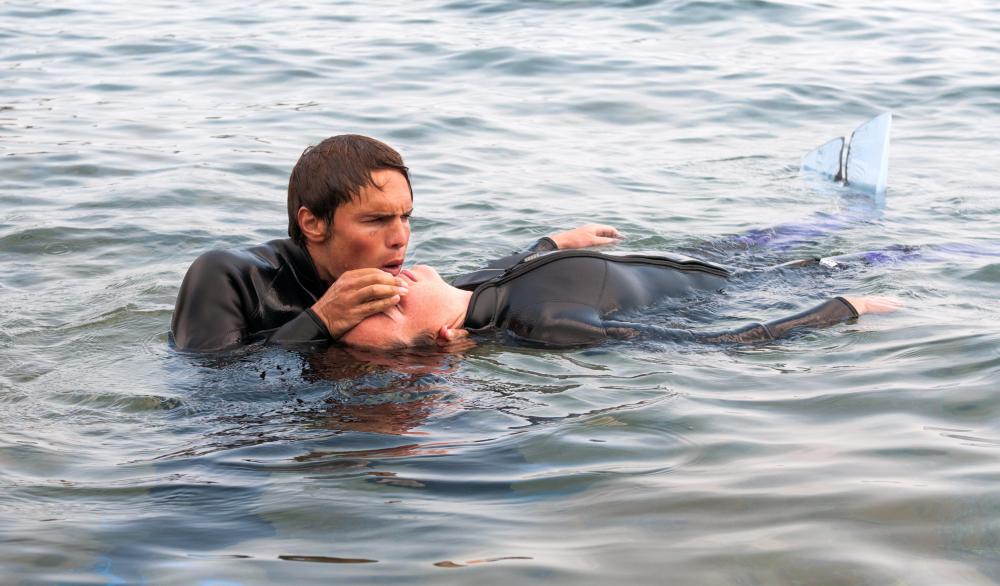
Breathing is next. The responder should place his face close to the patient's mouth to listen and feel for breathing, or use an object like a mirror. If the patient is breathing, the breath will condense on the mirror. A patient who is not breathing needs to be treated quickly. When the heart is beating but the patient is not breathing, the responder should administer rescue breathing until the patient is breathing again or help arrives.

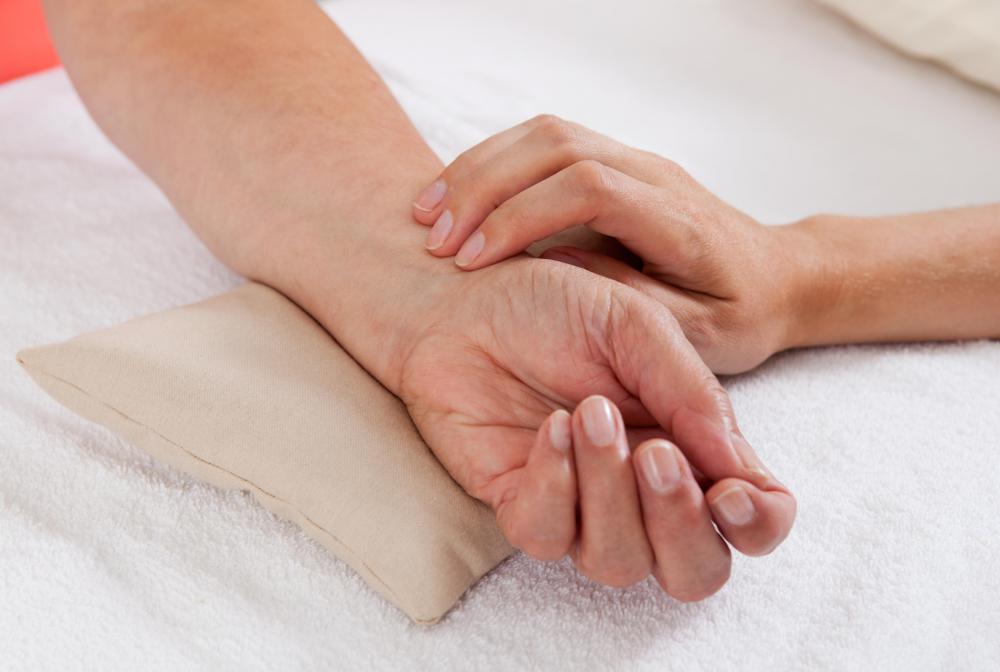
Finally, circulation should be checked by monitoring the patient's pulse at the wrist or throat. In addition, the responder should check the patient's color. If he or she is pallid or has splotchy areas of color, it suggests that the circulation may be compromised. The person who is providing treatment should try to keep the patient warm.
If all of the steps of the ABC of first aid are satisfied, responders can move on to a general assessment of the patient, looking at injuries and their severity. Responders constantly check the vital signs while they work on the patient, to ensure that the patient is still stable. At this point, there are a plethora of options, depending on the patient's condition. An untrained individual who is first on the scene should just try to make sure that the patient is breathing and apply pressure to obvious sites of bleeding.
Mary McMahon
Ever since she began contributing to the site several years ago, Mary has embraced the exciting challenge of being a TheHealthBoard researcher and writer. Mary has a liberal arts degree from Goddard College and spends her free time reading, cooking, and exploring the great outdoors.
Learn more...
Mary McMahon
Ever since she began contributing to the site several years ago, Mary has embraced the exciting challenge of being a TheHealthBoard researcher and writer. Mary has a liberal arts degree from Goddard College and spends her free time reading, cooking, and exploring the great outdoors.
Learn more...AS FEATURED ON:
AS FEATURED ON:


-
![Responders may have to initiate rescue breathing while administering first aid.]() By: Roy PedersenResponders may have to initiate rescue breathing while administering first aid.
By: Roy PedersenResponders may have to initiate rescue breathing while administering first aid. -
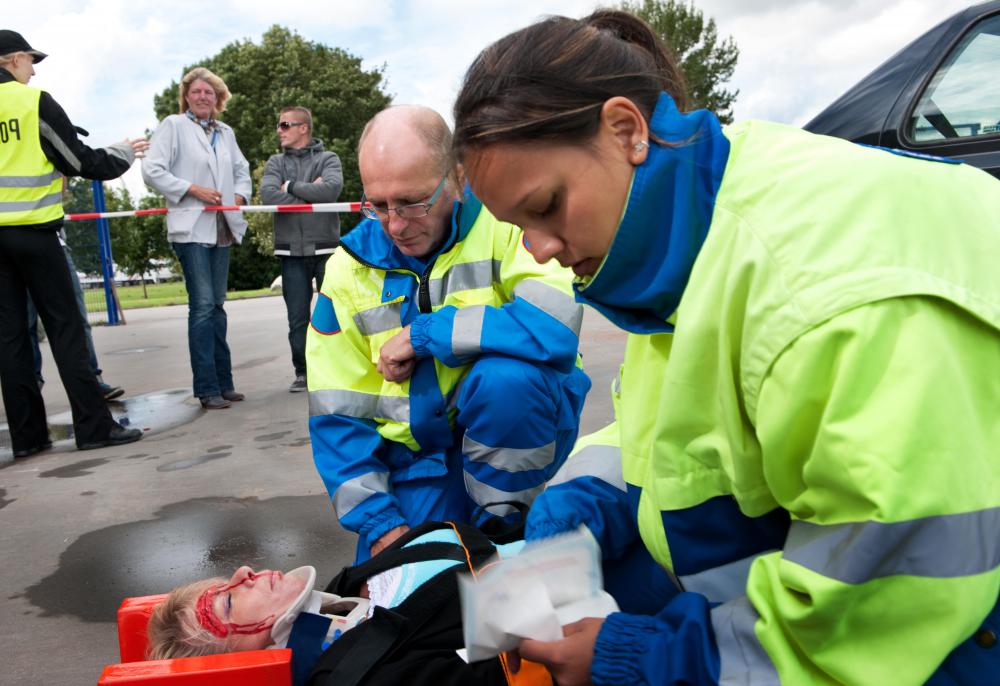
![First aid is intended to keep the victim alive until paramedics can arrive.]() By: corepicsFirst aid is intended to keep the victim alive until paramedics can arrive.
By: corepicsFirst aid is intended to keep the victim alive until paramedics can arrive. -
![Once the person's airway, breathing and circulation have been checked, other injuries can be evaluated.]() By: Warren GoldswainOnce the person's airway, breathing and circulation have been checked, other injuries can be evaluated.
By: Warren GoldswainOnce the person's airway, breathing and circulation have been checked, other injuries can be evaluated. -
![Following the ABC of first aid allows rescuers to immediately find an object that has blocked the airway of a child.]() By: MagaliceFollowing the ABC of first aid allows rescuers to immediately find an object that has blocked the airway of a child.
By: MagaliceFollowing the ABC of first aid allows rescuers to immediately find an object that has blocked the airway of a child. -
![Stabilization of injured people is a main component of first aid procedures.]() By: wellphotoStabilization of injured people is a main component of first aid procedures.
By: wellphotoStabilization of injured people is a main component of first aid procedures. -
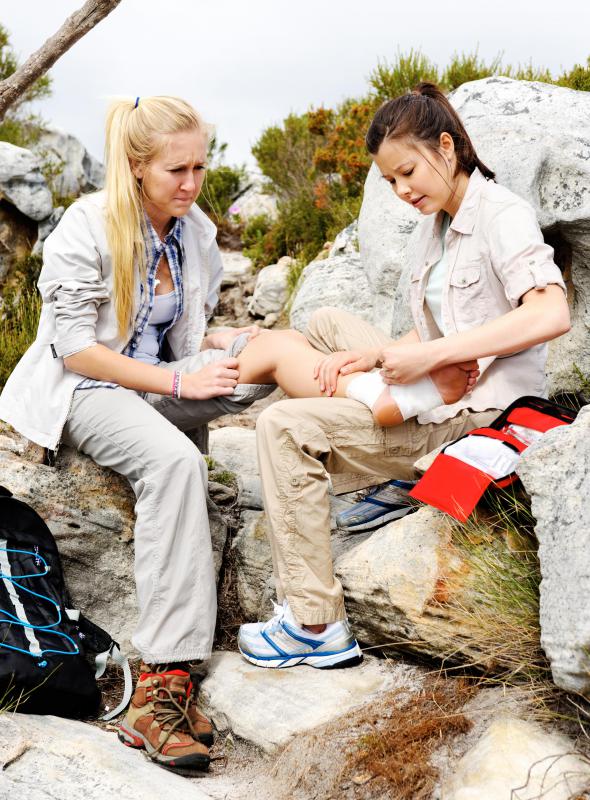
![Proper wound care is a basic part of first aid.]() By: sudok1Proper wound care is a basic part of first aid.
By: sudok1Proper wound care is a basic part of first aid. -
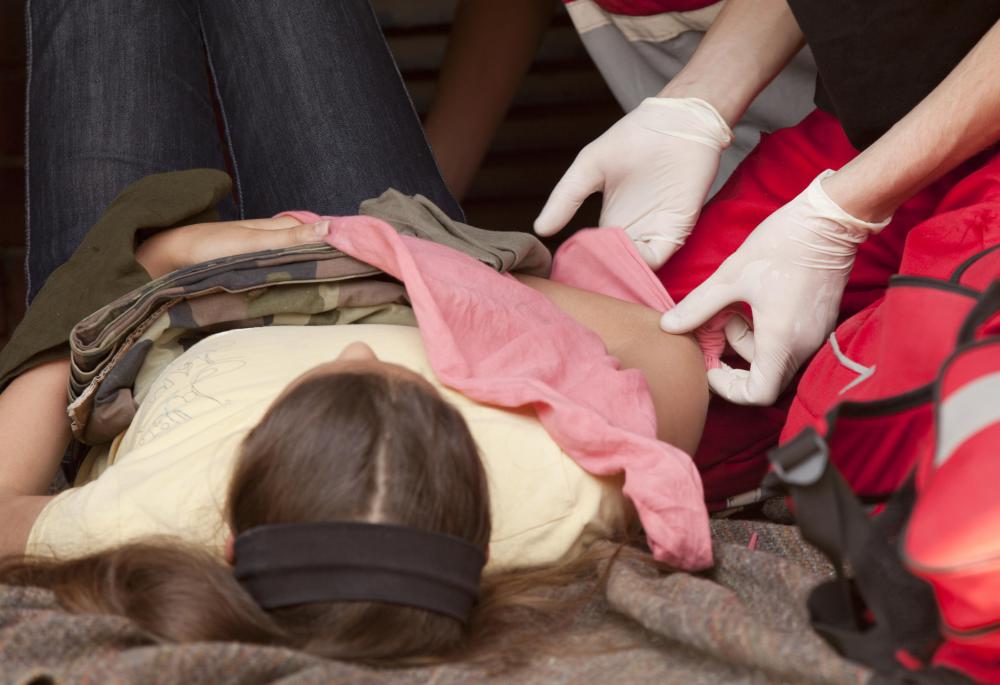
![Circulation may be checked by monitoring a patient's pulse from the wrist.]() By: Tyler OlsonCirculation may be checked by monitoring a patient's pulse from the wrist.
By: Tyler OlsonCirculation may be checked by monitoring a patient's pulse from the wrist.


Discussion Comments
Can someone please tell me what ABC is when dealing with a child who is unresponsive and breathing is not normal? -- H.Collins
I really need some tips to be used in teams of health emergency first aid. Am much more inspired by the ABC-first aid tip to be used before every thing can be made.
An unresponsive victim usually means one who is unconscious or otherwise unable to communicate.
I go along with -ellefagon. I have been an industrial first aid man for over 26 years in class A industries. that means very high hazard. The hardest part for me was not in treating patients, but waiting for accidents to happen. That is basically the stressful part for this type of job. Every scenario of an accident is different, you never know what to expect. You need a certain mindset for this type of job. If you think you have it then by all means go for it!
Very fine article!
I am Red Cross helper, paid and volunteer for 40 years,
with updates regularly and I can vouch for your advice here.
Two things:
One: most people do not have much emergency response training, so call 911 immediately on your cell, or recruit anyone nearby to get the pros to the site ASAP. Time is life.
Two: "Talk me through it" is a famous joke line, but not in this scenario. Report the crisis and simply *tell* them you are not a response pro, but willing to do anything that might help, if 911 will talk you through it.
They are supposed to be delighted to do so.
If your CPR is sketchy or you are frightened, that's normal, but having a pro there to talk you through it can make all the difference and calm you and save the life of the victim.
In fact, since there are so many things we can do *wrong* when someone is injured, whenever possible, *do* get that help from the pros.
CPR if breathing or heartbeat have stopped is *great* to do - *do it*.
For profuse bleeding, pressing a towel or teeshirt to the wound to slow the loss of blood is great, do it.
Beyond that, be sure or get the pros to advise you or wait till they arrive.
A favorite story: A friend was too tiny and not strong enough to do effective CPR on a larger friend who'd fallen with heart attack, but she was a nurse and knew what to do, so she "drafted" a big strong guy nearby to do it, and coached him through it - she did the breathing and he did more effective chest compressions.. and the victim recovered and went on to enjoy the rest of her vacation. I just thought it was so smart an idea.
Thanks again, Wise Geek
how can you help an unresponsive victim?
Post your comments