
At WiseGEEK, we're committed to delivering accurate, trustworthy information. Our expert-authored content is rigorously fact-checked and sourced from credible authorities. Discover how we uphold the highest standards in providing you with reliable knowledge.
What is the 18th Amendment?
 Tricia Christensen
Tricia Christensen
Tricia Christensen
The 18th Amendment to the US Constitution was ratified in 1919, and became one of the shorter lived and deeply controversial amendments. Under this amendment, the production, transportation, and sale of alcohol was banned. It was passed with the Volstead Act, which helped to define those beverages considered alcoholic and defined “intoxicating liquor” as containing 0.5% of alcohol or more.
Taken together, the 18th Amendment and the Volstead Act ushered in the Prohibition Era in the United States, which significantly increased illegal activity and the rise of the crime lords like Al Capone, who made much of his money through illegal manufacture, sale, and transportation of alcohol. The amendment did not succeed in creating a countrywide temperance movement. It can be said that the pervasiveness of large and small operations to provide people with access to alcohol helped make these beverages still widely available, even though they were illegal.

Part of the impetus in the various temperance movement groups that helped pressure Congress to pass the law was religious in nature, although there were other reasons why women especially supported banning access to alcohol. As with today, domestic violence against women tended to be more significant in homes where alcohol was used to excess. There were strong opponents to the temperance movement who were strongly religious too, however, and the split between support and opposition to the bill cannot be viewed as a total separation between the religious and nonreligious.

Though the 18th Amendment might have ended the drinking careers of some, its passage created more social problems. First, alcohol was still widely available, so it didn’t necessarily mean that people had stopped drinking, and those who were alcoholics very likely continued drinking regularly. The rise in organized crime was most significant and created increased violence, especially in urban areas. Not all people were eager to enforce the laws either, since many did not support them.

Continued pressure to repeal the law was applied to US leaders, and ultimately, the amendment was repealed by the 21st Amendment, ratified in 1933. This amendment also made the provisions of the Volstead Act unconstitutional and therefore struck at the heart of the temperance movement and the goal of prohibition. The issues created by organized crime were partly solved by allowing sale, manufacture, and transportation of alcohol again, though organized crime in various forms still continued to proliferate.
Tricia Christensen
Tricia has a Literature degree from Sonoma State University and has been a frequent WiseGEEK contributor for many years. She is especially passionate about reading and writing, although her other interests include medicine, art, film, history, politics, ethics, and religion. Tricia lives in Northern California and is currently working on her first novel.
Learn more...
Tricia Christensen
Tricia has a Literature degree from Sonoma State University and has been a frequent WiseGEEK contributor for many years. She is especially passionate about reading and writing, although her other interests include medicine, art, film, history, politics, ethics, and religion. Tricia lives in Northern California and is currently working on her first novel.
Learn more...AS FEATURED ON:
AS FEATURED ON:









-
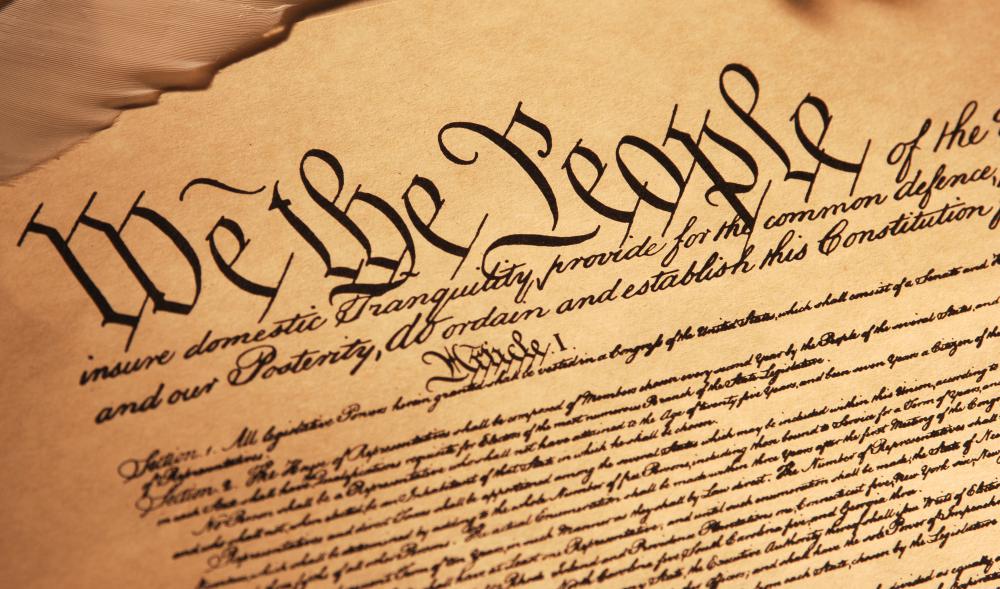
![The U.S. Constitution.]() By: James SteidlThe U.S. Constitution.
By: James SteidlThe U.S. Constitution. -
![The US Capitol Building, the seat of the US Congress.]()
The US Capitol Building, the seat of the US Congress. -
![The 18th Amendment banned alcohol consumption in the U.S. States in 1919.]() By: Nomad_SoulThe 18th Amendment banned alcohol consumption in the U.S. States in 1919.
By: Nomad_SoulThe 18th Amendment banned alcohol consumption in the U.S. States in 1919. -
![The 21st Amendment, passed in 1933, repealed the 18th Amendment, making it legal to again consume alcoholic beverages.]() By: Robert KneschkeThe 21st Amendment, passed in 1933, repealed the 18th Amendment, making it legal to again consume alcoholic beverages.
By: Robert KneschkeThe 21st Amendment, passed in 1933, repealed the 18th Amendment, making it legal to again consume alcoholic beverages.



Discussion Comments
And what people never like to look at is the fact that rates of abuse and other social ills did go down during Prohibition. Most people couldn't care less if they were allowed to drink or not, just as the average person today doesn't really care that they can't legally get hold of a tab of ecstasy whenever they want one.
I'm not saying when the 18th amendment was repealed they were wrong, but I think it would have been interesting to see what would have happened if they had held on a little longer.
@MrsPramm - I don't really believe in making anything like that illegal. Control it, yes. Make sure companies can't sneak heroin into your soda, make sure kids can't get it, make sure people are educated about it. Maybe make sure that very strong versions aren't on the market.
But, I should have a legal right to put whatever I want into my body, providing I'm not impacting others.
Maybe if they had passed an amendment that anyone who abuses their wife, or neglects their children, regardless of the reason, should be held accountable, the world would be a happier place today.
@SilentBlue - While pot can definitely be dangerous, it's mostly bad for young people who are still developing (similar to alcohol) and when used in combination with driving (similar to alcohol) and when used in excess (similar to alcohol). In most of those cases, pot is the lesser of the two dangers (although it depends on the kind of pot you use, much like the distinction between drinking a beer and pounding absinthe).
I've never been able to see why there is such a legal distinction made between the two substances. As they found out in the prohibition era, making that kind of thing illegal is pointless and expensive for the tax-payer.
Does it not strike you as odd that, by trying to end the alcoholism in this country, religious leaders, as well as political leaders, created a larger problem? They created a series of events that led to a further moral and social decline in this country.
@ShadowGenius
I think that the question is moral as well as legal. If coffee were considered to be a mind-altering drug, perhaps we would have coffee street gangs. Although marijuana is a milder form of illegal drugs, it is nevertheless dangerous and can do great damage to productivity and mental capacity. Alcohol only does as much damage when consumed to excess. So perhaps drunkenness should be illegal.
Perhaps the same issue faced by proponents of the 18th Amendment can be compared to the issue faced by people against the legalization of marijuana today. The drug industry is the strongest pillar of underground crime and violence. If these drugs were legalized, wouldn't that eliminate a lot of gangs?
People made a lot of money brewing alcohol secretly and delivering their illegal "moonshine" to places like "speakeasy" bars. This regulation helped to foster the growth of many illegal organizations like the Mafia in America. With beer and wine being a central and intrinsic part of many cultures, the 18th Amendment also was perceived as discriminatory. To this day, the cultural meme of the "drunken Irishman" has continued in the American conscious. Italians were also seen as shady double-dealing and violent people.
Post your comments