
At AllThingsNature, we're committed to delivering accurate, trustworthy information. Our expert-authored content is rigorously fact-checked and sourced from credible authorities. Discover how we uphold the highest standards in providing you with reliable knowledge.
What is Tapeworm?
A tapeworm is a parasitic organism that lives in hosts like pets, farm animals, and humans. Making up the class Cestoda, tapeworms are long, segmented worms of different species with a complicated reproductive cycle. A tapeworm infestation often has minimal symptoms, but a person can develop serious health problems if it goes untreated.
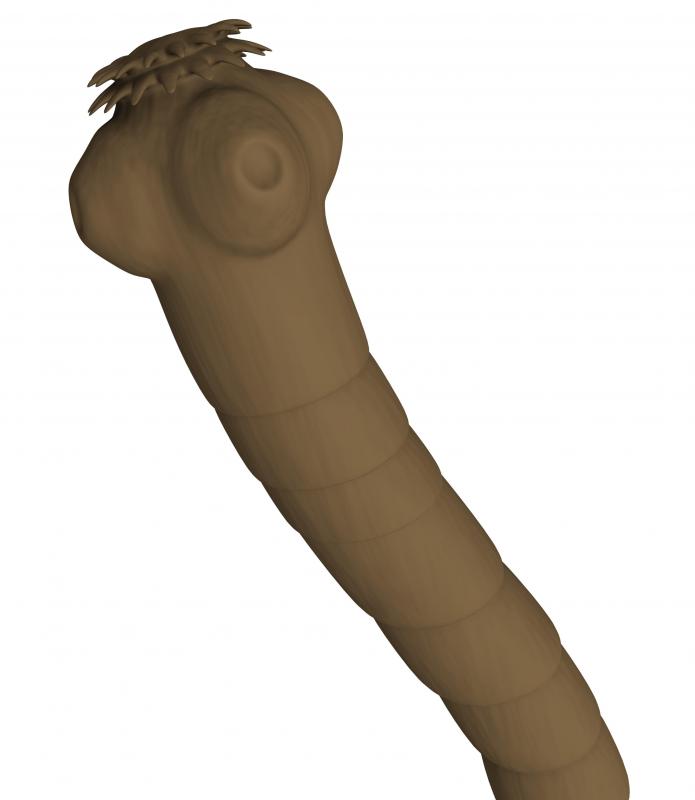
A tapeworm has a head, called the scolex, with a mouth of hooked appendages that allow it to attach to its host's intestinal lining. Right behind the head, the neck grows the segments that make up the rest of the elongated worm. A healthy, mature tapeworm can reach 20 ft (6.1 m) in a large host, winding down its small intestine. The end or tail segments break off and are passed with excrement.

In its adult phase, tapeworm absorbs nutrients from its primary host, which could be a dog, cat, cow, sheep, human, or other mammal. To reproduce, the tapeworm can fertilize its own eggs (in some species) and release them to be excreted with the host's stool. In the secondary phase, an intermediary host ingests these eggs, and they get embedded in muscles or organs. When the intermediary host, such as a cow, gets eaten by another primary host, the eggs begin to develop into new tapeworms.

Tapeworm is frequently picked up by swimming in a body of water, like a lake or river, and accidentally swallowing a small amount of water. However, one can also be infected by eating undercooked meat, such as beef, pork, or fish, or by getting bitten by a flea from an infected pet. Humans with tapeworm have subtle or nonexistent symptoms. These include weight loss, hunger, indigestion, weakness, diarrhea, nausea, vomiting, or anemia. If the tapeworm has spread, using you as an intermediate host, and embedded eggs in vital organs, your liver, lungs, heart, and brain can be affected.

Your family doctor can diagnose a tapeworm infestation by examining a stool sample for segments or eggs from a worm that has used you as their primary host. However, if the human is acting as secondary host, and cysts have formed in organs, a doctor may need to conduct a CT or ultrasound scan. Treatment of a tapeworm infestation relies on medicine, but cysts need to be surgically removed.
Frequently Asked Questions
What is a tapeworm and how does it infect animals or humans?

A tapeworm is a parasitic flatworm that lives in the intestines of animals and humans. Infection occurs through the ingestion of tapeworm eggs or larvae, often present in undercooked meat or contaminated food and water. Once inside the host, the larvae mature into adults and attach to the intestinal walls, absorbing nutrients from the host's diet.
What are the symptoms of a tapeworm infection?

Symptoms of tapeworm infection can be subtle or non-existent but may include abdominal pain, nausea, diarrhea, weight loss, and malnutrition. In some cases, individuals may notice segments of the tapeworm, called proglottids, in their stool. However, many people with tapeworm infections are asymptomatic and unaware they have a parasite.
How is a tapeworm infection diagnosed?

Diagnosis of a tapeworm infection typically involves a stool sample analysis to detect the presence of tapeworm eggs or segments. In some cases, blood tests or imaging studies like CT scans or MRIs may be used to identify cysts in other organs if the infection has spread beyond the intestines.
Can tapeworms be transmitted from pets to humans?
Yes, tapeworms can be transmitted from pets to humans, particularly if the pet is infested with fleas that carry tapeworm larvae. Humans can accidentally ingest infected fleas, especially young children who are in close contact with pets. Regular deworming of pets and flea control are important preventive measures.
What treatments are available for tapeworm infections?

Treatment for tapeworm infections typically involves oral medications that are toxic to the parasite, such as praziquantel or albendazole. These medications cause the tapeworm to dissolve and be digested by the host. It's crucial to follow the prescribed treatment regimen and practice good hygiene to prevent reinfection.
How can tapeworm infections be prevented?
Preventing tapeworm infections involves cooking meat to safe temperatures, washing hands and food surfaces thoroughly, and avoiding consumption of contaminated water. Regular deworming of pets and controlling fleas also reduce the risk of transmission. Travelers to areas with higher incidence rates should be particularly cautious about food and water sources.
AS FEATURED ON:
AS FEATURED ON:









-
![The tapeworm's mouth of hooked appendages allows it to attach to a host's intestines.]() By: 3drenderingsThe tapeworm's mouth of hooked appendages allows it to attach to a host's intestines.
By: 3drenderingsThe tapeworm's mouth of hooked appendages allows it to attach to a host's intestines. -
![Tapeworm is frequently picked up in small lakes or rivers.]() By: cantelowTapeworm is frequently picked up in small lakes or rivers.
By: cantelowTapeworm is frequently picked up in small lakes or rivers. -
![Sheep can host tapeworms.]() By: mato020Sheep can host tapeworms.
By: mato020Sheep can host tapeworms. -
![Dogs are at risk of tapeworm.]() By: GelpiDogs are at risk of tapeworm.
By: GelpiDogs are at risk of tapeworm. -
![Nausea is one possible sign of a tapeworm.]() By: ftlaudgirlNausea is one possible sign of a tapeworm.
By: ftlaudgirlNausea is one possible sign of a tapeworm. -
![Healthy, mature tapeworms can reach up to 20 feet in length.]() By: watashiwaniHealthy, mature tapeworms can reach up to 20 feet in length.
By: watashiwaniHealthy, mature tapeworms can reach up to 20 feet in length. -
![Stool samples that are collected at home are usually placed into plastic containers.]() By: luchschen_shutterStool samples that are collected at home are usually placed into plastic containers.
By: luchschen_shutterStool samples that are collected at home are usually placed into plastic containers.






Discussion Comments
How do you avoid tapeworms?
How long does it take until tapeworm symptoms are seen? And how do I tell if I see pieces of it in my stool?
I eat a lot of sushi and I began to worry because one of my close friends who also eats a lot of sushi was diagnosed with tapeworms last week. We have also eaten at the same restaurants many times and although she's not sure how she got the tapeworms, it's possible that it was from fish.
I've stopped eating any sushi with fish in it since then but I can't stop thinking that I might be infected too. I don't have any diarrhea or weight loss though. And I believe tapeworm infection also causes symptoms like bloating, mental confusion, etc. I don't seem to have these symptoms either but maybe it hasn't been long enough yet?
How long does it usually take to see any symptoms? And is treating tapeworm possible through natural remedies or supplements?
@burcidi-- It's possible for you to get it if a flea from your dog bites you.
There aren't many ways that you could get tapeworm from your pet if you're careful about handling feces and if you wash your hands often.
Tapeworm leave their eggs in feces so it could get on fleas or flies that touch the feces. If a flea bites another pet or a human, it's possible for the eggs to get into the bloodstream and grow in the new host. If a pet eats a fly with tapeworm eggs on it, that pet can get a tapeworm infected too.
You might want to take your dog to the vet again. They should do a test to see if there are still tapeworms in the system. That's the best way to know what the risks are.
We got a puppy from a pet shop three weeks ago. We took him to the vet and he got all his shots. Anyway he's a really healthy and happy puppy and seems to be growing and gaining weight fine so far.
Just yesterday when my mom took him out though, she noticed a tapeworm in his stool. We called the vet and he thinks that one of the shots he was given is getting rid of the tapeworms in his system and we shouldn't worry. But my mom is really worried. She thinks we will get the tapeworms too. She cleaned the entire house with bleach today and she's talking about taking the puppy back.
I don't want him to go back but I don't want to get tapeworms either. What are the chances of us getting tapeworms from my dog? And if he is getting rid of them from his system, how long will that take? Should we do anything in particular to protect ourselves?
I need information and suggestions, please help!
yes, its true, but unfortunately, it can cause you to die. I just saw a program on tv that was talking about that.
i've heard about some crazy people ordering this and using it for weight loss...is that true? no amount of weight could make me want to consciously and purposefully put a tapeworm in my body!
Post your comments