
At WiseGEEK, we're committed to delivering accurate, trustworthy information. Our expert-authored content is rigorously fact-checked and sourced from credible authorities. Discover how we uphold the highest standards in providing you with reliable knowledge.
What is Tachycardia?
 Jeff Petersen
Jeff Petersen
Jeff Petersen
An unusually fast beating of the heart is called tachycardia. Medical professionals diagnosing a patient with this condition may say that the patient is "tachy." Normal heart rate for an adult is between 60 and 100 beats per minute. If the heart rate climbs above 100 beats per minute, the patient is said to be experiencing tachycardia.
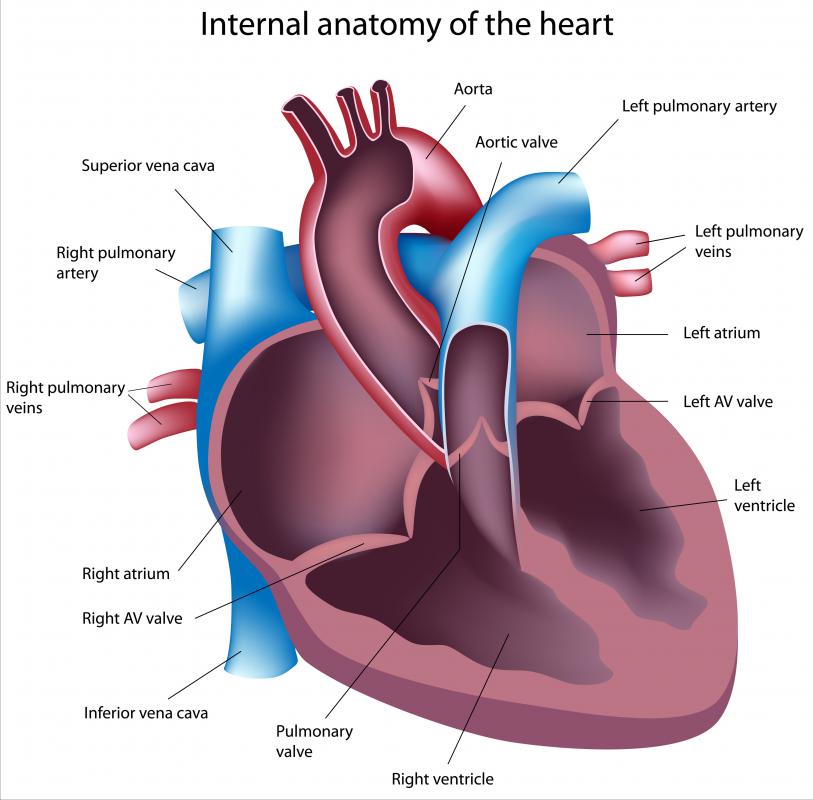
Tachycardia is not always life threatening, but it can lead to serious and life threatening conditions. The two main categories are ventricular and supraventricular tachycardia, referring to the area of the heart where the problem occurs.

If the rapid heartbeat occurs in the ventricles, it is called ventricular tachycardia, or V-Tach. This can lead to ventricular fibrillation, a condition in which the ventricles beat so rapidly that they do not effectively pump blood. A patient in ventricular fibrillation can be shocked with a defibrillator in an effort to restore normal heart rhythm.

If the tachycardia starts in the upper part of the heart, above the ventricles, the condition is called supraventricular tachycardia. Also referred to as SVT, this is the more common variety, and isn't generally considered dangerous as long as it lasts for only a few seconds. If it lasts for an extended period of time, or occurs frequently, it may indicate a serious problem, and the sufferer should seek medical treatment.

Tachycardia can have many causes, including medications, low blood pressure, a quick change in position from reclining to upright, or damage or disease of the heart or lungs. Treatment often begins by looking for the underlying cause of the rapid heartbeat and treating that problem. This, in turn, usually restores the heart to its natural rhythm.
If other treatments do not work, a medical professional may give a patient medication to correct the rapid heartbeat. In more severe cases, a device called an implantable cardioverter defibrillator is used. This helps a patient with frequent tachycardia by monitoring the heart rate and applying a small electrical shock when necessary to keep the patient's heart beating normally.
Jeff Petersen
Jeff is a freelance writer, short story author, and novelist who earned his B.A. in English/Creative Writing from Creighton University. Based in Berkeley, California, Jeff loves putting his esoteric knowledge to good use as a WiseGEEK contributor.
Learn more...
Jeff Petersen
Jeff is a freelance writer, short story author, and novelist who earned his B.A. in English/Creative Writing from Creighton University. Based in Berkeley, California, Jeff loves putting his esoteric knowledge to good use as a WiseGEEK contributor.
Learn more...AS FEATURED ON:
AS FEATURED ON:









-
![Tachycardia may be a side effect of certain medications.]() By: somkanokwanTachycardia may be a side effect of certain medications.
By: somkanokwanTachycardia may be a side effect of certain medications. -
![Tachycardia may occur as a result of low blood pressure.]() By: Syda ProductionsTachycardia may occur as a result of low blood pressure.
By: Syda ProductionsTachycardia may occur as a result of low blood pressure. -
![Tachycardia refers to a rapid heart rate.]() By: Alila Medical MediaTachycardia refers to a rapid heart rate.
By: Alila Medical MediaTachycardia refers to a rapid heart rate. -
![A defibrillator may be used to treat ventricular fibrillation.]() By: RenewerA defibrillator may be used to treat ventricular fibrillation.
By: RenewerA defibrillator may be used to treat ventricular fibrillation. -
![Tachycardia may occur as a result of drug abuse.]() By: aaabbcTachycardia may occur as a result of drug abuse.
By: aaabbcTachycardia may occur as a result of drug abuse.




Discussion Comments
I usually while playing feel that my heartbeat is beating about 5 to 6 beats per second. It increases from normal to this rate in just an instant and then I feel pain in my chest, severe sweat comes out of my body, I feel that my body is getting hot, and it lasts for 30 to 40 minutes, and then within a second, it gets back to normal giving me a pain in my heart.
I tried but was never successful in counting my heartbeat as it is too high. Suggest something I can do.
a high white blood count is usually due to an infection somewhere in your body. good luck!
i'm so sorry that you have to suffer like that. i hope that you don't feel any pain because of it, so i hope you feel better. From someone who knows.
i was recently in the hospital this weekend and i had this happen to me because i had medication in me. i had morphine, and sugar water and other things in my system and every time i'd move it would go crazy or when my mother would tap her feet it would go nuts now i dunno if they kept me in the hospital because of this or because i wasn't well enough to leave because of my elevated white blood count can someone help me?
Post your comments