
At WiseGEEK, we're committed to delivering accurate, trustworthy information. Our expert-authored content is rigorously fact-checked and sourced from credible authorities. Discover how we uphold the highest standards in providing you with reliable knowledge.
What is Subcutaneous Tissue?
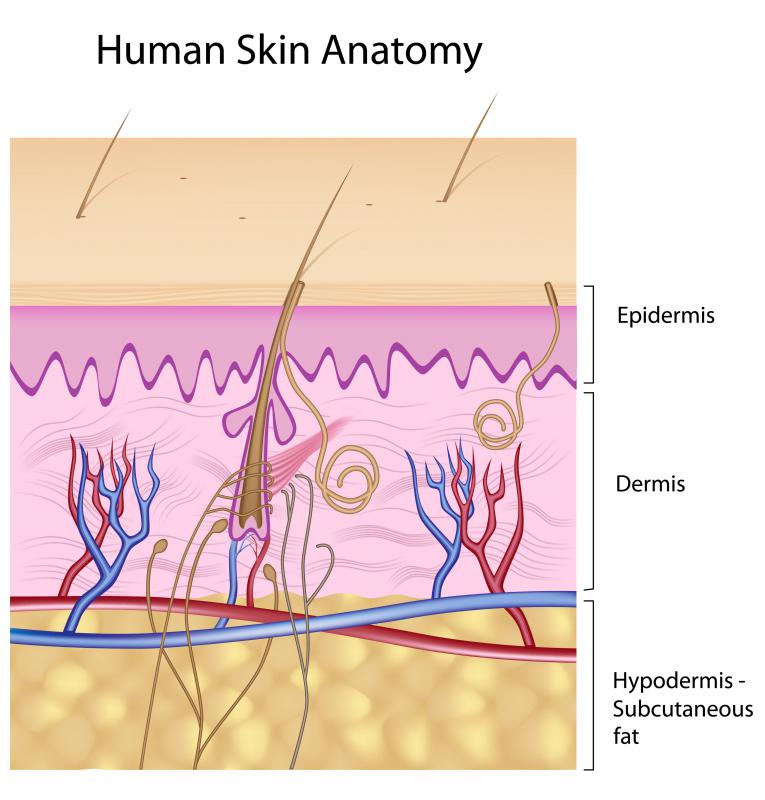
Human skin has three layers: the dermis, epidermis, and hypodermis. Each layer has different functions. The deepest layer, the hypodermis, is also known as subcutaneous tissue. This layer is responsible for regulating body temperature, and also protects the inner organs and bones. In addition to its other functions, this layer of skin plays a role in pigmentation.
Humans’ subcutaneous tissue contains many elements, including elastic fibers, nerves, and hair follicle roots. It is often said, however, that the hypodermis consists mainly of adipose tissue. An adipoyte is a fat cell, making this tissue mainly fat. There are also large blood vessels distributed throughout the tissue. Together, these components create a layer of skin that acts as a type of insulation for the body.

When thinking of insulation, people tend to think of retaining heat. This tissue is a full-service temperature regulating mechanism, however, and helps to prevent a person from getting too hot or too cold. It is in this layer that the sweat glands are located so that, when a person’s body begins to overheat, it is a signal from the tissue that generates sweat to help cool it down.

The insulation provided by this deepest layer of skin is also useful in helping prevent injury. When a person falls or bumps into something, it is this layer of skin that acts as a cushion. By doing so, the hypodermis helps protect the body’s delicate inner organs and bones. The subcutaneous tissue becomes thin when a person gets old, which plays a role in many of the changes that can be noted in elderly people’s body temperature, and their tendency to fall more often and be more seriously injured by those falls.

In some cases, medicines are said to be given subcutaneously, which usually refers to injections into the hypodermis. This is believed to be the most effective manner to administer some drugs, such as human growth hormones. Just as the subcutaneous tissue can store fat, it can also provide good storage space for drugs that need to be released gradually because there is limited blood flow.
AS FEATURED ON:
AS FEATURED ON:









-
![A subcutaneous injection refers to an injection in the hypodermis.]() By: aceshotA subcutaneous injection refers to an injection in the hypodermis.
By: aceshotA subcutaneous injection refers to an injection in the hypodermis. -
![Subcutaneous tissue is mostly made up of adipose tissue, which is mainly fat.]() By: VRDSubcutaneous tissue is mostly made up of adipose tissue, which is mainly fat.
By: VRDSubcutaneous tissue is mostly made up of adipose tissue, which is mainly fat. -
![Subcutaneous tissue is the deepest layer of human skin, and is also known as the hypodermis.]() By: AlilaSubcutaneous tissue is the deepest layer of human skin, and is also known as the hypodermis.
By: AlilaSubcutaneous tissue is the deepest layer of human skin, and is also known as the hypodermis. -
![The skin is made up of the epidermis, dermis, and subcutaneous layers.]() By: Deyan GeorgievThe skin is made up of the epidermis, dermis, and subcutaneous layers.
By: Deyan GeorgievThe skin is made up of the epidermis, dermis, and subcutaneous layers. -
![The hypodermis lies just below the epidermis and the dermis.]() By: LoloStockThe hypodermis lies just below the epidermis and the dermis.
By: LoloStockThe hypodermis lies just below the epidermis and the dermis.




Discuss this Article
Post your comments