
At WiseGEEK, we're committed to delivering accurate, trustworthy information. Our expert-authored content is rigorously fact-checked and sourced from credible authorities. Discover how we uphold the highest standards in providing you with reliable knowledge.
What is Steatosis?
 Mary McMahon
Mary McMahon
Mary McMahon
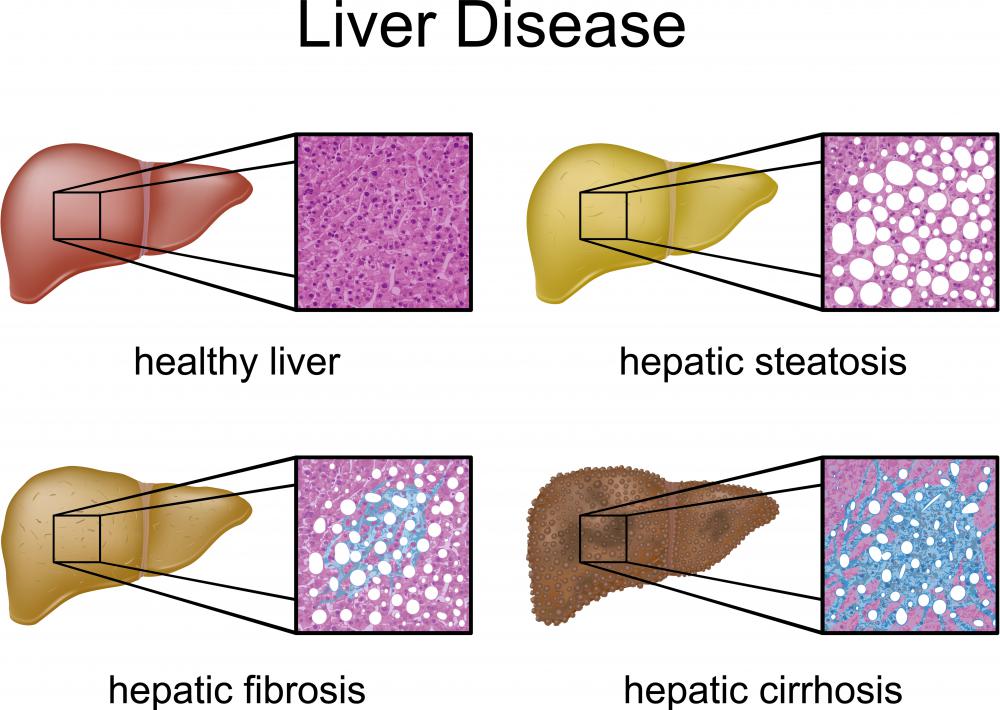
Steatosis is the deposition of fat in the interstitial spaces of an organ. Specifically, many people use this term to talk about depositions of fat in the liver, and it is sometimes also called “fatty liver disease.” As a general rule, this condition is reversible with a variety of treatments, but it can cause serious complications if it is not caught and addressed.
One of the most common causes of steatosis is alcoholism. In fact, alcoholism is such a common cause that other forms of this condition are lumped under the term “non-alcoholic steatosis.” When the problem is diagnosed, alcohol consumption is usually discussed with the patient to rule out its role. If the patient does not drink in large amounts, the cause could be insulin resistance, hepatitis infection, or obesity.

If fatty liver disease is allowed to progress, it will turn into steatohepatitis, a serious inflammation of the liver. If this is not treated, cell damage and death will begin to occur, potentially putting the patient at risk of death. The end result is cirrhosis of the liver, a condition that is marked by an extreme decrease in liver function. This is not a good thing, since the liver helps the body process a variety of toxins, and without a functioning liver, a patient will die.

Treatments are focused on restoring lever function so that the body can metabolize the fatty buildup. As a result, patients are typically forced to go onto a restrictive diet that excludes substances like alcohol, which could exacerbate the condition. If obesity is the cause, patients are usually strongly encouraged to lose weight to reduce the strain on their livers. Medical professionals also try to identify the root cause of the problem, as treatment of the cause can usually reverse the symptoms.

One of the dangers of steatosis is that it often exhibits few symptoms at the beginning. Patients might feel a bit tired, or experience some abdominal soreness, but they may not be able to identify the cause. Unless a patient happens to be tested, the condition may progress until more obvious symptoms emerge, making the condition more difficult to treat. People with hepatitis are often regularly tested for signs of this problem, and they are encouraged to eat a controlled diet to reduce fat deposition in their livers.
Mary McMahon
Ever since she began contributing to the site several years ago, Mary has embraced the exciting challenge of being a WiseGEEK researcher and writer. Mary has a liberal arts degree from Goddard College and spends her free time reading, cooking, and exploring the great outdoors.
Learn more...
Mary McMahon
Ever since she began contributing to the site several years ago, Mary has embraced the exciting challenge of being a WiseGEEK researcher and writer. Mary has a liberal arts degree from Goddard College and spends her free time reading, cooking, and exploring the great outdoors.
Learn more...AS FEATURED ON:
AS FEATURED ON:









-
![Alcoholism is the most common cause of steatosis.]() By: Photographee.euAlcoholism is the most common cause of steatosis.
By: Photographee.euAlcoholism is the most common cause of steatosis. -
![Obesity can cause steatosis.]() By: sunabesyouObesity can cause steatosis.
By: sunabesyouObesity can cause steatosis. -
![Individuals with steatosis are required to go on a restrictive diet.]() By: PhotoSGIndividuals with steatosis are required to go on a restrictive diet.
By: PhotoSGIndividuals with steatosis are required to go on a restrictive diet. -
![Several types of liver disease, including hepatic steatosis (fatty liver disease).]() By: peterjunaidySeveral types of liver disease, including hepatic steatosis (fatty liver disease).
By: peterjunaidySeveral types of liver disease, including hepatic steatosis (fatty liver disease). -
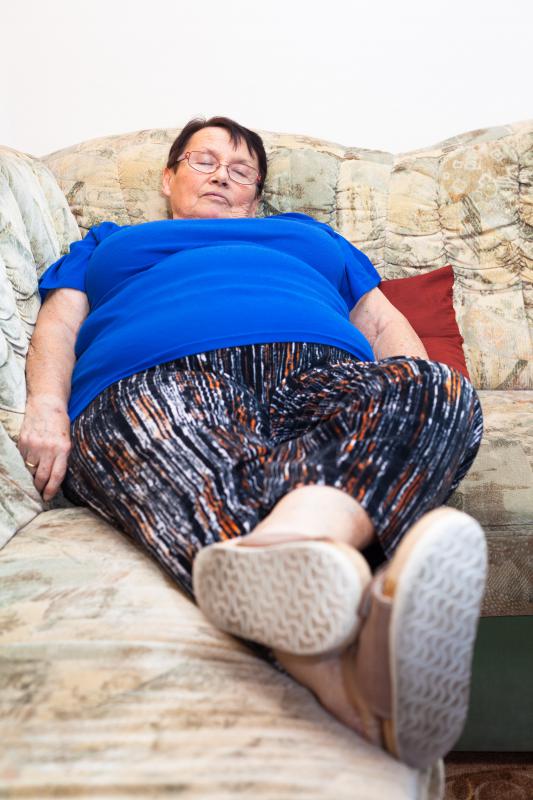
![People who are very overweight can place excessive strain on the liver.]() By: JanMikaPeople who are very overweight can place excessive strain on the liver.
By: JanMikaPeople who are very overweight can place excessive strain on the liver.



Discussion Comments
I was just diagnosed yesterday. Beforehand while I was waiting for a few months to see this doctor (VA healthcare) I was nauseated every day and extremely fatigued. So I started taking black seed oil twice a day (a teaspoon) first thing in the morning and last thing at night.
I'm going to do a liver cleanse here shortly using Braggs Organic Olive Oil (three tablespoons first thing in the morning and last at night) with half a fresh squeezed lemon in it. I know I also need to change my diet, eat out less and cook more at home and lose weight. Guess it's time for me to do the "Great taste no pain" diet again. I was losing about a pound a day the first week. The hard part for me will be the resting even though I'm tired all the time, I live in the country and there's always work to be done. But I do find myself meditating more.
Both of my biological parents had hemochromatosis so I just had a genetic test done to see if I had inherited it as well.
@dal8509: If you drink alcohol, you must stop immediately. Eat light leafy green vegetables and raw vegetables. Lose weight gradually, one or two pounds per weak if you are over weight. Exercise by walking. Avoid stress at all costs. (Even avoid stressful television shows.)
If you are a male, consider taking an exercise supplement called DHEA. This will cause your body to boost testosterone levels and remove mid section fat. Don't take too much of it or you will become irritable. Injections of testosterone will make you feel better, but are illegal. (steroids) This is what has made me better.
My fatty liver steatosis was caused by alcoholism. Consider being tested for all forms of hepatitis. Get a second opinion if at all possible. You must figure out the root cause of your condition and stop it immediately. My cause is alcoholism. Pray for me and I will pray for you. It is reversible with a proper diet.
I was diagnosed with Steatosis a month ago, and I have felt an almost constant nausea since the last week of December. I don't heave health insurance, and have been denied due to my condition. What remedies can I use to treat myself of this condition?
@anon32746- From what I could find, it sounds like there is organ failure throughout the body. The cells are dying too. It is a very slow process, but when it has begun, there is no stopping it. I do not know about seizures; I could not find anything about them.
What happens to someone who dies from steatosis. Do they pass out and the liver shuts down? Does the body seize?
Post your comments