
At TheHealthBoard, we're committed to delivering accurate, trustworthy information. Our expert-authored content is rigorously fact-checked and sourced from credible authorities. Discover how we uphold the highest standards in providing you with reliable knowledge.
What is Scoliosis?
 Michael Pollick
Michael Pollick
Michael Pollick
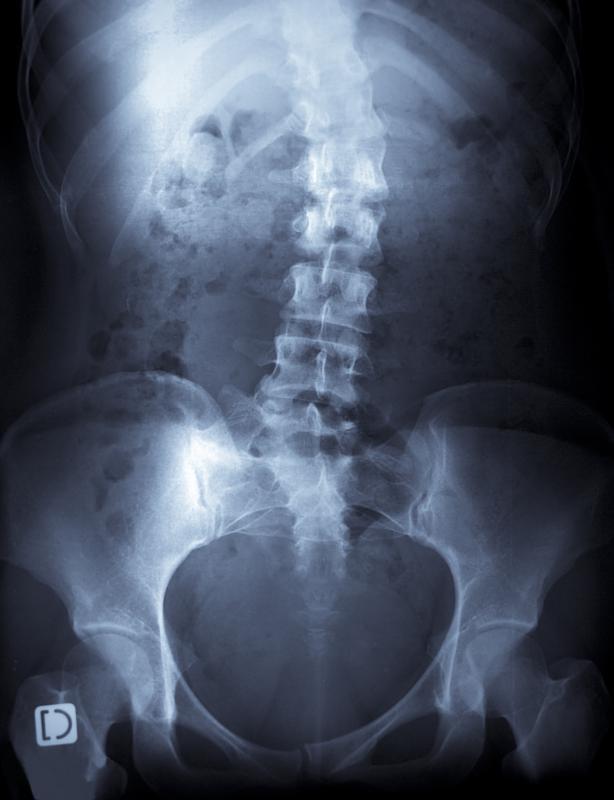
Scoliosis is a deformity of the spine which causes a sideways S- or C-shaped curvature. Many people do not have perfectly straight spines, but medical professionals tend to wait until the curvature is past ten degrees to diagnose scoliosis. A 10° spinal deviation is not easily detectable — it may only appear as a slight droop in one shoulder or a slightly uneven waistline. Some people can have as much as a 30° deviation without noticeable pain. A C-curve is more common than an S-curve. The S shape typically forms as the spine tries to self-correct the original C-shape deviation.
Some reports show that up to 25% of people have scoliosis, but the most severe form only affects about 3%. Most incidents are idiopathic, meaning the cause is unknown. Girls, especially those in the prepubescent growth stage, are much more likely to develop scoliosis than boys. This may be connected to the earlier growth spurts experienced by girls, usually between the ages of 10 and 14. Adult onset of scoliosis is rare. Neuromuscular conditions such as MS or extremely poor posture can lead to a pronounced curvature of the spine.

Most people with scoliosis either outgrow the condition or undergo successful corrective surgery. Treatment may also take the form of a back brace for those patients who are still growing. The brace is meant to encourage a straighter path for the developing spine to follow, but it won't necessarily correct any existing curvature. A common surgical practice for severe cases involves fusing several vertebrae together to correct the patient's posture and prevent further twisting or curving. Chiropractic treatments such as spinal manipulations do not appear to have very high success rates.

Scoliosis may sound more ominous than it actually is. Unless the degree of curvature is very pronounced, many children and adults may never realize anything is out of order. Many schools offer free scoliosis screenings for younger students, usually around the 8th grade, with any positive findings reported directly to parents. A family physician may also be able to test young patients for any lateral deviations in the spine. If the condition is discovered early and corrective action is taken, the effects of scoliosis can be controlled if not cured.
Michael Pollick
A regular TheHealthBoard contributor, Michael enjoys doing research in order to satisfy his wide-ranging curiosity about a variety of arcane topics. Before becoming a professional writer, Michael worked as an English tutor, poet, voice-over artist, and DJ.
Learn more...
Michael Pollick
A regular TheHealthBoard contributor, Michael enjoys doing research in order to satisfy his wide-ranging curiosity about a variety of arcane topics. Before becoming a professional writer, Michael worked as an English tutor, poet, voice-over artist, and DJ.
Learn more...AS FEATURED ON:
AS FEATURED ON:


-
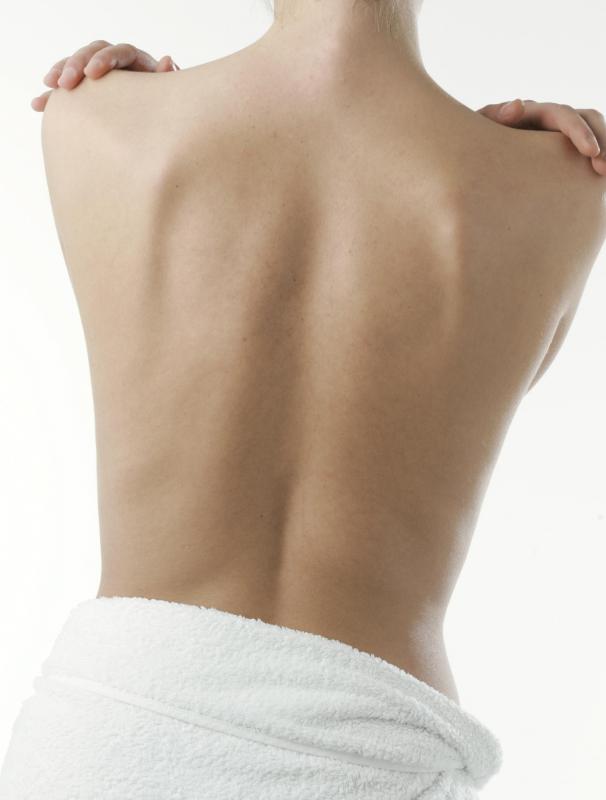
![Up to 25% of people may have scoliosis but most have it to such a slight degree that it may be ignored and poses no significant discomfort or threat to health.]() By: PapirazziUp to 25% of people may have scoliosis but most have it to such a slight degree that it may be ignored and poses no significant discomfort or threat to health.
By: PapirazziUp to 25% of people may have scoliosis but most have it to such a slight degree that it may be ignored and poses no significant discomfort or threat to health. -
![Scoliosis causes curvature of the spine.]() By: laurent dambiesScoliosis causes curvature of the spine.
By: laurent dambiesScoliosis causes curvature of the spine. -
![Unfortunately, chiropractic treatments do not appear to effectively treat scoliosis.]() By: WavebreakMediaMicroUnfortunately, chiropractic treatments do not appear to effectively treat scoliosis.
By: WavebreakMediaMicroUnfortunately, chiropractic treatments do not appear to effectively treat scoliosis. -
![Scoliosis typically develops during adolescence.]() By: maxximmmScoliosis typically develops during adolescence.
By: maxximmmScoliosis typically develops during adolescence. -
![Adult onset of scoliosis is rare.]() By: Syda ProductionsAdult onset of scoliosis is rare.
By: Syda ProductionsAdult onset of scoliosis is rare.


Discussion Comments
I am in my mid 50's also with a s curve of 36 and 49. I am male and developed spinal meningitis at age 10 or 11.
I am 31 and I have scoliosis. My curve is a C and 14 percent. I just recently found out that my Mom had scoliosis and she did not know until she became pregnant. She had spinal meningitis as a child around age 7 or 8. I wonder if there is a link between the two. She has since passed away so I cannot ask her questions about hers, but I am curious to learn more.
My daughter was in the NICU for three weeks with meningitis, very scary. She is now two years old and I noticed a few weeks ago that her spine is starting to have a C curve to it. I would really like to know if there is a link between the two. If so i would have liked to have known that so i could have been aware.
My son has congenital scoliosis and my question is, is there going to be long term effects or will he have to have surgery on his back in the future? He is two months old and i have never heard of it until now.
my son also has congenital scoliosis. Will he have to have surgery at some point or is it a possibility that he will be OK?
I have scoliosis and know two others with it and between the three of us there is no link to spinal meningitis. So, I don't know that there is a connection between the two diagnoses. I've never heard of one before. I've been told by specialists in scoliosis that it's genetic.
My older sister had spinal meningitis when she was 2 years old and has scoliosis. My daughter had spinal meningitis when she was 7 days old and she has scoliosis. Do you think Scoliosis is related to Spinal Meningitis? I do.
I have had scoliosis, curvature of the spine since I was quite young, I am now in my mid 50's and have asked before how this could have started but no one seems able to answer me. I was just wondering, when my mother was young,(13) she developed spinal meningitis and was extremely lucky to survive. Could this have anything to do with my scoliosis?
Post your comments