
At DelightedCooking, we're committed to delivering accurate, trustworthy information. Our expert-authored content is rigorously fact-checked and sourced from credible authorities. Discover how we uphold the highest standards in providing you with reliable knowledge.
What is Sauerkraut?
 Mary McMahon
Mary McMahon
Mary McMahon
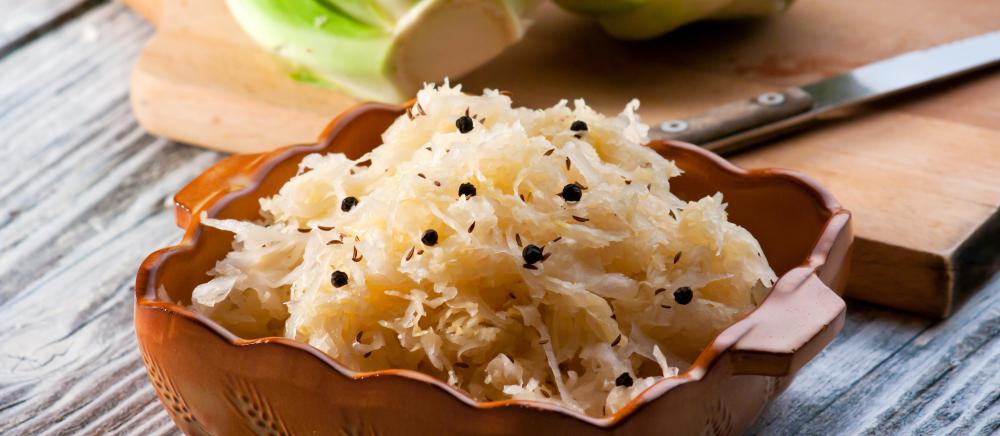
Sauerkraut is a fermented cabbage dish that is often closely associated with Germany, Alsace, and the Netherlands, although China and Korea also make their own versions. When made well, it has a characteristically tangy, zesty flavor that some consumers find quite enjoyable. It is often used as a garnish, especially with meats like sausage, and it can also be added to salads, sandwiches, and other foods. Most markets carry sauerkraut, and it can also be made at home relatively easily.
There are only two ingredients in traditional sauerkraut: shredded cabbage and salt. The cabbage is tossed with large amounts of salt and then tightly packed into a crock or airtight jar. The salty conditions promote beneficial acid forming bacteria, which convert the natural sugars in the cabbage into lactic and acetic acid, which will preserve the cabbage and give it a tang. If made in a traditional crock, the mixture must periodically be skimmed to remove natural scum; once cured, the dish can be canned and kept for up to several years.

Many cooks also add other ingredients to their sauerkraut, like juniper, bay leaves, or garlic. These spices add flavor to the finished dish without interfering with the curing process. In China and Korea, soured cabbage is often heavily spiced; the formidable Korean kimchi, for example, is used to add a kick to many Korean dishes. Despite containing only cabbage and salt, sauerkraut is a great addition to the diet; many early sailors realized that it could help to prevent scurvy, for example.

Cooks who want to try their hand at making sauerkraut should start small, with 5 pounds (2.25 kilograms) of cabbage. They should shred or finely chop the cabbage and toss it with 3 tablespoons (54 g) of salt. The cabbage and salt should be tightly packed into stoneware crocks or glass jars, and the jars covered with clean cloths, plates, and a weight such as a brick or a rock. Every day, the cook should open the crocks to remove the natural scum that will form on the top, and then replace the cloth with a fresh one. After around 10 days to two weeks, the cabbage will have finished curing, and it can be canned for storage.

After a cook has perfected the basic recipe, he can play around with added ingredients and spices, and larger batches. He should keep the ratio of salt to cabbage the same, and make sure to store it in a cool, dry place while it cures to prevent the budding of yeasts and harmful bacteria that could ruin the dish.
Mary McMahon
Ever since she began contributing to the site several years ago, Mary has embraced the exciting challenge of being a DelightedCooking researcher and writer. Mary has a liberal arts degree from Goddard College and spends her free time reading, cooking, and exploring the great outdoors.
Learn more...
Mary McMahon
Ever since she began contributing to the site several years ago, Mary has embraced the exciting challenge of being a DelightedCooking researcher and writer. Mary has a liberal arts degree from Goddard College and spends her free time reading, cooking, and exploring the great outdoors.
Learn more...AS FEATURED ON:
AS FEATURED ON:


-
![Sauerkraut is made with cabbage and salt and is often used as a garnish.]() By: Dani VincekSauerkraut is made with cabbage and salt and is often used as a garnish.
By: Dani VincekSauerkraut is made with cabbage and salt and is often used as a garnish. -
![Sandwiches often feature sauerkraut.]() By: karandaevSandwiches often feature sauerkraut.
By: karandaevSandwiches often feature sauerkraut. -
![Garlic, which is often used in making sauerkraut.]() By: NatikaGarlic, which is often used in making sauerkraut.
By: NatikaGarlic, which is often used in making sauerkraut. -
![Salt, which is used in making sauerkraut.]() By: Jiri HeraSalt, which is used in making sauerkraut.
By: Jiri HeraSalt, which is used in making sauerkraut. -
![Sauerkraut is often featured with bratwursts.]() By: Brent HofackerSauerkraut is often featured with bratwursts.
By: Brent HofackerSauerkraut is often featured with bratwursts. -
![Sauerkraut is a fermented cabbage dish that is often associated with Germany and the Netherlands.]() By: SasajoSauerkraut is a fermented cabbage dish that is often associated with Germany and the Netherlands.
By: SasajoSauerkraut is a fermented cabbage dish that is often associated with Germany and the Netherlands.



Discussion Comments
@LindaG: Taste your kraut to see if it is turning sour. You may not see bubbles, depending on the speed of fermentation, but it's highly likely the kraut is fermenting. Judge when it is done by how sour it is. Once it is to your taste, refrigerate it to slow down the fermentation so it doesn't become too sour.
Anon, virtually all commercial sauerkraut is just cabbage and vinegar. It is sour, which can be good for you, but it isn't alive and doesn't have the beneficial fermentation byproducts - or the amazing flavor. Use good cabbage from a local farmer for maximum taste.
I make it myself in in rather large quantities in a large ceramic pot. Very easy, dirt cheap and very healthy. Eat with boiled potatoes and a smoked sausage.
I like sauerkraut but the only dish I know how to make with it is a Reuben sandwich and a modified T.O.A. both of which I can't eat because they are disgusting! Rubens: I can't stand Rye bread, T.O.A.: Make one for yourself and you'll understand. What's a T.O.A. you ask? Step one: get a decent sized pan, step two: Collect the following ingredients: Tomato puree, tomato Joice, two onions, Anchovies, and vinegar, and the you have the option of adding black olives,lemon juice, sauerkraut, or assorted pickled foods but the original T.O.A. only has the first five ingredients. Anyway empty the can of tomato puree and about half a cup of tomato juice into the dish then cut the onions into rings and add them to the dish, open the can of anchovies and then add about three teaspoons (table spoons?) of vinegar and allow cover the dish. Allow it to cool and mildly pickle in the fridge for a day or two and then eat it raw, use it as a dip, or topping, but you're better off avoiding this dish. Oh and by the way like all dishes seasoning is totally optional, my grandad, inventor of the T.O.A. (as far as I know), used to like his spicy if I remember right.
My quart has been in the crock for 10 days at temp of 60-65.It is showing no bubbles or foam?
Does sauerkraut in a can, bought in a store, provide the benefits of fermented cabbage...the lactic acid, etc. ???
Post your comments