
At TheHealthBoard, we're committed to delivering accurate, trustworthy information. Our expert-authored content is rigorously fact-checked and sourced from credible authorities. Discover how we uphold the highest standards in providing you with reliable knowledge.
What is Saline Solution?
Saline solution is a mixture of sodium chloride, or salt, and sterile water. It is available in several concentrations, but the most common one is 0.9% sodium chloride in water. It's typically used for medical purposes, and is found in intravenous (IV) drips, contact lens solution, and nasal irrigation sprays. In addition to this, it's often used in chemistry experiments.
Medical Uses

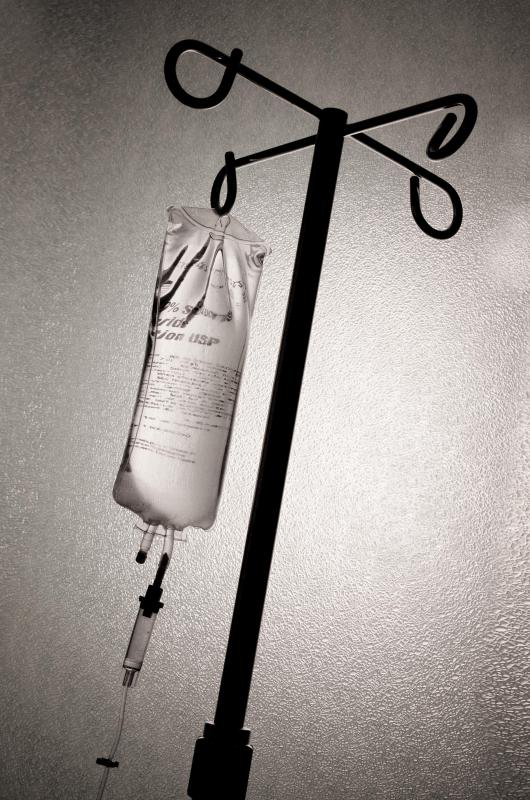
There are a wide variety of medical uses for saline solution, ranging from rehydration to wound care. One of the most common uses is in IV drips for those who are dehydrated from severe vomiting or diarrhea or are unable to eat. In these situations, the fluid is typically mixed with sugars like dextrose or glucose. This helps prevent complications and also helps reduce the amount of sodium circulating through the patient's body. Otherwise, side effects from too much sodium — such as an increased heart rate or convulsions — could occur.

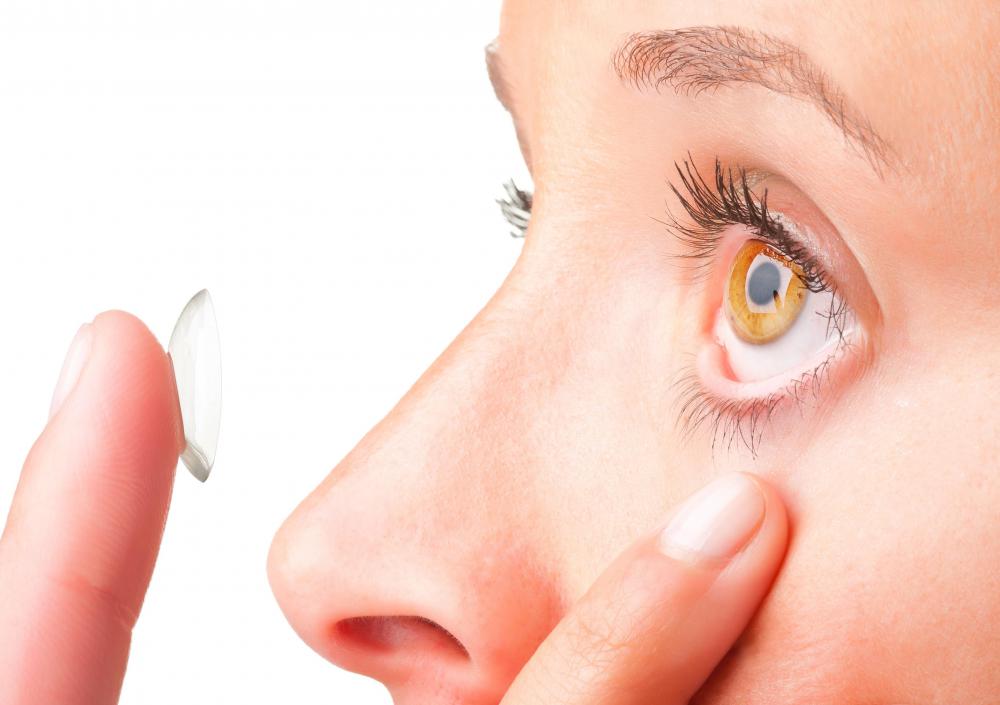
Other medical purposes for saline solution include rinsing and safe storage of contact lenses, as well as nasal irrigation and wound care. Solutions for rinsing and storing contact lenses may sometimes contain other chemicals to keep the product sterile, so they should not be used for other purposes.
As a nasal irrigation, saline helps to safely rinse out the inside of the nose and promote nasal health. People who suffer from chronic sinus problems, including congestion and irritation in the nose, can benefit from periodic nasal irrigation because it helps clear mucus, congestion, pollen and dander, and can reduce post nasal-drip that may irritate the throat. In addition to washing out the nasal passages, saline solution can be used to clean out wounds, though it is not as effective in wounds with decaying tissue as other materials.
Other Uses

Besides its medical uses, saline solution is also used in chemistry experiments, where it can serve as a buffer or be used to maintain the pH of a solution or cell culture. In this context, the mixture often contains other ingredients, like potassium, calcium, or magnesium. It can be made on-site by putting salt tablets into purified water, but is also available pre-made.
Side Effects

Saline solution is generally considered safe as long as it is made and used properly. Most people don't have any side effects when using it for eye or nasal irritation, though injections of it can cause soreness and redness at the injection site. Rarely, it can cause a serious allergic reaction, so anyone having chest tightness, redness, hives, difficulty breathing, or swelling in the mouth should seek immediate medical attention. Additionally, some people have experienced infections when using homemade saline solution, but this generally happens when it is made with tap water or is not properly purified. Those with very high blood pressure or kidney problems should generally not have saline IVs or injections, since it expands blood vessels and can cause edema.
Homemade Solution

An at-home saline solution can be made by combining 0.5 teaspoon (4.5 g) of non-iodized salt with 1 cup (500 ml) of purified water and allowing it to reach room temperature, covered. At home mixtures should never be used for anything other than nasal irrigation. People who are not sure how to safely rinse their nasal passages should ask for directions from a medical professional or pharmacist.
AS FEATURED ON:
AS FEATURED ON:


-
![Hanging IV bag of saline solution.]() By: mario beauregardHanging IV bag of saline solution.
By: mario beauregardHanging IV bag of saline solution. -
![A saline solution may be given to those who are dehydrated from severe vomiting.]() By: jedi-masterA saline solution may be given to those who are dehydrated from severe vomiting.
By: jedi-masterA saline solution may be given to those who are dehydrated from severe vomiting. -
![If a patient experiences hives from a saline solution, a doctor should be notified.]() By: Jürgen FälchleIf a patient experiences hives from a saline solution, a doctor should be notified.
By: Jürgen FälchleIf a patient experiences hives from a saline solution, a doctor should be notified. -
![Many people store contact lenses in a saline solution.]() By: ruigsantosMany people store contact lenses in a saline solution.
By: ruigsantosMany people store contact lenses in a saline solution. -
![Saline solutions can be found in nasal irrigation sprays.]() By: Ken HurstSaline solutions can be found in nasal irrigation sprays.
By: Ken HurstSaline solutions can be found in nasal irrigation sprays. -
![A saline solution can be used to rinse out the mouth and lessen the pain from a dental injury.]() By: MediablitzImagesA saline solution can be used to rinse out the mouth and lessen the pain from a dental injury.
By: MediablitzImagesA saline solution can be used to rinse out the mouth and lessen the pain from a dental injury. -
![Salines solutions are made by combining salt and sterile water.]() By: Meliha GojakSalines solutions are made by combining salt and sterile water.
By: Meliha GojakSalines solutions are made by combining salt and sterile water. -
![Many contact lens solutions and rinses contain saline solution.]() By: chrisdorneyMany contact lens solutions and rinses contain saline solution.
By: chrisdorneyMany contact lens solutions and rinses contain saline solution.




Discussion Comments
Is it safe to take saline solution internally?
That those with very high blood pressure or kidney problems should generally not have saline IVs or injections is the general belief held by most of the medical profession. But I think that the actual treatments that doctors use for high blood pressure disprove this point.
For example, ACE inhibitors are prescribed to relax or open the arteries to allow blood to be pumped through easier. If the cardiovascular system (which includes the arteries) is so full of salt and water, why would there be a need for medication to open them even further?
Also commonly prescribed are blood thinners. With blood being 94 percent water to begin with, and with all of this increased water, what are blood thinners supposed to do? (Note: there is a medical debate on what blood thinners actually do. Some say that they thin the blood – as the name implies, and some say they’re an anticoagulant (an obvious attempt to define an alternative category). But it’s the same thing.
The one that really has everyone perplexed is diuretics. If the “too
much water in the vessels” theory is wrong, then how do diuretics
lower the blood pressure, and where does the expelled water come from?
Error in the recipe for home-made isotonic solution: It takes a pint (500 ml), not a cup (about 250 ml), to dilute 4.5 g to isotonic.
What will happen to the body if the concentration of sodium chloride which is 0.9 percent in a normal saline increased, and what will happen if it was decreased?
An isotonic saline solution contains 0.85%w/v NaCl.How many grams of NaCl are needed to prepare 5L of solution?
Is it a good thing to inject saline under your skin on your forehead, and then use your thumb to make an indentation in the middle?
@Elsie: Too much saline causes water retention, and hence, temporary high blood pressure as well.
This is caused by a sodium/potassium imbalance. Potassium chloride will reverse the affect.
I've experimented and caused this same thing to happen, by ingesting a tablespoon of salt in saline. I gained five pounds in one day, and lost it the next.
I re-ran the same experiment with Morton's Lite Salt (NaCl/KCl mix). I used a full tablespoon and had zero weight gain. It's a healthier salt, and most people do not eat the recommended amount of potassium through diet.
Salt isn't bad for you. Your whole body consists of salt. You just can't consume too much. If you don't have salt, however, it is bad for you. Just like anything else, too much is a bad thing.
Funny how salt is bad for you, but if you go to the hospital the first thing they do is hook you up to a salt water drip. Science is so contradictory.
I checked with an experienced pharmacist on the correct ratio/proportions necessary to make a nasal saline 0.9 percent isotonic* solution. Use 250 ml (1 cup) of distilled water (or purified by boiling 5 min then cooled). To this, add 1/3 or 2.25 grams of non-iodized canning or pickling salt.
Note: some sites say anywhere from 1/4 to 1 tsp. The correct proportion to achieve 0.9 percent is exactly 1/3 teaspoon.
Store in a sealed/covered container for up to 5 days. Use the solution as close to body temperature as possible for better absorption.
*Isotonic means "same as body" saline levels.
Can a saline solution (drip) be given orally? Will it have the same hydrating effects?
is saline solution really better than tap water concerning wound irrigation to decrease wound infection?
can i mix my own salt/water and use on track for irrigation of the cannula?
If saline is just water/salt and helps reduce mucus and sugar increases it, would it be safe to say that one could give salt water in feeding tube to help clear up mucus or any foods that contain salt?
in this operation (transurethral prostatectomy) why does the doctor often use sorbitol, not use NaCl?
i am doing a speech on tracheostomies and you use the solution to clean around the trach. what is the reason for that?
Using a 15 percent glucose in an I.V. solution instead of 5 percent glucose would not be safe. Explain why this happens.
Does NSS affect the activity of microorganisms?
can you put saline in your eyes to clear bacteria cause by conjunctivitis?
Can you swab your nostrils with saline to prevent the flu?
Is there a normal saline solution without dextrose for diabetic patients who require an iv drip??
what is the range of PH for saline solution?
i want to use saline solution to clean my hair after a shower (due to hard water). what do you guys think?
i am doing a science experiment on saline solution.
can you use it to clean ear piercings?
To lose the water weight maybe you could take a diuretic, they're supposed to get rid of water weight. anon39610, almost everyone has had saline at some time, we're okay, relax.
don't even think about taking saline. it is proven to cause bone cancer through the molecule sodium chloride. it's another form the secret government uses to poison you
what happens when you directly ingest normal saline solution? like drinking about 60 ml of NSS by accident?
Can somebody or an expert explain if injecting a normal saline solution with 2 vials of 5x5 ml ampoules of iron has a side effect on knee joints that can cause an early or sudden osteoarthritis? That is what I am having right now, why so suddenly or abruptly I developed this OA and I just received 3x of IV with iron and I need 4 more days of iron with IV fluid. Thanks
Cut salt out of your diet completely. Read the labels on your food products. Sodium retains water. Once your body is balanced, make sure to use iodized salt in your diet to prevent thyroid disease.
When I was in hospital with septicemia, they had me on a saline drip for 3 days, I gained 8 pounds, and I looked like I was 3 months pregnant, my belly was swelled up. what will help me get rid of all this water weight?
When I was in hospital with septicemia, they had me on a saline drip for 6 days, I gained 15 pounds, and I looked like I was 6 months pregnant, my whole body was swelled up. After I got out of hospital i lost about 5 pounds in a few days, but now I can not seem to get rid of the other 10 pounds, what would help me get rid of all this water weight?
what will happen to the patient if excessive amounts of intravenous dextrose solution have been given accidentally?
Post your comments