
At DelightedCooking, we're committed to delivering accurate, trustworthy information. Our expert-authored content is rigorously fact-checked and sourced from credible authorities. Discover how we uphold the highest standards in providing you with reliable knowledge.
What is Sake?
The word sake in Japanese can refer to any alcoholic beverage, but in general, it is used in English to mean a specific type of rice alcohol, also known as nihonshu. It is sometimes called rice wine, but in truth, it is not a wine, nor is it exactly a beer, nor a spirit. Sake is a rather unique type of fermented alcohol.
To begin the fermentation process, rice is milled down until mostly only starch remains. At this point, the starch is fermented to turn into sugar, then further fermented so that the sugars transform into alcohol. This is somewhat similar to the production of beer, but unlike beer brewing, the starch breakdown is not caused by enzymes from the malt, but rather from a special mold.

After fermentation, sake is naturally cloudy from bits of particulate left from the grains. Some, such as nigori, is allowed to remain clouded, but the majority is filtered so that it is clear like a spirit. Sake is best enjoyed while fresh, so unlike wine and more like beer, it is rarely aged. Sake is fairly high in alcohol for a fermented drink, ranging from 14% to 16% alcohol — as compared to 8% to 14% for most wines, or 4% to 6% for most beers. When produced, sake usually contains around 20% alcohol, but most producers add water to dilute the drink to a more palatable 15%.

The original history of sake is not known. Some theories trace it back to mainland China nearly 7,000 years ago, while others place it in Japan sometime in the third century CE. By the seventh century, sake development had reached a fairly high point of sophistication, using a number of techniques borrowed from China. Production continued to improve for the next 500 years, with a number of new techniques and simplifications of older techniques being introduced.

During World War II, the sake industry was dealt a rather vicious blow, as rice, necessary for the war effort, became a critical commodity; as a result of this great need, many producers began adding straight alcohol and sugar to their sake, reducing the quality in a process that continues in some varieties to this day. By the 1960s, however, sake was on the rebound, and by the 1990s, it had reached levels of quality unseen in its long history. Today, many breweries have returned to more classic methods of production, and sake is exported in enormous quantities — even while its popularity in Japan diminishes.
AS FEATURED ON:
AS FEATURED ON:


-
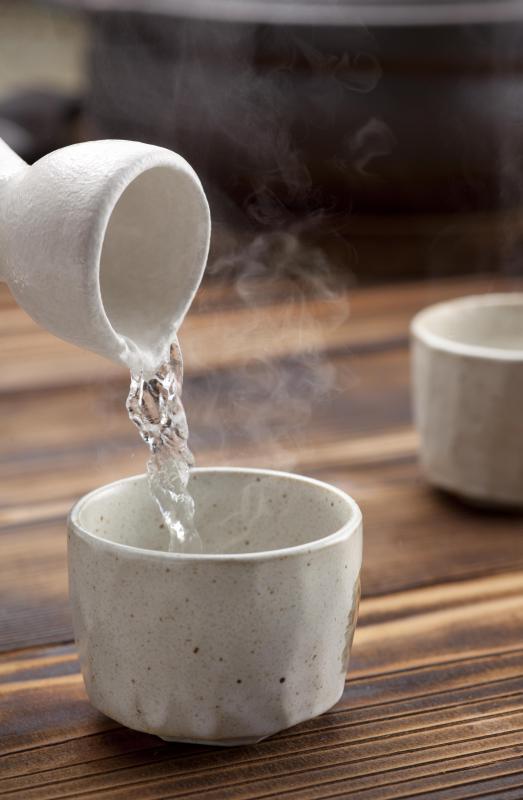
![Sake is made from fermented rice.]() By: womueSake is made from fermented rice.
By: womueSake is made from fermented rice. -
![Filtered sake is clear in color.]() By: BRADFiltered sake is clear in color.
By: BRADFiltered sake is clear in color. -
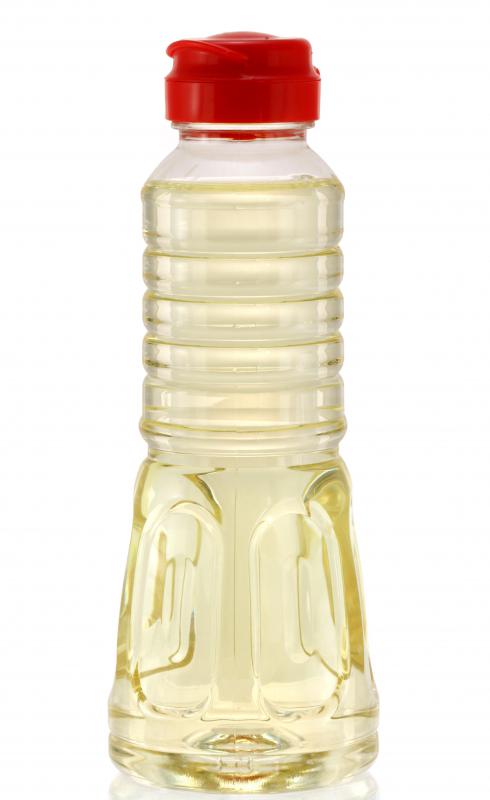
![Mirin is a type of sweetened Japanese rice wine, or sake, used for cooking.]() By: sassyphotosMirin is a type of sweetened Japanese rice wine, or sake, used for cooking.
By: sassyphotosMirin is a type of sweetened Japanese rice wine, or sake, used for cooking.

Discussion Comments
@fiorite- I am not up on my sake reviews, so I cannot recommend any one in particular, but I know you can buy tasty infused sakes that are reasonably priced. This will allow you to send more money for the relief effort. These infused sakes are very flavorful, and are often a big hit with the ladies (I used to work at a sushi bar).
For the guys, I would go with Japanese beers and sake bombers. These types of drinks are less sweet, and a little stronger, usually appealing to those who like a stronger taste.
@Fiorite- My wife and I go to this great sushi bar near our house, and she always orders the same sake drink every time. The drink is called a Harajuku Lover, and it is a combination of Grey Goose Pear and a sparkling sake. The drink comes in a champagne glass and has a slice of perfectly ripe pear in it. I have to say that I am not one for sweet cocktails, but I have tried a sip of hers before, and it is good...nice and strong.
I suppose you could use any vodka for the drink, but the pear flavor really sets it off. I bet my wife would like the drink just as much if it had a raspberry or cherry vodka in it.
Would one only drink sake straight up or is it good in mixed drinks? Do you need special sake cups when you are serving the drinks?
I am having a party for the Japan relief effort and I need to think of some good sake drinks. I am charging everyone money at the door and we are taking all of the funds and sending it to the Red Cross to help tsunami victims. We will be serving sushi (catered of course...I can barely make a sandwich let alone sushi) and different Japanese drinks. I would appreciate any suggestions.
Post your comments