
At TheHealthBoard, we're committed to delivering accurate, trustworthy information. Our expert-authored content is rigorously fact-checked and sourced from credible authorities. Discover how we uphold the highest standards in providing you with reliable knowledge.
What Is Reduced Fat?
In the world of foods and beverages, the term “reduced fat” typically indicates that a particular product has a lower overall fat content than it naturally would, or than would be found in the original version. There are a number of techniques manufacturers use to remove fat, and there are different standards in different places when it comes to how much actually has to be removed in order to qualify for a “reduced” designation. Laws around the world vary somewhat when it comes to precise definitions, but in the United States, a reduced fat product must have at least 25% less fat than the original. It is important to remember, however, that this does not mean that it is necessarily a low fat product, and it may not actually be healthier than the full-fat version, either. Producers often add in other ingredients, particularly salt, to improve taste despite lowered fat, and this can skew the nutritional profile. People who are concerned about their fat intake or their overall nutrition are usually encouraged to read labels very carefully and strive for a diet that is balanced and complete and naturally low in fats.
Fat Reduction Process

Fat is a part of many different foods, particularly those derived from animals. It usually occurs naturally, but is at times added, as is often the case with processed foods, usually as a means of improving flavor or taste. Naturally-occurring fats are typically removed through separation. In milk, for instance, the raw fluid is agitated such that fat globules bind together and float to the top, where some or all of them can be removed fairly easily. Processors can manually remove fat from cuts of meat, or may also treat prepared meat with a chemical solution or wash that can dissolve the fat off.
In the case of processed fats, reducing the overall count is often a matter of adding fewer fatty ingredients from the beginning. Substituting lower fat alternatives is another approach.
Overall Nutrition

Stating that a product is reduced fat can be confusing on many levels. The problem is that some products that have had their fat levels reduced indeed a much better choice, and some are clearly not; the only way to find this out is to read the labels carefully and compare the ingredients. In many cases, the lower fat content will be replaced with another unhealthy ingredient, such as higher amounts of sugar.
Potentially Unexpected Additives
Sugar and salt are two of the most common ingredients that are added back into the recipe to make a fat-reduced product taste better. In many cases, sugars that are added can lower the reported fat actually contained in the food or beverage while actually causing the product to generate more fat once ingested. Added sugar turns into fat in the body, and thus the fat reduction has not benefited the consumer.
Salt isn’t usually much better. Foods high in sodium can lead to higher blood pressure, and may cause bloating and water retention; over long periods of time, this can cause arterial and even heart problems. Eating salty food can also be an issue for the simple reason that the palate becomes used to the taste, and this often leads people to eat even more foods that are high in sodium.
Importance of a Balanced Diet
There are, of course, a number of reduced fat products that are healthy, and these foods usually contain more fiber and less sugar. The only way to find out is to compare the labels and pay attention to the ingredients that have been altered or replaced. If the product that claims less fat has more fiber, less sugar, less fat, and less sodium than the original version, it is generally a much better choice than the original. There is a demand from consumers in most parts of the world for healthier, low-fat foods, so is important for the consumer to be aware of what the term means and how it can be of aid in planning a health diet.
It’s also important for people striving for a diet low in fats to be sure to eat a variety of different foods. A balance of fruits, vegetables, and grains can naturally lead to lowered fat consumption, and can ensure that the fats taken in are good and helpful fats. Not all fats are equal; some, like unsaturated fats and omega-3 fatty acids, are generally considered healthy, but others, particularly trans fats, can be quite harmful.
AS FEATURED ON:
AS FEATURED ON:


-
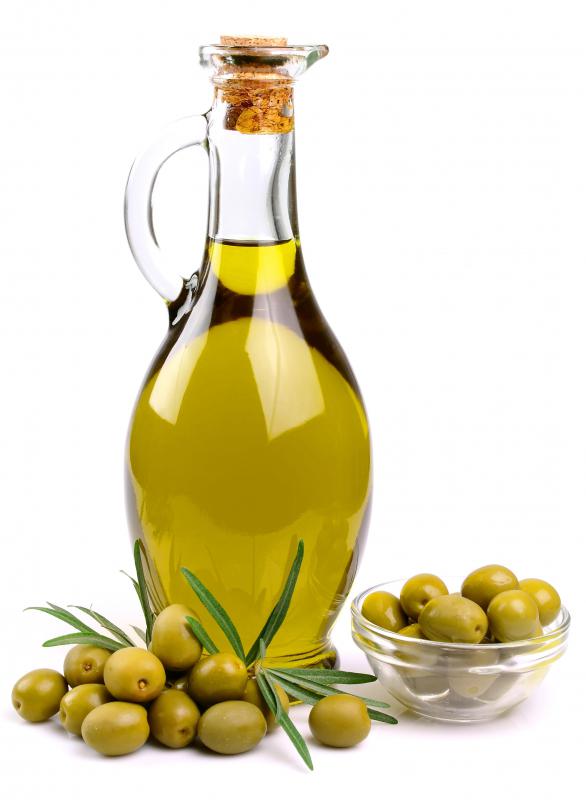
![When you do consume fat, opt for a monounsaturated one like heart-friendly olive oil.]() By: margo555When you do consume fat, opt for a monounsaturated one like heart-friendly olive oil.
By: margo555When you do consume fat, opt for a monounsaturated one like heart-friendly olive oil. -
![Comparing ingredients on reduced fat and full fat products can help consumers make the best choice.]() By: KadmyComparing ingredients on reduced fat and full fat products can help consumers make the best choice.
By: KadmyComparing ingredients on reduced fat and full fat products can help consumers make the best choice.

Discussion Comments
@Crispety - You know you are right. I have also noticed that foods that are labeled fat free have either a higher salt content or sugar content to make the food taste better.
I have tried fat free cookies that really tasted good but had a lot more sugar than I wanted. I think that I might be better off eating the regular cookies but just have them once in a while.
I have also looked at sugar free cookies but they have more fat added to them which is how they get them to taste so good. I think you really have to look at the labels and see what you are getting.
@SurfNturf - I agree with you on the portion sizes, but not all reduced fat products taste good. For example, I have never been able to find a reduced fat cream cheese that tastes good.
They all taste really bland. I think that some foods should be consumed as they are with no fat removed. I think that if the food doesn’t taste right it doesn’t matter that it is reduced fat because you are not going to eat it.
I always like to buy the reduced fat ice cream. It tastes almost as good as the regular ice cream but does not have all of the calories and fat. The only problem that I have is that I tend to eat more than I should and since it is reduced fat I feel that I can get away with it.
I think that that is the only pitfall. If you are eating foods that have a reduced fat label you should stick with the normal portion size so that you don’t eat too much. I am glad that manufacturers are altering the food to make it healthier for us.
Post your comments