
At HomeQuestionsAnswered, we're committed to delivering accurate, trustworthy information. Our expert-authored content is rigorously fact-checked and sourced from credible authorities. Discover how we uphold the highest standards in providing you with reliable knowledge.
What is Radiator Bleeding?
Radiator bleeding eliminates air that has accidentally gotten into the radiator's coils. All hot water radiators must be bled on a regular basis, as the heating and cooling of water naturally releases air bubbles which remain in the coils. This air is not dangerous, but if it's not released, the radiator may not work as well as it should; it may heat unevenly or not at all. The bleeding process is relatively simple, although it can be a little messy.
How a Radiator Works

A hot water radiator works by circulating heated water in a series of metal coils or fins. As the hot water moves through fins, they heat up and warm the air that surrounds the radiator. The act of heating and cooling water within the radiator creates air inside the fins, and that air rises to the top of the fins, displacing some of the water. Since air doesn't conduct heat nearly as efficiently as water, the radiator cannot function as effectively, making it both costly and wasteful to run one with air trapped inside.
How to Bleed a Radiator

The procedure for radiator bleeding is relatively simple. Before it is done, the boiler should be turned off for safety reasons. Even if the boiler is off, the water inside may still be dangerously hot, so radiator bleeding should be performed with caution. An old rag or a small bowl should be placed under the valve to prevent water dripping on the floor.

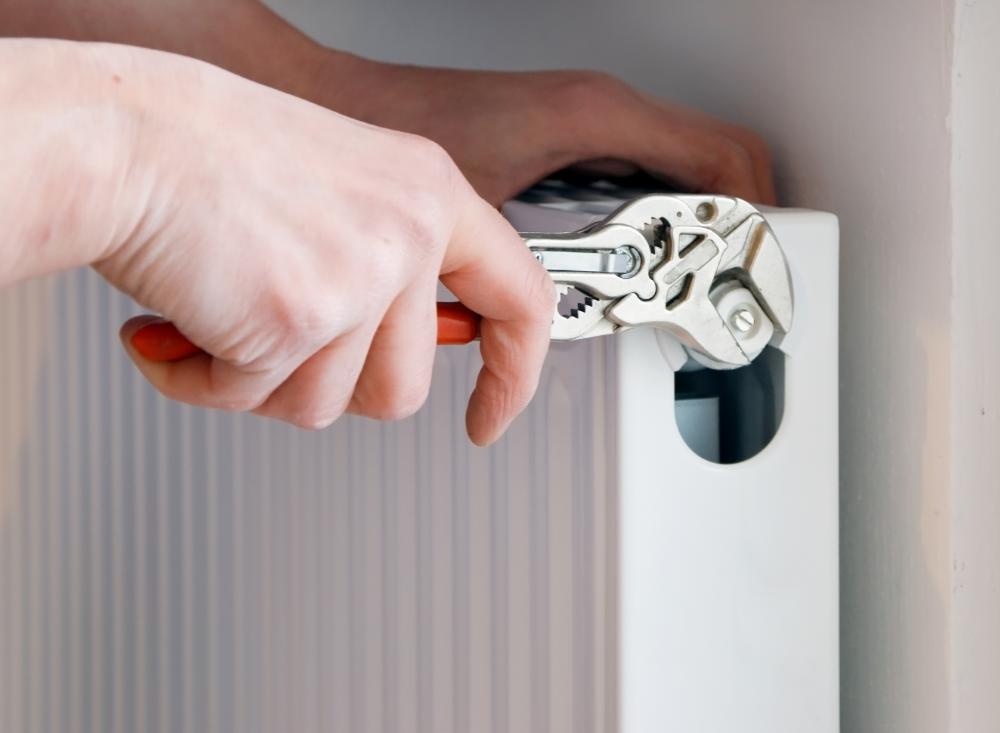
Most radiators come with a notched fork, called a bleed key; others require the use of a flathead screwdriver or crescent wrench. There should also be a protrusion near the top of the radiator on one side, called the bleed valve. The bleed key, screwdriver, or wrench is fitted into the bleed valve and carefully turned counterclockwise slightly, usually just a 1/4 or 1/2 turn. The trapped air will start escaping with a hissing sound. When the water begins to dribble out, that's a sign that all the air has been purged out of the radiator. The bleed valve can therefore be gently tightened again.
If the bleed key is missing and the system does not accommodate a screwdriver, it may be possible to buy a new key at a hardware or or other do-it-yourself store. If a key is not available, a wrench can also usually be used to loosen the cap or screw at the end of the radiator.
Although only one radiator may be having problems, it's a good idea to bleed all radiators in a heating system at the same time. Bleeding one radiator does not remove all of the air from the system, so this can prevent other heaters from developing problems that will require the entire process to be repeated. Once the entire system has been bled, the boiler should be turned on again and the radiators should be checked after several hours to make sure they are heating correctly.
As air is released during radiator bleeding, the pressure in the system will drop. The water level may need to be adjusted through the fill valve on the boiler to increase the pressure to the level required to move the water through the system. If multiple radiators need to be bled, it may be necessary to adjust the water level between bleedings to keep the pressure high enough to force the air out. Homeowners who are not sure how much pressure their heating system needs or how to adjust it should contact a professional for assistance.
How Often Should Radiators Be Bled?
Experts on home maintenance and energy efficiency recommend that radiators be bled at least twice a year. If the radiator is used daily or must be refilled with water, it can be beneficial to bleed it more often. One that is heating unevenly — which is significantly hotter at the bottom than at the top — should be bled promptly so that the system works at its best.
If Bleeding Doesn't Solve the Problem
In some cases, it may be necessary to bleed a heating system several times before all the air is pushed out, especially if the pressure in the system has dropped. If a radiator is still not heating correctly several hours after the water level has been adjusted and the boiler has been turned back on, repeating the bleeding process may be necessary. Other problems can cause poor radiator performance, however, so if no air escapes during the second bleed, it may be necessary to call in a professional. A professional radiator inspector can determine whether sludge in the water is gumming up its circulation or if a mechanical component needs replacing.
AS FEATURED ON:
AS FEATURED ON:


-
![Working on a radiator.]()
Working on a radiator. -
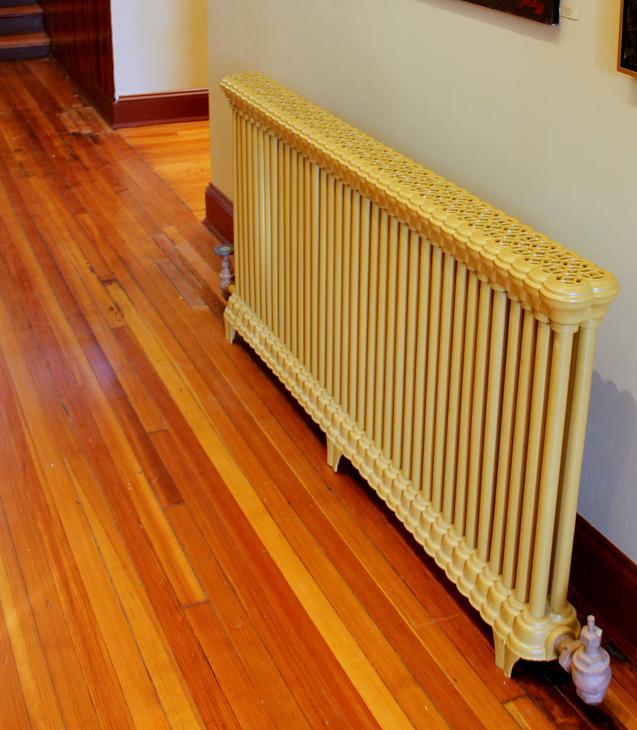
![Radiator in a hallway.]() By: John MRadiator in a hallway.
By: John MRadiator in a hallway. -
![Repairing a radiator sometimes requires a flathead screwdriver.]() By: micahbowerbankRepairing a radiator sometimes requires a flathead screwdriver.
By: micahbowerbankRepairing a radiator sometimes requires a flathead screwdriver.

Discussion Comments
I have an oil condensing boiler and a pressurised system. Every three months or so the gauge drops to zero pressure. I bring it up to 1 bar, bleed the radiators and all is well for another three months.
Last week when I turned on the system, I got a rotten smell like gas coming through the floor boards. This only happens when I turn on the boiler. There is no visible sign of any leak. Any ideas?
Our radiator is only getting hot on the first half, then it slowly gets cooler and cooler towards the end. This is the case on the top half and bottom half. It is warmest towards the front where the steam is coming in. We have seven radiators, all on the main floor, and it is just this one that we are having problems with. Any ideas?
Can you help please? I have fitted a new radiator. The flow in is coming in and getting hot, but the flow out is not getting hot. All the valves are open,and the radiator gets hot at the top first. Please advise.
Please help! We bled all of our radiators but are still terrorized by a constant banging and screeching noise. We can't sleep with the noise, but are afraid to shut the radiators off because it's too cold and our pipes might freeze.
You can use a knife or screw to bleed your radiator if you don't have a key.
Radiator keys:
I'd found them in 2 places:
1. Poundland. Within "Plumbing Accessory Kit". £1.00 Manufacturer - Tool Box, PO Box 13657, Birmingham B2 2FQ.
2. Select and Save. "Clock Type Radiator Key. 2-pack" £1.09 Made by Am-Tech. Professional Quality Tools. Stock Code C3125.
In bleeding my radiator I actually let the water out (quite a lot) instead of steam, i.e., I got the instructions wrong. Will my radiator fill up with water again? Would be grateful for advice. Thanks.
--zrzs
pliers will not fit in to turn bleed valve. no space to get in.
my bleed valve has become rounded and the bleed key will not fit. how do i turn the bleed valve?
If air hisses out or even if there is silence, but no water follows, then it is because your header tank is empty. The header tank is generally in the loft and the usual fault it that the ball valve is jammed. i.e. the floating ball will have been jammed in the floating position (since in a working system the valve very rarely opens), so it just needs a gentle nudge back down to get the system working again. Then bleed all the radiators again.
A pair of pliers will do it. you don't need a key.
To pbloch, if water emerged without air escaping first that just means there was no air present in that part of the system. This is as it should be and is the condition you are aiming for when you bleed.
I have a few radiators that I have bled and the air flow stops but no water. On other days the same radiator will be hot. The one in the kitchen and the one in the bathroom seem to be cold almost all the time. The others on the second floor are warm to hot almost all the time.
What do I need to do now. There still seems to be a great amount of air in the system. I have been bleeding it regularly for almost a month now to no avail.
what do I do if water does not come out after the air has stopped coming out? I waited 60 seconds for water.
Look online if you can't find a place that sells keys. I found one super cheap. Whenever you need to find something uncommon or difficult to come by, try the internet. works for me 90 percent of the time.
If you do not have a radiator key, a drum key will also work. That is, if you play drums or have a drummer in the family.
When I bleed my radiators, the only time water comes out is when they are hot, not just warm. Should I bleed them once a year or more during the cold season. If the temperature warms up and my heat goes down I have to bleed the air out again when I turn the heat up? Am I doing something wrong?
Why does this happen? I also have one radiator that no air or water comes out and it is never hot, just mildly warm. I never have to bleed my radiators on my first floor because they are always warm--should I bleed them anyway? My boiler is made by American Radiator Company. I cannot find a manual on how to care for it. Any suggestions? I don't understand the gauges.
You can usually find extra keys at a neighborhood plumbing or hardware supply store. They are not usually at HomeDepot. I believe you start at the top floor and work your way down when bleeding.
water keeps coming out of the radiator but no heat...We have been bleeding it for 1 1/2 hours...what is wrong here.
My radiators do not have keys. There is a key only on one of all of them.. I bled it so its good but the rest of them still have air trapped in them.
Hi. I think I've done my radiator bleeding terribly wrong. I actually bled some of the water out & now the boiler won't work. It switches on but then stops after 5 seconds & the light just blinks quickly. What should i do?
The hissing sound stopped but no water came out. How long do I wait for water to dribble out? And if it doesn't is something wrong?
I have old hot water radiators, I would like to buy extra keys for them. where can I get them?
When I tried to bleed the radiators, a little water came out but no air (hissing sound). Do you think it still worked?
You can buy a new key at a hardware store.
I have a radiator that I need a long key about 6 inches. The id is 1\4 inch. Where can I find one that long???
Does a radiator need to be warm before bleeding?
I think I need to bleed my radiator, but I can't seem to find the key. Can you tell me where can I buy another one? My radiators are old and have been painted over, will it be difficult to bleed with a standard key?
Should the heating system radiators be bleed in any particular order, ie from first radiator on the heating run to the last or visa versa or from second floor to first or visa versa? The heating system should be turned off, but should the water be hot when purging the system?
Can you buy any radiator key to bleed a radiator, or must you use one that came with the radiator?
Post your comments