
At DelightedCooking, we're committed to delivering accurate, trustworthy information. Our expert-authored content is rigorously fact-checked and sourced from credible authorities. Discover how we uphold the highest standards in providing you with reliable knowledge.
What is Quince Paste?
 Mary McMahon
Mary McMahon
Mary McMahon
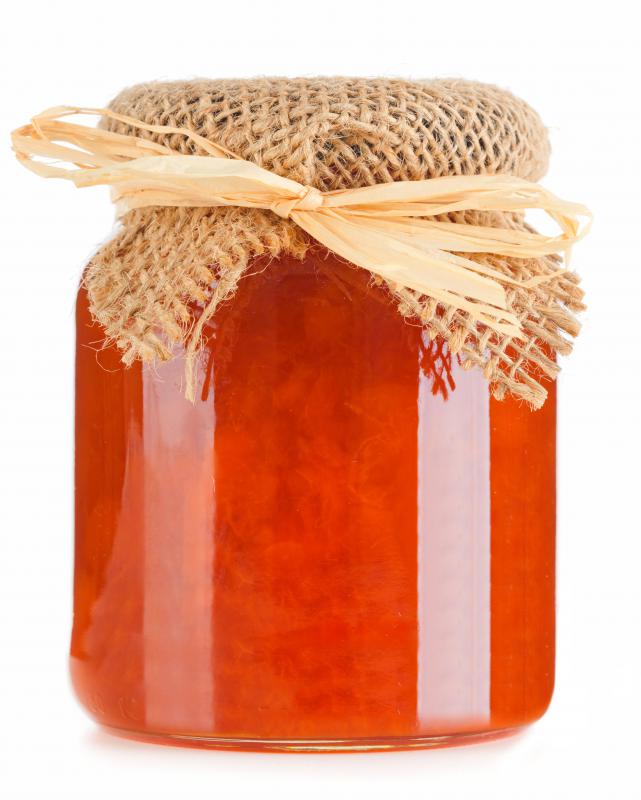
Quince paste is a thick jam made from the fruit of the quince tree. This richly red to orange-colored jam has a sweet taste and a slightly floral flavor, and it is extremely popular in Southern Europe and the Middle East. Outside of these regions, it can be somewhat harder to obtain, and it may be viewed as a delicacy, with a corresponding high price.
Quinces have been cultivated in Southern Europe for centuries, both for their fruit and as an ornamental; flowering quinces have delicate pink flowers which are quite attractive. The quince fruit looks sort of like an Asian Pear, and it is generally not edible in a raw form, being extremely hard and bitter. Quinces were exchanged by the Romans as love offerings, and used in a variety of Greek and Roman dishes historically. In the modern day, quince paste and quince jam are common in the Middle East, especially Lebanon, and Spain.

To make quince paste, cooks loosely chop quince fruits and boil them in water until they soften. Then, sugar and lemon juice are added and the mixture is pulped. The procedure is akin to that used to make applesauce or apple butter, with the goal being a smooth, even-textured paste. In Spain, where quince paste is known as dulce de membrillo, it is almost more like a jelly, thanks to the high pectin content, which is caused by using whole fruits, rather than fruits without seeds and pith.

There are a number of ways to use this jam. It is commonly offered with breakfast, where it may be spread on breads, and it can also be used to accompany roast meats and other dishes, with its sweet, floral flavor complementing a range of foods. In Spain, quince paste and Manchego cheese is a very popular snack, with some people considering it the national dish of Spain, although a number of delicacies vie for this honor.
Like other jams and jellies, quince paste can keep for a long time if it is properly processed and stored in a sealed container. Once the container is opened, however, the clock starts ticking. It's a good idea to refrigerate it after opening, and to eat it within a few months. Some crystallization is normal as the sugar in the paste precipitates out, but discoloration and the development of mold are signs that it has been contaminated, and it should be discarded.
Mary McMahon
Ever since she began contributing to the site several years ago, Mary has embraced the exciting challenge of being a DelightedCooking researcher and writer. Mary has a liberal arts degree from Goddard College and spends her free time reading, cooking, and exploring the great outdoors.
Learn more...
Mary McMahon
Ever since she began contributing to the site several years ago, Mary has embraced the exciting challenge of being a DelightedCooking researcher and writer. Mary has a liberal arts degree from Goddard College and spends her free time reading, cooking, and exploring the great outdoors.
Learn more...AS FEATURED ON:
AS FEATURED ON:


-
![Quince paste has a sweet and floral flavor.]() By: Antonio GravanteQuince paste has a sweet and floral flavor.
By: Antonio GravanteQuince paste has a sweet and floral flavor. -
![Quinces have been cultivated in Southern Europe for centuries.]() By: EklerQuinces have been cultivated in Southern Europe for centuries.
By: EklerQuinces have been cultivated in Southern Europe for centuries.

Discussion Comments
If you have ever had a "Linzer Tart"? You know, the shortbread type cookie with tart raspberry jam covered in powdered sugar? Then you have likely tasted quince jam. Most bakeries combine the raspberry and quince preserves for the filling. It's one of my favorites.
I just told my roomie that I was reading about quince and he told me that Pepperidge Farms "Linzer Tart Cookies" were on sale this week. I'll check out the ingredient list to see if they use quince in their recipe -- likely not, though. It's a huge cost-cutting conglomorate now (I think owned by Campbell's Soup).
They do, however, have quince jam in a round flat container in the ethnic foods aisle, likely imported from Spain. I may try it with some good smelly cheese because I usually like that sort of thing!
You can find quince paste at Gourmet Food Stores or Trader Joes.
I found the stuff here in Houston at HEB food stores. I think because Houston is a port, they have a ton of internationally available foods here. I love trying new things, and this was offered on crackers with brie cheese, and it was lovely!
@purplespark: I have had many people ask me where to buy quince paste. I used to work as the executive chef at a resort. We served quince paste and it was in high demand.
I don't know about any grocery stores that would have it but there are several internet sites where you can find it. Most of them are gourmet shops that ship the products out. I have actually ordered some from them and it was pretty good.
Can you buy quince paste already made? I don't know where I would find quince.
If you can come across some quince, this is a great recipe for quince paste.
You need 3 quince, juice of ½ lemons, 2 cups sugar, and a pinch of salt.
Peel and core your quince and cut into wedges. Put the quince in a boiler and cover with water. Add the lemon juice. Bring to a boil, until the fruit is very soft. Drain the water and let it cool for about 10 minutes.
Put the cooked fruit in a food processor (or a blender) and blend until it is the consistency of applesauce. Measure your fruit. It should be around 2 cups. Place it in a heavy pan. Measure ¾ of that amount in sugar. For example, if you have 2 cups of fruit, you would need 1 ½ cups sugar.
Boil the sugar and fruit and simmer. Be sure to stir often. The mixture should start to thicken. Cook on low heat until the mixture is a thick paste that will stay together in a ball.
Pour the mixture into a lightly oiled dish. Let cool for about 30 minutes. You can slice it when it’s firm.
Post your comments