
At SmartCapitalMind, we're committed to delivering accurate, trustworthy information. Our expert-authored content is rigorously fact-checked and sourced from credible authorities. Discover how we uphold the highest standards in providing you with reliable knowledge.
What is PPP or Purchasing Power Parity?
Purchasing power parity (PPP) is an economic technique used when attempting to determine the relative values of two currencies. It is useful because often the amount of goods a currency can purchase within two nations varies drastically, based on availability of goods, demand for the goods, and a number of other, difficult-to-determine factors. PPP solves this problem by calculating the price of a specific item so that the price is the same when expressed in two different currencies. The equation is stated as S = P1 ÷ P2 where S is equal to the exchange rate of Currency 1 to Currency 2, P1 is equal to the price of a specific item in Currency 1, and P2 equals the price of the same item in Currency 2.
The Big Mac® Index

Perhaps the most famous example of purchasing power parity was given by The Economist magazine as the Big Mac® index. Using the Big Mac® index, the cost of a McDonald's Big Mac® sandwich can be determined in a number of countries, and then an exchange rate can be concluded based on this index. For example, if a Big Mac® costs $3 US Dollars (USD) in the US, and 9,000 riel in Cambodia, the exchange rate can be determined as $1 USD for 3,000 riel. This indexed exchange rate would then be used to determine relative value of other items.
Primary Uses
One of the most common uses of PPP is in lessening the misleading effects of shifts in a national currency. This is particularly an issue when calculating a nation's Gross Domestic Product (GDP), which is the market value of all services and goods produced by a country in a specific amount of time. For example, if the riel falls in value to 80% of its value on the US dollar, the GDP as expressed in US dollars will also drop to 80%. This does not accurately reflect the standard of living in that country (a common use of GDP), however, because the devaluation of the riel is most likely due to international trade issues that will not yet have had any effect on the average Cambodian. By using purchasing power parity, however, one is not misled by the temporary devaluation of the riel in relation to the dollar — a Big Mac® still costs 9,000 riel in Cambodia and $3 USD in the US, and so the Big Mac® index exchange rate remains the same.
There may be long-term effects of using the PPP technique as well. For example, a large retailer may use the equation to find that products can be purchased cheaper in a foreign country. If enough products are purchased at the lower price, over time it may have enough of an impact to increase the price of that product in the foreign country. At the same time, the country that was selling the product at the higher rate may decrease prices once demand slows. The idea behind long-term PPP is that the two countries will eventually offer the same product for the same price, despite the difference in currencies.
Disadvantages
Purchasing power parity is, of course, an imperfect device for determining things such as GDP, as the exchange rate will vary based on the basket item used for the index. This effect is lessened by looking at a large sample of commodities, rather than one or two, but this simply minimizes the problem rather than eliminating it entirely. It is also worth noting that PPP lumps items together into broad classes, not taking into account things such as quality — a hat is a hat is a hat, and its value in the index remains static, even though a shoddy hat's value on the international market would be much lower than a well-made hat's value.
AS FEATURED ON:
AS FEATURED ON:









-
![A cashier taking a payment.]()
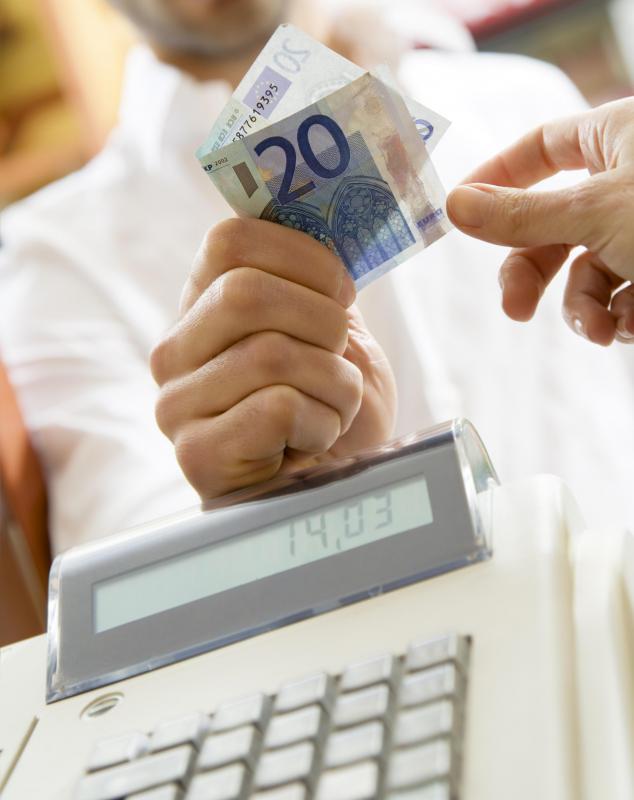
A cashier taking a payment.
Discussion Comments
how is ppp calculated in india and abroad and how is it more beneficial in an economic sense? ankush p.
So what is PPP. For instance if a cup of coffee costs 1 dollar in the US and Rs. 5 in India, could someone tell me what is PPP in this case? --JL
I am trying to calculate a PP adjusted GDP of few countries. I have the nominal gdp data (quarterly) and also have the inflation rates. Can you please help me figure out the calculations? Many thanks,
Sanjana
i got the idea of gdp(ppp) from this site. but somebody tell me inflation(price escalation) may also show the gdp with extraordinary amount. so does gdp with ppp take into account this price change or not? if not how might it be a good measure of gdp for (high inflationary) country. Thanks.
To Dobrinj
'the big mac index might be a good approximation, but it can be skewed one way or another because meat, or bread, or lettuce might be abnormally high in some area due to specific geographic conditions.'
McDonald's, as a franchise, tries to source all ingredients from the same places, thus the price of the Big Mac is affected minimally if at all by the cost of ingredients. This is why the Big Mac as opposed to a basket of goods can be used as some indicator of PPP; MacDonald's prices products according to other regional factors. It therefore can be (tenuously) used as an indicator of those local factors.
=)
i think there are inherent problems with developing a good purchasing power parity system. the big mac index might be a good approximation, but it can be skewed one way or another because meat, or bread, or lettuce might be abnormally high in some area due to specific geographic conditions.
what we really want to know is what it really costs to live (or visit) somewhere. so you might think that we could compare how much it would cost for a family to live comfortably in one place vs another. but this raises the problem of how to define "comfortable." being comfortable in one place might be very different than another.
it seems that in the end, that although purchasing power parity is very interesting and potentially useful, at best it can just be a rough comparison.
Post your comments