
At AllThingsNature, we're committed to delivering accurate, trustworthy information. Our expert-authored content is rigorously fact-checked and sourced from credible authorities. Discover how we uphold the highest standards in providing you with reliable knowledge.
What is Poison Ivy?
Poison ivy is a vine or a shrub that is part of the cashew family. It is harmful, and it grows in many parts of the United states and southern Canada. This plant is usually seen twining around tree trunks or on the ground, although sometimes it grows bush-like. There are several species, including poison oak, which grows in the Pacific Northwest, and sumac, which grows in the eastern United States.
The tissues of these poisonous plants contain an oil, urushiol, that is similar to carbolic acid, which is extreme skin irritant. A person can become poisoned just by removing his or her shoes after walking through poison ivy, or it can be contracted from other people — but only if the oil stays on their skin. Remember, it is not the skin eruption that causes the infection, but the oil from the plant.

If someone comes into contact with the plant, wash the skin thoroughly, hopefully to prevent the oil from penetrating and infecting the skin, thereby causing a rash. If blisters do appear, they will be itchy and can be treated them with calamine lotion, Epsom salts, or bicarbonate of soda. There is a vaccine that can be taken by injection or orally; as with most vaccines, it must be administered before the person encounters the plant.
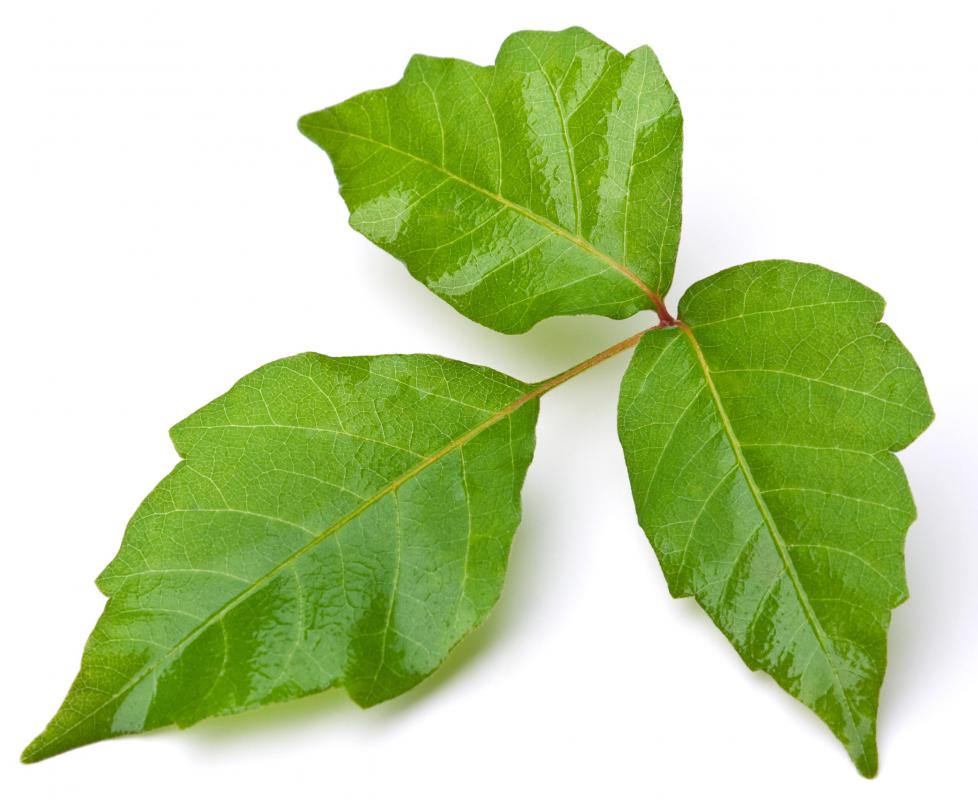
Poison ivy can be identified fairly easily. Its leaves are red in early spring, then change to a shiny green. They turn yellow, red, or orange in the fall.

Each leaf is made up of three leaflets that have notched edges. Two of the leaflets make a pair, and the third leaf stands alone at the tip of the stalk. There are small green flowers that grow in bunches on the main stem close to where the leaves join. In the late season, poisonous berries appear. They are white and have a waxy look.
Poison ivy and oak are very common. It is hard to eradicate them through chemical spraying or other means.
Frequently Asked Questions
What is poison ivy and how can I identify it?

Poison ivy is a plant known for causing an itchy, blistering rash upon contact with its oil, urushiol. It can be identified by its characteristic "leaves of three," which are glossy with smooth or slightly toothed edges. The plant may have greenish-white flowers and white to green-yellow berries, depending on the season.
How does poison ivy cause a rash?

Poison ivy contains urushiol, an oily resin that binds to skin proteins upon contact. This binding triggers an allergic reaction in most people, leading to a rash characterized by itching, redness, and blisters. The severity of the reaction varies from person to person and can develop within 12 to 72 hours after exposure.
Can poison ivy be found in any specific habitat?

Poison ivy is versatile and can be found in a variety of habitats across North America, from wooded areas to riverbanks, and even in urban settings. It thrives in sunny or shaded areas and is particularly common along the edges of paths and roads where it receives ample light for growth.
Is it possible to prevent a poison ivy reaction?
Preventing a poison ivy reaction involves avoiding contact with the plant. Wear long sleeves, pants, and gloves when in areas where poison ivy may grow. If contact occurs, wash the affected skin with soap and water immediately to remove urushiol. Over-the-counter creams and washes can also help prevent the oil from spreading.
What should I do if I come into contact with poison ivy?

If you come into contact with poison ivy, promptly wash the area with soap and water to remove the urushiol oil. Avoid scratching to prevent infection and consider using topical treatments like hydrocortisone cream or calamine lotion to alleviate itching. If the reaction is severe or widespread, seek medical attention.
Can pets transmit poison ivy oil to humans?
Yes, pets can carry urushiol oil on their fur after coming into contact with poison ivy, potentially transmitting it to humans. It's important to bathe pets wearing gloves if they've been in areas with poison ivy. Also, wash any clothing or objects that may have touched the plant to prevent further spread of the oil.
AS FEATURED ON:
AS FEATURED ON:









-
![Poison ivy.]() By: epanthaPoison ivy.
By: epanthaPoison ivy. -
![A man with poison ivy blisters on his hand.]() By: Wild GeeseA man with poison ivy blisters on his hand.
By: Wild GeeseA man with poison ivy blisters on his hand. -
![Epsom salts can treat poison ivy blisters.]() By: Brooke BeckerEpsom salts can treat poison ivy blisters.
By: Brooke BeckerEpsom salts can treat poison ivy blisters. -
![There are topical creams that can be applied to a poison ivy rash.]() By: picsfiveThere are topical creams that can be applied to a poison ivy rash.
By: picsfiveThere are topical creams that can be applied to a poison ivy rash. -
![Poison ivy may cause severe itching.]() By: nebariPoison ivy may cause severe itching.
By: nebariPoison ivy may cause severe itching. -
![A poison ivy rash may appear as a red, itchy rash marked by bumps.]() By: librakvA poison ivy rash may appear as a red, itchy rash marked by bumps.
By: librakvA poison ivy rash may appear as a red, itchy rash marked by bumps.




Discussion Comments
To stop the intense itching so you can sleep, hold the affected area under water as hot as you can stand it, for about 45 seconds. This releases the histamines. It lasts for about five hours and you will have to do it again, but this is a life saver. I thought I was pulling up honeysuckle vines in the spring a few years ago and later found out it was poison ivy vines. I had blisters on the inside of both arms from my wrists to my elbows.
You can also get poison ivy by inhaling it. If someone is burning brush and poison ivy or poison oak is in the burning brush, the wind can carry the ash with the oil on it and anyone within the vicinity allergic to poison ivy/oak can become quite infected from it.
To jabuka-Not true. If the rash is oozing the clear, yellowish oil, it can be spread.
Thank God I have found someone who knows the name of the Poison Oak vaccine. thank you. Do you know where you can get it? Or a pharmacy that carries it if you get a script?
i have finally found a website that at least acknowledges the existence of a poison ivy vaccine; believe it or not, there are a number of websites that say there is not any.
I personally know better because i know people who have had the vaccine and i can vouch for it, the stuff really works! i have seen people vaccinated with the poison ivy shot(rhus tox is the name of it) and pull poison ivy bare handed! my advice to all outdoors people is to talk to your doctor about this vaccine but to still not pull poison ivy bare handed.
Sincerely, a horticulturist in the know
The rash of poison ivy is not contagious. You can get the rash only by getting in contact with the oil of the plant.
Post your comments