
At WiseGEEK, we're committed to delivering accurate, trustworthy information. Our expert-authored content is rigorously fact-checked and sourced from credible authorities. Discover how we uphold the highest standards in providing you with reliable knowledge.
What is Pleurisy?
 Tricia Christensen
Tricia Christensen
Tricia Christensen
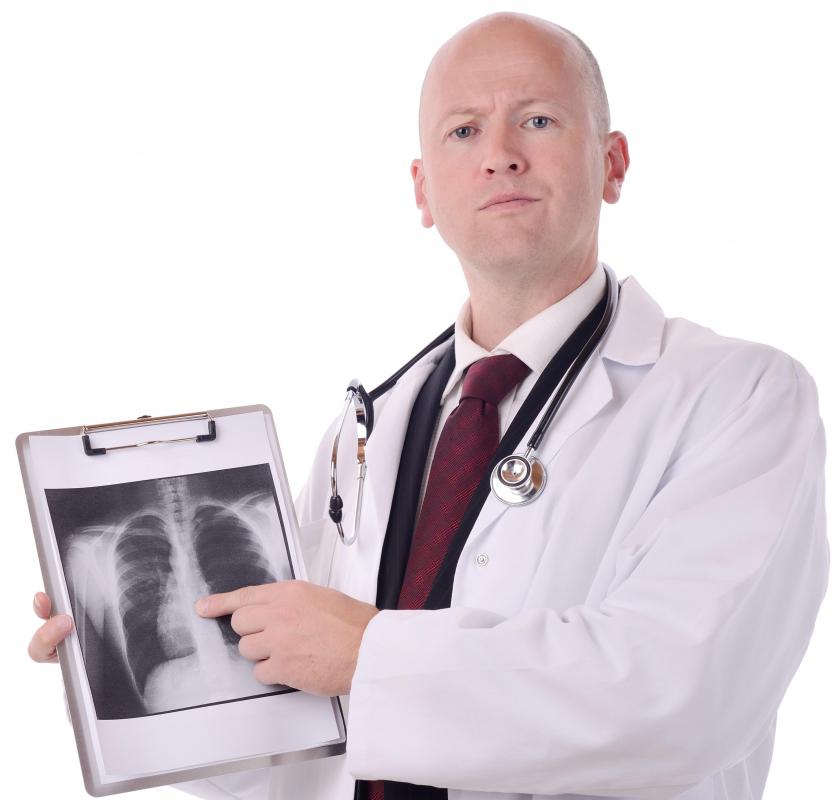
Pleurisy or pleuritis is an inflammation of the tissues, pleura, surrounding the lungs and lining the rib cage. It is marked by severe chest pain, which can be especially pronounced if someone is breathing hard from exertion. Chest x-ray can confirm diagnosis, though sometimes diagnosis is confirmed by ruling out other causes of chest pain like angina, as the condition is not always easy to visualize, even with advanced x-ray technology.
Pleurisy can present with pneumonia, or is sometimes caused by pleural effusions, trapped liquid in the lining of the lungs. It rarely goes unnoticed because of the pain associated with the condition. Pneumonia can be of bacterial or viral origin, but pleural effusions are most commonly associated with some forms of heart surgery, such as the Fontan repair to alleviate single ventricle.

Pleurisy may also be present after a viral infection, when there is no pneumonia. Sometimes, this condition indicates underlying autoimmune disorders like lupus or rheumatoid arthritis. In most cases, however, pleurisy is the result of viral infection. Those who have the condition, as well as other risk factors for autoimmune disorders, should consult their doctor about further testing.

Unfortunately, pleurisy often takes a couple of months to improve. On its own, the condition does not generally cause any other symptoms beyond what some describe as excruciating pain. It can be debilitating, because pain can be very intense, restricting activity, ability to work, and the ability to perform simple tasks.
Where pleurisy is a symptom of an underlying condition, such as lupus, treating the condition can often improve pleuritis. Generally, those with active lupus are on steroids to help with inflammation, and may also be on antibiotics to treat infections. Antibiotics to treat bacterial pneumonia may also reduce swelling of the pleura.

In cases of pleural effusions, hospitalization may be required to keep close watch on respiratory stability. Treatment for pleural effusions often involves a fluid restricted diet, and oral medications like Lasix®, a diuretic that helps to increase fluid output. In addition to treatment of underlying symptoms, when they exist, pain is managed in several ways. Those affected may take steroids or narcotic pain medications. However, the primary goal is to reduce swelling, so most doctors recommend non-steroidal anti-inflammatory drugs, also called NSAIDs.

NSAIDs in low doses are available over the counter as ibuprofen or naproxen sodium. Stronger NSAIDs or higher doses may be required to reduce swelling. Often, prescription strength ibuprofen is prescribed. One can, however, save a little money by asking one’s doctor to direct the proper dosage amounts using the nonprescription forms.
Physicians may also prescribe bed rest, good diet, and time away from work to promote healing. Even with treatment, the condition can still persist for several months, and remains difficult to resolve successfully without considerable pain for those affected.
Tricia Christensen
Tricia has a Literature degree from Sonoma State University and has been a frequent WiseGEEK contributor for many years. She is especially passionate about reading and writing, although her other interests include medicine, art, film, history, politics, ethics, and religion. Tricia lives in Northern California and is currently working on her first novel.
Learn more...
Tricia Christensen
Tricia has a Literature degree from Sonoma State University and has been a frequent WiseGEEK contributor for many years. She is especially passionate about reading and writing, although her other interests include medicine, art, film, history, politics, ethics, and religion. Tricia lives in Northern California and is currently working on her first novel.
Learn more...AS FEATURED ON:
AS FEATURED ON:









-
![Pleurisy is marked by severe chest pain.]() By: milan2099Pleurisy is marked by severe chest pain.
By: milan2099Pleurisy is marked by severe chest pain. -
![Individuals suffering with pleurisy may require hospitalization.]() By: iceteastockIndividuals suffering with pleurisy may require hospitalization.
By: iceteastockIndividuals suffering with pleurisy may require hospitalization. -
![Bed rest is often recommended to patients suffering from pleurisy.]() By: Hunor KristoBed rest is often recommended to patients suffering from pleurisy.
By: Hunor KristoBed rest is often recommended to patients suffering from pleurisy. -
![The human respiratory system. Pleurisy is an inflammation of the membrane that surrounds the lungs.]() By: pixelcaosThe human respiratory system. Pleurisy is an inflammation of the membrane that surrounds the lungs.
By: pixelcaosThe human respiratory system. Pleurisy is an inflammation of the membrane that surrounds the lungs. -
![A chest x-ray can confirm the diagnosis of pleurisy.]() By: Rob hyronsA chest x-ray can confirm the diagnosis of pleurisy.
By: Rob hyronsA chest x-ray can confirm the diagnosis of pleurisy. -
![Ibuprofren is often prescribed to treat pleurisy.]() By: Geo MartinezIbuprofren is often prescribed to treat pleurisy.
By: Geo MartinezIbuprofren is often prescribed to treat pleurisy.



Discussion Comments
Mine started with a cold. My heart hurt when I coughed, and I thought I was going to die, and stayed out of work and in bed for a long while. It took forever to get rid of. The next time I got a cold, same thing, it felt like I was having a heart attack. I couldn't even sleep it hurt and it scared me so badly, but finally, I turned on my side in fetal position with the side that hurt taking all my weight and pushing down on the hurt. The pain stopped immediately and I finally got some sleep, as long as I slept on the side that hurt! I talked to a friend who said it sounded like pleurisy, her mother had it. I looked up pleurisy and sure enough, this is how to stop the pain while in bed, so it must have been pleurisy.
The next Thanksgiving Day, as I was putting out the lights on the bushes for Christmas, and did not wrap up well enough, that night, I knew. I could tell I was going to have a cold because my throat was already getting weird while eating turkey dinner again that day.
My sister got out her sure cure for colds, black elderberry lozenges and told me to take two and I wouldn't get that cold. I told her it wouldn't work because the last few colds I also got pleurisy and it is different from a cold. But guess what? It worked. It cures pleurisy Get some now! Get sambucol or sambucus syrup or lozenges. It will cure pleurisy and you will never get it again! It works.
I told my friend who got it and who had already gone to three doctors who couldn't tell him what he had or give him anything that worked for it. He thought he was having a heart attack and it was the same symptoms. I told him about Sambucol and he got some and it cured him. Try it, and you will see! Take as recommended and it will cure you forever from pleurisy.
I had this pain. I thought I was having a heart attack, but apparently, after an X-ray, and an ECG, the doc said it's pleurisy. I have to take ibuprofen. I can't take a deep breath. I can barely move. Its' awful.
I am 14, and I was diagnosed with pleurisy six months ago. I am in excruciating pain, and my doctors can't find anything. After ECG's, X-rays, blood tests, and CT scans, they can't find anything. I'm 14 and at my breaking point. I hate what I have and right now I don't even know what it is. Someone please help me.
Have any of you been tested for Cystic Fibrosis?
My previously healthy daughter had her first attack of pleurisy in Oct 2009 (age 14), and another in March 2010. In each case, she had had a cold from which she had recovered, then the pain started after she got well.
Then in Sept 2010 she was diagnosed with acute aplastic anemia, a fatal if untreated disorder, caused by her immune system attacking the stem cells in her bone marrow.
I'm trying to understand the connection between the pleurisy (which seems to have autoimmune causes) and the aplastic anemia, another autoimmune disease.
I have been having trouble breathing and am having a pain on my left side right underneath my rib cage.
I was in the hospital last week with a bowel blockage and with all the x-rays I had, I would have thought that something would have showed up even though the pain just started yesterday.
I have severe chest pains, and constant pain in my right lung. I'm a terrible worrier and when i worry the pain stretches out between my whole chest area.
I am 15 years of age and a smoker. I have stopped smoking for a few days now but continuous pain starts for an hour period then ends. my mother said it could be pleurisy though i do not know. the doctor gave me some medication though i don't seem to be feeling any better.
my blood pressure is high and my urine is fine. what should i do? please help.
i am 15 years old and i am having chest pain. i went to the hospital and they said i been diagnosed with pleurisy. they told me to take ibuprofen but when i take it my chests start hurting more than it used to.
It stopped for like a couple of months then it started coming back and it hurt even worse. what should i do?
I was diagnosed with pleurisy when i was around ten.
I'm fourteen now and am still having the same pains.
Could it still be pleurisy??
anon12734,
i would definitely go see your doctor, but those symptoms sound a lot like something that happened to my brother. when he was about your age, one his lungs collapsed for no apparent reason. apparently, this is fairly common for young guys, especially if they are tall and thin...he did have to spend some time in the hospital, and when it didn't resolve on it's own, he had minor surgery. good luck! let us know what your diagnosis is!
okay, I'm 17, and I have NOT been sick or anything?? but the past three days every time I cough, sneeze, or even yawn, I can't breath, and have this excruciating pain to the right of my chest, well, my right lung. and at all times it feels like there is an extremely sharp glass shard or something striking through my chest all the way to my back shoulder. and it hurts to breath or eat.. but I don't have a fever, I have a slight cough, but every time I cough, it feels like my lung is about to explode!! it is horrible. is this pleurisy??
I have had severe chest pain for the last couple of days with a cough and a fever. Could it be pleurisy?
Thanks,
pelhamfire
I was diagnosed with pleurisy, and then it went away the next day. Is this heard of? I often wonder if that is what I really had because it went away so quickly and I have read it lingers for months.
Post your comments