
At WiseGEEK, we're committed to delivering accurate, trustworthy information. Our expert-authored content is rigorously fact-checked and sourced from credible authorities. Discover how we uphold the highest standards in providing you with reliable knowledge.
What is Pleural Fluid?
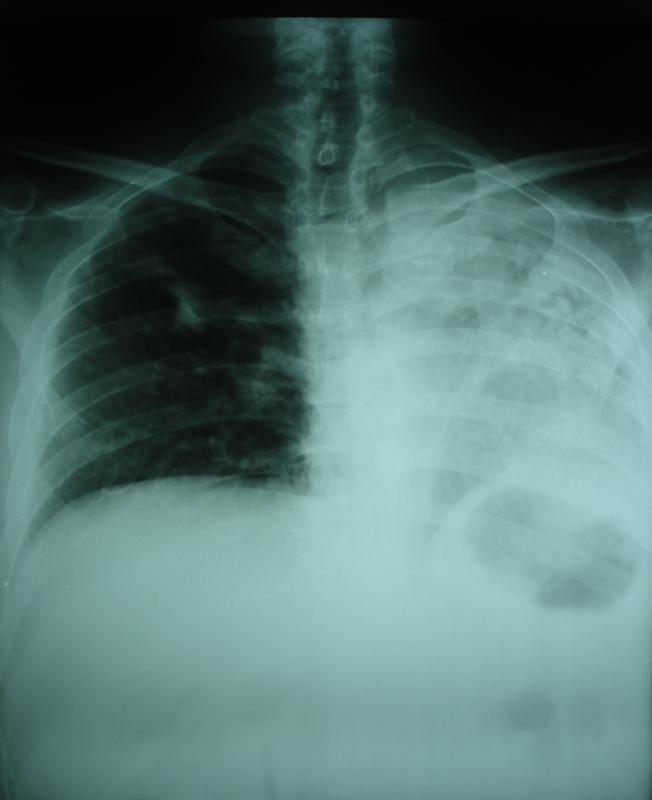
Pleural fluid is a thin, transparent fluid produced in the area around the lungs that helps them expand and contract effortlessly. In a normal, healthy body the fluid is constantly produced and replaced, but some medical conditions can cause a person to have a build-up of too much fluid. This situation is called a pleural effusion. A few other conditions are associated with pleural effusion caused by pleural fluid, including lung disease and congestive heart failure. Pleural effusion is dangerous if left untreated, but is relatively easy to treat.
Keeps the Lungs Moving Smoothly

The lungs inflate and contract within a membrane called the pleura. A normal pleura has a few milliliters of pleural fluid to act as a lubricant and help the lungs move easily against the membrane. The body is usually very good at reabsorbing this fluid; it takes a multi-dozen increase in the production of pleural fluid before the body will start to get overwhelmed and not be able to absorb the fluid quickly enough. When this happens, fluid will start to build up in the pleural cavity, causing a pleural effusion.
Causes of Pleural Effusion

There are a few things that can cause pleural fluid to build up in this way, including congestive heart failure, rheumatoid arthritis, cirrhosis, lung cancer, tuberculosis, and drug allergies. There are three categories of pleural effusions: trasudate, exudate, and unclassified. The difference between transudative and exudative effusions is just the manner in which the fluid gets into the pleura — in a transudative effusion the fluid is pushed out of the capillaries by an increase in pressure; in an exudative effusion inflammation is the root cause, not pressure. Heart failure is associated with transudative effusions, while a drug allergy or bacterial pneumonia can cause an exudative effusion. Tuberculosis is an unclassified cause of effusion. Many cases of effusion are idiopathic, though, meaning that they have no known cause.
Effects of Too Much Fluid

The effects of having all this extra fluid in the lungs can be very dangerous. If enough fluid builds up, it can make it hard or impossible for the person to breathe normally. Pleural fluid can also get infected, which can turn into an abscess. It's best to deal with any increase in fluids as soon as possible, though can be hard, since some people with too much pleural fluid don't have any symptoms until a lot of fluid builds up. When a person is diagnosed as having an increase in fluid, doctors will take a sample of the fluid to test to try to determine the cause of the build-up, and will also drain the fluid.
AS FEATURED ON:
AS FEATURED ON:









-
![Pleural build up may occur as a result of lung cancer.]() By: XtremestPleural build up may occur as a result of lung cancer.
By: XtremestPleural build up may occur as a result of lung cancer. -
![Heart failure may cause the buildup of pleural fluid.]() By: Piotr MarcinskiHeart failure may cause the buildup of pleural fluid.
By: Piotr MarcinskiHeart failure may cause the buildup of pleural fluid. -
![A pleural effusion occurs when excess fluid builds around the lungs.]() By: Dr CanoA pleural effusion occurs when excess fluid builds around the lungs.
By: Dr CanoA pleural effusion occurs when excess fluid builds around the lungs. -
![Cirrhosis of the liver can cause pleural fluid to build up.]() By: peterjunaidyCirrhosis of the liver can cause pleural fluid to build up.
By: peterjunaidyCirrhosis of the liver can cause pleural fluid to build up.



Discussion Comments
I did a chest X-Ray and after two days the doctor called me to do a Pleural Echography. What could be the reason for this new examination?
@meandcoffee- What do the pleural fluid studies consist of? Exactly what bacteria and other substances are they looking for?
@digs- My wife is a nurse, and she said they sometimes do a pleural fluid analysis when a person has pneumonia. For pneumonia patients, they must drain off the fluid from the chest by inserting a tube. They have to drain the fluid in order to study it for bacteria and other substances.
Do they use different methods of pleural fluid drainage depending on the cause? Although it sounds in some cases like the fluid subsides of its own accord once the cause is treated.
Post your comments