
At AllTheScience, we're committed to delivering accurate, trustworthy information. Our expert-authored content is rigorously fact-checked and sourced from credible authorities. Discover how we uphold the highest standards in providing you with reliable knowledge.
What is Pascal's Law?
Pascal's law says that when the pressure at any point in a static fluid in a closed system is changed, the change in pressure will disperse equally throughout the fluid. That is, the pressure at a point far away from the region of change will change by the same amount as a point nearby. A closed system can simply be an enclosed container, or it may be something more complex, such as two or more interconnected containers; the important thing is that no fluid can enter or leave the system. It is also important to note that, in physics, a fluid can be either a liquid or a gas. The law can be demonstrated by a number of simple experiments, and has important applications, such as in the hydraulic press.
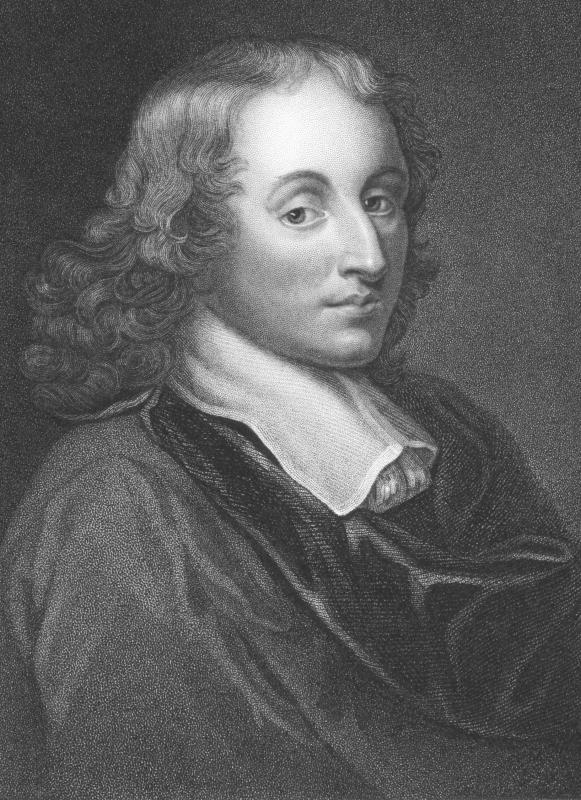
The principle was named after the French mathematician and philosopher Blaise Pascal who discovered it in the 1600s. It applies to static situations and not to dynamic conditions where other factors could affect pressure values. For example, it does not apply to fluids that are in motion or subject to changing temperatures.
Demonstrations

There are a variety of Pascal's law experiments that can be used to demonstrate the effect. Pascal himself showed that it worked by filling a barrel with water and inserting a long pipe into the top. When he poured water into the top of the pipe, the barrel burst. The weight of the water in the pipe caused an increase in pressure inside the barrel that pushed against the sides until they gave way.

Perhaps the most basic way of demonstrating the law at home involves simply squeezing a balloon. In this example, the flexible walls of the container show how the increase in pressure caused by squeezing is dispersed throughout the balloon. The balloon will bulge uniformly in all directions, not just at the side opposite that which is squeezed.
In another common demonstration, a bottle is filled to the top with water, and some matchstick heads are dropped into it so that they float. The neck of an inflated balloon is stretched over the bottle, and then lightly squeezed. The matchstick heads now sink some distance into the water. This is because the increase in pressure due to the squeezing of the balloon is transmitted down into the water, forcing some of it into the porous matchstick heads and causing them to sink, due to the extra weight. When the pressure on the balloon is removed, the water pressure decreases, air pressure in the matchstick heads forces water out, and they float again.
Applications

Perhaps the best-known application of Pascal’s law is the hydraulic press, a device that converts a small force into a larger one. It generally consists of two connected chambers, each with a piston — a movable barrier that can be pushed down or pulled up without allowing fluid to escape — and containing a fluid that cannot be compressed. One chamber-piston combination is larger than the other: this is the “output.” The idea is that a small force applied to the smaller, or “input,” piston will result in a larger output force. Pressing down on the input increases the pressure, and that increase will be the same against the larger output piston.
Calculating the Output Force
The output force is calculated by dividing the area of the output piston by the area of the input piston then multiplying the result by the input force. If the output piston has ten times the area of the input, the output force will be ten times the input force. For example, if the input force is 5 units, the input area is 2 units and the output area is 20 units, the output force will be 50 units. In this way, heavy objects can be lifted without the need to apply a large force.
This does not mean that extra energy is appearing out of nowhere. The amount by which the output piston is raised will be less than the amount by which the input piston is pressed down, which evens things out. In the above example, if the input piston is pushed down 10 units, the output piston will be raised by 1 unit. The principle is similar to using a lever to lift a rock. Hydraulic mechanisms of many types, such as the braking systems on aircraft and some vehicles, rely on Pascal’s law.
AS FEATURED ON:
AS FEATURED ON:









-
![Portrait of Blaise Pascal.]() By: Georgios KollidasPortrait of Blaise Pascal.
By: Georgios KollidasPortrait of Blaise Pascal. -
![Diagram of Pascal's law.]() By: MorphartDiagram of Pascal's law.
By: MorphartDiagram of Pascal's law. -
![Aircraft brake systems use hydraulics based on Pascal's law.]() By: stable101Aircraft brake systems use hydraulics based on Pascal's law.
By: stable101Aircraft brake systems use hydraulics based on Pascal's law.


Discussion Comments
I glued two oral flushing syringes together filled one with water and the other empty. It proves the theory without spending a ton of money.
Search things about Pascal online.
get a cup full of water that can fit a can in it. and get an empty can of pop or something like that. put the can in the water. it should float. and then have your son press down the can with his fingers and the water will rise evenly.
it was bit easy to understand. you've given good examples.
@momothree: I read that in the article and I appreciate you clarifying how exactly to perform that experiment. You were very helpful! We are going to try it.
@medicchristy: This is a fairly easy project to do regarding Pascal’s law. You will need some matchsticks, a bottle, a rubber balloon, and some twine.
Cut the heads off the matches. You can discard the tail ends. Fill the bottle to the brim with water. Drop the matchstick heads into the bottle. Cover the mouth of the balloon tightly over the bottle’s opening. Press your finger on the balloon “diaphragm” covering the mouth of the bottle. The twine can be used to secure the balloon to the mouth of the bottle if needed.
The match heads will float on top of the water at first. As soon as the finger is pressed on the balloon diaphragm, they will start to sink to the bottom. When you lift your finger, the matchstick heads will float again.
Why does this happen? The match heads move down because of the pressure that is transmitted through the water. When you press down on the balloon diaphragm, a small amount of water penetrates into each match head which gives it enough weight to sink. When you move your finger, there is enough air pressure inside the match heads to force the water out and make the match heads rise again, hence Pascal’s Law is proven.
My son has to do a science project that is supposed to prove Pascal's Law. Does anyone know of a good project that he could do?
Post your comments