
At HomeQuestionsAnswered, we're committed to delivering accurate, trustworthy information. Our expert-authored content is rigorously fact-checked and sourced from credible authorities. Discover how we uphold the highest standards in providing you with reliable knowledge.
What is Particle Board?
 Michael Pollick
Michael Pollick
Michael Pollick
On any given day, saw mills and other wood processing factories generate a significant amount of scrap material. Most of these wood shavings and piles of sawdust are sent to landfills or incinerated, but some of this material ends up as an engineered product called particle board. This product is an inexpensive alternative to solid wood paneling or boards. It is primarily intended for interior projects in which appearance and durability are not a priority.
A section of particle board does not have a grain like other wood. The product is made by combining sawdust and other waste wood with a special resin. This slurry of wood chips and glue is then pressed through an extrusion machine into long sheets. Customized saws cut these sheets into various sizes, according to the needs of the customer. Manufacturers of inexpensive home furnishings, such as shelving, entertainment centers and bookcases, often use this composite wood for their do-it-yourself kits.

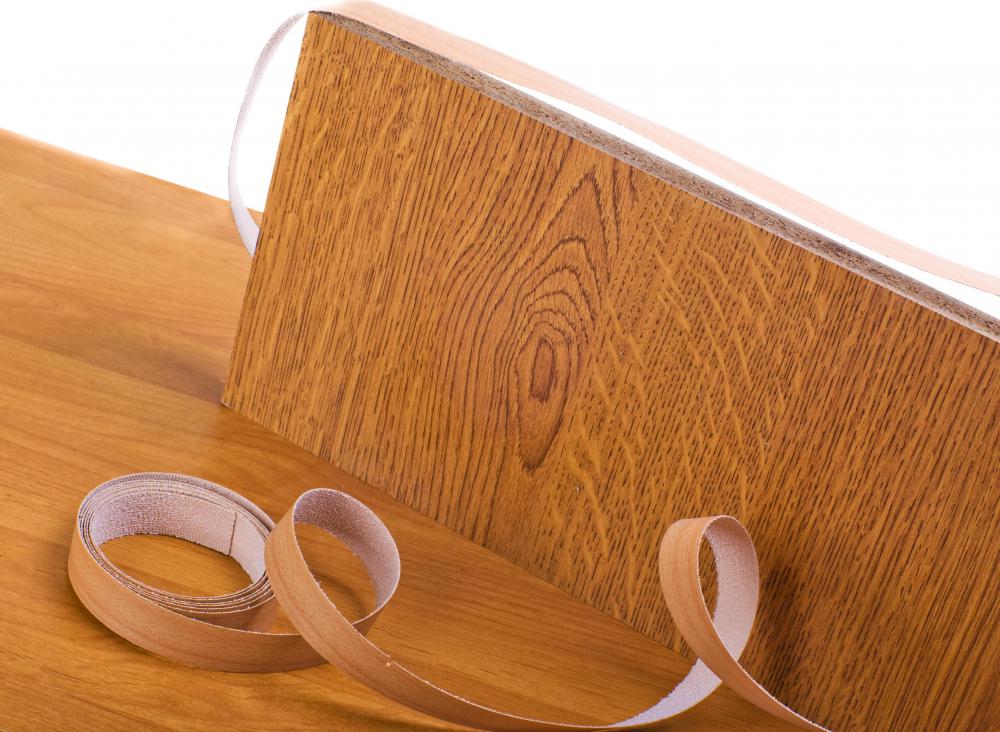
Although unfinished particle board bears little resemblance to traditional hardwoods, producers often add a thin veneer of real wood to improve its appearance. The material can also be painted or laminated. One of the things it cannot handle, however, is exposure to moisture, so few if any outdoor projects feature the engineered wood.
Water causes particle board to stain and warp, which can seriously limit its use in home products. The product can be used as subflooring, but only if it fits snugly enough to form a moisture barrier. Once the material becomes wet, it loses much of its tensile strength and even a woman's high-heeled shoe could cause damage.

Particle board also has some positive aspects. Waste wood materials can be recycled to form a useful product, and consumers can purchase inexpensive alternatives to high-end cabinets and shelves. Depending on the manufacturer and the quality of the resin, composite wood can be surprisingly durable. It may not be able to withstand stress as well as hardwood products, but it performs well enough for light duty projects such as closet shelving or portable cabinetry.
Michael Pollick
A regular HomeQuestionsAnswered contributor, Michael enjoys doing research in order to satisfy his wide-ranging curiosity about a variety of arcane topics. Before becoming a professional writer, Michael worked as an English tutor, poet, voice-over artist, and DJ.
Learn more...
Michael Pollick
A regular HomeQuestionsAnswered contributor, Michael enjoys doing research in order to satisfy his wide-ranging curiosity about a variety of arcane topics. Before becoming a professional writer, Michael worked as an English tutor, poet, voice-over artist, and DJ.
Learn more...AS FEATURED ON:
AS FEATURED ON:


-
![Particle board being cut with a circular saw.]()
Particle board being cut with a circular saw. -
![Nail being driven into a piece of particle board.]()
Nail being driven into a piece of particle board. -
![Veneer is often added to particle board to improve its appearance.]() By: Jovan NikolicVeneer is often added to particle board to improve its appearance.
By: Jovan NikolicVeneer is often added to particle board to improve its appearance. -
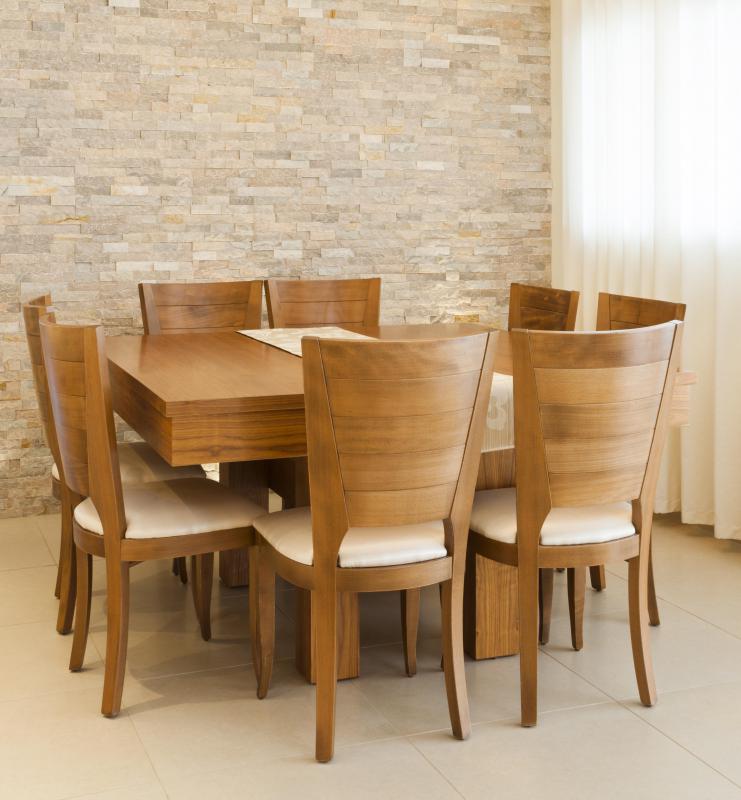
![Some furniture is made more attractive through the use of a veneer covering.]() By: Dmitry PistrovSome furniture is made more attractive through the use of a veneer covering.
By: Dmitry PistrovSome furniture is made more attractive through the use of a veneer covering.


Discussion Comments
I have a 6 foot bookshelf made of particle board that I want to attach to the wall for safety reasons. How should this be done? Will screws or nails pull out of the particle board? Thanks for any help you can give me.
I removed wallpaper from my living room walls and lo and behold the walls are not gyprock but some sort of pressed board. It sounds like the particle board you speak of. How can I repair it for painting and what re the results like. Need I now rebuild with gyprock?
Particle board is like a dry waffle but 1/2 inch or 3/4 inch with a smooth surface that can be painted, but first you need special primer. The first coat should never be oil primer or paint never, never, never.
You can use only multi-purpose latex primer and second and third coat needs to be acrylic latex eco friendly. Why? Because you will be in contact with those materials that you paint and you will smell them every day and you don't want to die because of toxic substances that are coming through, usually from oil or other cheap paint.
That is why the best choice is Sherwin Williams. You can get a good discount and those kinds of paint they have are the best. Just buy a small can and you will see for yourself what is the effect on your particle board.
I'm doing a project right now and will be done soon.
can rice residue also be used for particle board?
The subfloor of my kitchen-dinning area has particle board 3/4 inch, and linoleum in good condition on top. Questions:
1. Do I need to remove the linoleum?
2. Do I need to remove the particle board?
3. Do I need to add plywood 1/2 inch on top of
the particle board? (if not removed?)
4. Do I need to use cement board 1/4 inch, on top of the plywood?
Please, give me your advice. Thanks. (JPS)
I'm covering my hardwood with particle board before I carpet. I don't want to glue it. Could you tell me which is the best type of nail to use? Thanks, Oz
I would like to know about the quantity ration of timber and glue for making particle board of 100m3/day?Also please let me know about the use and amount of water in PB manufacturing?
my partical board cabinets got wet and took almost two weeks to dry. should they be replaced?
Particleboard (one word) Is also used in the core of Steel doors. There are lots of different kinds and uses. Everything from fire retardant to moisture resistant. A 3/4" piece of pb can hold up to 120lbs over an 18" span and is easy to cut because it has no grain.
how can you tell the difference between standard particle board and moisture resistant particle board just by looking at it? do i need to cut the board to identify the difference?
Particle board is nice.
A type of engineered, particle board, laminated materials somewhat large pieces of wood products, underlayment, new construction for vinyl siding over same. Doe's it receive weather treatment products to prevent moisture, so that tyvec doesn't have to be used? Life expectancy without Tyvec?
How resistant is Particle Board to Termites? Can it be used as a sub-base for a Bamboo board floor?
My laundry room walls are particle board and look just terrible. Can they be painted or papered over to look more attractive?
I have a medicine cabinet in the bathroom of my summer cottage which I recently bought. I drove a small nail through the inside to level a shelf. However, the nail punctured the side, but did not go through the side molding, which I would like to repair and re-paint. How can this be done?
Post your comments