
At AllThingsNature, we're committed to delivering accurate, trustworthy information. Our expert-authored content is rigorously fact-checked and sourced from credible authorities. Discover how we uphold the highest standards in providing you with reliable knowledge.
What is Paramecium?
A paramecium is a unicellular organism belonging to the kingdom Protista, so it isn't exactly a plant or an animal. The organism can digest food, move through water by propelling itself with cilia, and reproduce. As one of the oldest organisms on earth, it has evolved and developed very simple methods of defense, genetic exchange, and mobility.
There are several different species of paramecia, but all are ciliate protozoa. This means they use cilia to swim through water, and their one complex cell, a eukaryote, conducts all of the organism's basic functions. It doesn't divide labor between different tissues or cells like an animal. Instead, each paramecium is capable of an aerobic exchange, similar to breathing, reproducing asexually, ingesting nutrients, and expelling waste.
Physical Appearance

With good vision, it is possible to just make out the speck of a paramecium, since they are about .02 inches (.5 mm) long. They're better viewed under a microscope, where a slipper or kidney shaped cell can be seen. Lining the outside of its membrane are tiny, beating hairs called cilia. Cilia move in conjunction, like a line of oars on a ship, to move the paramecium through liquid. The eukaryote is even smart enough to navigate around obstacles and towards food.

When a paramecium encounters food, it swivels to move the food into its gullet. The gullet is a small opening, like a mouth. It's lined with other cilia to help "swallow" the bits of organic or decaying matter it eats, such as other unicellular organisms or bacteria. The food will continue down the gullet to get stored in food vacuoles until the cell needs energy.

It may also be possible to make out other rounded structures, called organelles, that sort of function like an animal's organs. One such organelle is the contractile vacuoles. The paramecium must keep osmotic equilibrium, which means the water pressure outside its skin and inside its body needs to be equal at all times. Contractile vacuoles pass water from inside the cell to outside, and vice versa.
Reproduction

Under most circumstances, paramecia reproduce by splitting themselves down the middle and giving each new organism half of the organelles. This is called binary fission, and is a simple form of asexual reproduction. Occasionally, a paramecium will meet another and exchange genetic material during a kind of primitive sexual reproduction. The membranous skins combine to make one giant paramecium, at which point the tiny micronuclei that hold all of the genetic material switch around. When it divides into four smaller paramecia, they now have new combinations of DNA.
Frequently Asked Questions
What exactly is a paramecium?
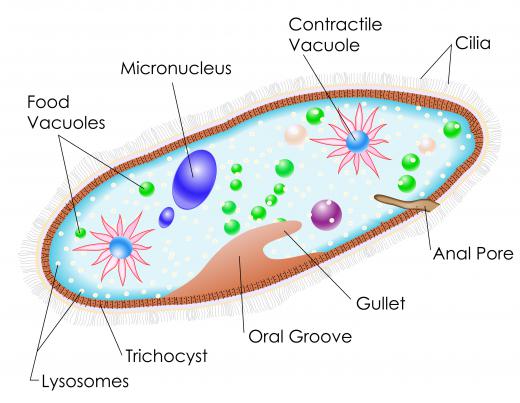
A paramecium is a single-celled, freshwater organism classified under the kingdom Protista. It's a ciliate protozoan that uses tiny hair-like structures called cilia to move and feed. Paramecia are renowned for their oblong shape and the complex behaviors they exhibit, such as avoiding obstacles and finding food, despite being only one cell.
How does a paramecium reproduce?
Paramecia primarily reproduce asexually through a process called binary fission, where one cell divides into two genetically identical offspring. However, they can also engage in a form of sexual reproduction known as conjugation, where two paramecia exchange genetic material to increase genetic diversity, as noted by research in protistology.
What is the lifespan of a paramecium?
The lifespan of a paramecium can vary, but typically, an individual can live up to a few weeks. In optimal conditions, with ample food and proper temperature, they can survive longer. Their lifespan is also influenced by their ability to reproduce quickly, ensuring the continuation of the population.
What role do paramecia play in the ecosystem?
Paramecia play a crucial role in aquatic ecosystems as part of the microzooplankton community. They help maintain the balance of bacterial populations by feeding on them, and in turn, serve as prey for larger organisms. This makes them an integral part of the food web, contributing to the cycling of nutrients in their habitats.
Can paramecia be harmful to humans?
Paramecia are generally not harmful to humans as they are not known to be pathogenic or cause diseases. They are often used in scientific research and educational settings to study cellular processes and ecological interactions due to their complex yet observable behaviors and simple maintenance requirements.
How do paramecia obtain their food?
Paramecia feed on microorganisms like bacteria, algae, and yeasts. They use their cilia to create water currents, drawing food particles close to their oral groove. Once near the mouth opening, food is engulfed into food vacuoles where digestion occurs. This method of feeding is known as phagocytosis, a common trait among many protozoans.
AS FEATURED ON:
AS FEATURED ON:









-
![Paramecia.]()
Paramecia. -
![Three Paramecium caudatum.]() By: micro_photoThree Paramecium caudatum.
By: micro_photoThree Paramecium caudatum. -
![Paramecium are better viewed under a microscope.]() By: WavebreakMediaMicroParamecium are better viewed under a microscope.
By: WavebreakMediaMicroParamecium are better viewed under a microscope. -
![Paramecium are celiated organisms.]() By: Matthew ColeParamecium are celiated organisms.
By: Matthew ColeParamecium are celiated organisms. -
![Although single-celled, paramecia can perform a variety of functions.]() By: snapgalleriaAlthough single-celled, paramecia can perform a variety of functions.
By: snapgalleriaAlthough single-celled, paramecia can perform a variety of functions.


Discussion Comments
Why are they not animal or plant cells?
Does a Paramecium respond to light?
Can paramecium make you sick?
What do they smell like?
Could you give reasons about why a paramecium is unicellular?
Is the paramecium from the kingdom protista?
I was studying for my science test, it said something about paramecium. I thought to myself, "I've heard that word before." Then it hit me. I have a microscope, and it came with samples of random organisms, paramecium included. So I looked at the paramecium under the 40X lens, and saw hair-like strands floating back and forth. Super cool!
What's the definition of a gullet?
The actual function it does for the body is it eats bacteria. Therefore, it helps the body by killing the bad bacterias that can hurt your health. It also eats other small organisms such as algae and yeast.
This is all really nice info but where did the paramecium come from?
well paramecium don't have a "function", they are protozoans and can be used ecologically, how? in the sewage treatment, their cilia move the water, and in symbiosis with bacteria and fungi they can make less toxic sewage.
what's the structure of a paramecium?
paramecium is really cool to look under a microscope. it has all different kinds of colors like blue, green, red, yellow, pink and purple. i think paramecium are some of the coolest things to look at under a microscope.
what is the main function of paramecium?
What do paramecium do for the environment?
I really needed this for science. Thanks.
where do paramecium eat?
Does a paramecium produce methane gas?
what is the color of the paramecium?
What are the parts of the paramecium?
What is the actual function of the paramecium to the body?
Where did the paramecium come from??
I think this provides nutrients to the fish, and is probably only fed to small fish that do not need to eat large amounts of food, this is also part of a wild fishes diet. So this is also why:)
I've heard paramecium are used to feed fish. Why is this? What benefit does this have to the fish? What sort of fish is it feed to?
Post your comments