
At BeautyAnswered, we're committed to delivering accurate, trustworthy information. Our expert-authored content is rigorously fact-checked and sourced from credible authorities. Discover how we uphold the highest standards in providing you with reliable knowledge.
What is Panthenol Spray?
Panthenol spray is a foam or water-based version of panothenic acid most commonly used as a topical moisturizer or as a mild first aid treatment. It is usually best known for its moisturizing properties. One of the biggest chemical attributes of panthenol is its ability to bind closely to water molecules and effectively “seal in” moisture, and because of this, people often spray it on their hair or skin as something of a leave-in conditioner or spray-based lotion. This same quality also makes it popular as a wound closer, and some researchers have speculated that it can help small scrapes and cuts heal faster. It is sometimes also marketed as a means of treating sunburn, insect bites, and other minor skin irritations. The value of this spray as a medical treatment has not been widely established, and there is some debate in the healthcare community with respect to whether it should be used or recommended for anything more than simple cosmetic use.
Chemical Composition

Panthenol is a common cosmetics ingredient derived from pantothenic acid, more frequently known outside of scientific circles as Vitamin B5. It carries the molecular formula C9H19NO4, and typically appears as a thick, colorless liquid. It is commonly added to things like shampoos and lotions in order to boost their moisturizing capabilities.
Making the compound into a spray is usually fairly straightforward, and usually involves watering it down or otherwise thinning it out so that it will disperse evenly as a mist or fine spray. Sometimes it’s pressurized into an aerosol can, but more often it’s simply used in a pump-style spray bottle. Concentrations of active ingredient can and do vary from manufacturer to manufacturer, but in most cases sprays are mostly water or other ingredients. It’s not uncommon to find mixtures that have as little as 1% or 2% panthenol. On the other hand, some preparations have as much as 50%; this is just one of the many reasons why people need to be mindful about reading the product labels carefully. Panthenol products aren’t usually prescription drugs, which means that they’re more readily available but also means that they’re not as closely regulated. There’s more room for variety, and the quality can shift between brands.
Cosmetic Uses

One of the most common uses for the spray is as a topical moisturizer, and in most cases it is easily and quickly absorbed into the skin. Some studies show that panthenol in its pure forms is also capable of plumping up the skin, which may help smooth out wrinkles and fine lines in addition to providing moisture. Topical sprays are often used for this purpose, though the quality of the end result will necessarily depend on the concentration. Panthenol is also commonly used as a moisturizing ingredient in sunblock sprays, spray-on conditioners and hairspray. In these cases it’s usually just one of several ingredients, however.
First Aid Applications

Though medical studies are inconclusive, panthenol spray is used in various parts of the world to help heal minor skin wounds. Some argue that using pantothenic acid topically can help speed the healing of wounds. Tests in animal research have tentatively shown this to be the case, but testing in humans hasn't been as conclusive. Certain anti-bacterial properties of panthenol may help the body recover more quickly, which can be beneficial even if it doesn’t directly impact wound closure time.

People sometimes also use the spray to treat skin irritations, including many topical allergic reactions. Some users claim the Vitamin B5 product helps ease the symptoms associated with poison oak and poison ivy. Some research indicates that panthenol may have anti-inflammatory properties that make it effective at soothing rashes and bites, but a lot of this depends on personal body chemistry and the intensity of the irritation.

Sprays can also be used to treat sunburn. The internal ingestion of Vitamin B5 has shown to be effective at healing sunburn generally, but the topical application hasn't been well tested. Sprays that also contain aloe and other soothing ingredients are often more immediately effective. Pantothenic acid has shown to be vital to the metabolic process, however, and this, together with its anti-bacterial properties, may help skin repair itself while helping to prevent bacterial growth or infection.
Risks and Common Precautions

Most sprays containing pathenol are considered generally safe, but this doesn’t mean that they’re a good idea for all people or for all uses. Allergic reactions, while rare, are possible, and the varying concentration levels mean that results may not be consistent. Most medical experts also discourage the use of this or any other over-the-counter product as a first-line treatment for any condition, particularly conditions that have been diagnosed as serious. Using it on wounds is usually safe in the short-term, but anyone who notices a cut getting worse should usually stop treatments and get evaluated by a qualified healthcare expert.
AS FEATURED ON:
AS FEATURED ON:


-
![Panthenol may be helpful in speeding up the recovery process of sunburns.]() By: Rostislav SedlacekPanthenol may be helpful in speeding up the recovery process of sunburns.
By: Rostislav SedlacekPanthenol may be helpful in speeding up the recovery process of sunburns. -
![Some users claim that panthenol spray helps ease the symptoms of poison ivy.]() By: paradoksBSome users claim that panthenol spray helps ease the symptoms of poison ivy.
By: paradoksBSome users claim that panthenol spray helps ease the symptoms of poison ivy. -
![Panthenol is included as a moisturizing ingredient in hairspray.]() By: gemenacomPanthenol is included as a moisturizing ingredient in hairspray.
By: gemenacomPanthenol is included as a moisturizing ingredient in hairspray. -
![Panthenol spray may be capable of plumping up the skin and smoothing out wrinkles and fine lines.]() By: Piotr MarcinskiPanthenol spray may be capable of plumping up the skin and smoothing out wrinkles and fine lines.
By: Piotr MarcinskiPanthenol spray may be capable of plumping up the skin and smoothing out wrinkles and fine lines. -
![Panthenol spray may be used to soothe rashes caused by poison oak.]() By: marilyn barbonePanthenol spray may be used to soothe rashes caused by poison oak.
By: marilyn barbonePanthenol spray may be used to soothe rashes caused by poison oak. -
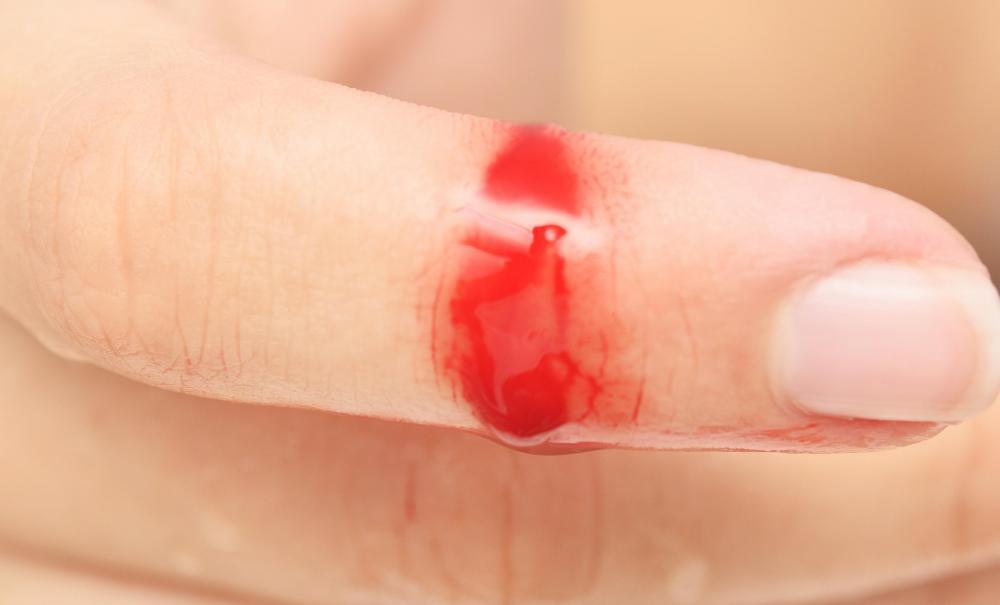
![Panthenol spray may be effective in speeding recovery from minor wounds.]() By: rufarPanthenol spray may be effective in speeding recovery from minor wounds.
By: rufarPanthenol spray may be effective in speeding recovery from minor wounds. -
![Panthenol is a common ingredient in insect repellents.]() By: Henrik LarssonPanthenol is a common ingredient in insect repellents.
By: Henrik LarssonPanthenol is a common ingredient in insect repellents. -
![Panthenol spray may be useful in treating bug bites.]() By: claffraPanthenol spray may be useful in treating bug bites.
By: claffraPanthenol spray may be useful in treating bug bites. -
![Panthenol spray may help soothe skin irritations.]() By: uwimagesPanthenol spray may help soothe skin irritations.
By: uwimagesPanthenol spray may help soothe skin irritations.






Discussion Comments
A friend of mines father owns a small pharmaceutical company. They specialize in medicated skin products. They are about to roll out a new product that they are particularly proud of. It is a burn spray that contains panthenol as one of its active ingredients. The idea is that you would spray the spray into your mouth after burning it on a hot cup of coffee or eating a hot cheesy piece of pizza. They are actually focusing their marketing on coffee shops and pizzerias.
I for one think this is a great idea. There is nothing worse that burning the roof of your mouth and then having it be numb, uncomfortable and tasteless for the rest of the day. I have been able to try the spray and it really works. I dived into a pan of lasagna too soon and burned my mouth really badly. A few mists of the spray and the pain was gone completely. I was able to go right back to enjoying my meal. I guess panthenol really works
This article brings up the issue of holistic vs western medicine. Despite the fact that people all over the world have been using a form of panthenol spray to treat wounds for many years, the western scientific community cannot prove its health benefits. This is not an isolated incident.
Often times western medicine dismisses traditional and folk remedies who have no greater science behind them then the strength of tradition. Just because they do not conform to the narrow standards of "healing" identified by our empirically obsessed culture, the are written off and mere placebos. But you can't argue with results. If people try this spray and it works and there are no side effects, I say keep it up. Just because science can't prove something doesn't mean that it doesn't exist/work.
Since panthenol has healing properties, it is also used to treat damaged hair. Hair that has been chemically altered by perms or highlights can benefit from panthenol.
Though nothing can totally undo the damage brought on by over-processing your hair, products using panthenol can help improve its appearance a bit. My hair fell victim to my need for change, and I had a perm, a straightener, and multiple highlights on the same hair without ever cutting any of it. Pieces of it would come off in my hand, and they were soft and frizzy, as though they had melted. Panthenol products at least gave what remained of my hair a sheen and softness.
I recently received minor burns from bacon grease, so I got some panthenol spray. I read that it is mixed with allantoin to treat mild burns and other skin irritations.
I wanted to know what I was spraying on my skin before I applied it, so I researched allantoin. Allantoin has soothing, healing, and moisturizing properties. It helps cells regenerate and encourages the growth of healthy new skin. It also softens skin and chemically removes dead or scaly tissue when applied to it. A low concentration of allantoin is very effective, as low as 0.1% and up to 2%.
After reading this, I wondered if Pantene hair products got their name from panthenol. I did some digging, and it seems that they did.
Switzerland is responsible for the development of the compound panthenol in 1940. In World War II, experimental treatments involving panthenol sought to cure burns, and during these treatments, people discovered that panthenol also improved the elasticity, health, and moisturization of the hair. So, the drug company from Switzerland, Hoffman-La Roche, invented Pantene shampoo and put it on the market in 1947. Though at first you could only get it in Europe, it gained a good reputation, and U.S. department stores picked it up.
Post your comments