
At DelightedCooking, we're committed to delivering accurate, trustworthy information. Our expert-authored content is rigorously fact-checked and sourced from credible authorities. Discover how we uphold the highest standards in providing you with reliable knowledge.
What is Oregano?
 Mary Elizabeth
Mary Elizabeth
Mary Elizabeth
An herb is a plant whose leaves, seeds, or flowers are used for flavoring food or in medicine. Other uses of herbs include cosmetics, dyes, and perfumes. The name derives from the Latin word herba, meaning “green crops.”
Oregano is a collection of perennials in the mint family. The most common include Greek (Origanum vulgare hirtum or Origanum heracleoticum), Italian (Origanum majoricum), Cretan (Origanum onites), and Syrian (Origanum syriacum). Note that the genera names Origanum and Marjorana are used interchangeably by some, and that the herb Marjoram (Origanum marjorana) is in the same family.
For several reasons, there is a great deal of confusion in distinguishing marjoram from oregano. For one thing, they have the same genus, Origanum, while the species differ. For another thing, people call them by each other’s names:
- Greek oregano, O. vulgare, is called not only wild marjoram, but also Spanish thyme.
- Cretan oregano, O. onites, is also called pot marjoram or French marjoram.
- Marjoram, O. marjorana, is also called pot marjoram.
- O. heracleoticum is sometimes known as winter marjoram.

So, you can see how confusing this may become. Marjoram and oregano have more than species and similarity of flavor in common. A USDA analysis showed that these two culinary herbs have the highest amount of antioxidants, and more when they’re fresh than when they’re dried.
But there are differences, too. Oregano is a hardy perennial, while marjoram is more sensitive; this herb may grow taller than marjoram. Also, marjoram prefers the soil slightly damper.

Another confusion arises between the oreganos mentioned above and Mexican oregano (Lippia graveolens or Lippia berlandieri). Mexican oregano is used in a similar way, but is actually an herb from a different family, with a similar taste but a higher amount of essential oil. There are other herbs that are called oregano, as well, in other parts of the world.
Description. The height and flowering characteristics of oregano vary a bit with each species. The Greek species grows to about 18 to 24 inches (46 to 61 cm), and has white flowers, which bloom from June to August. The leaves are grey-green.

Gardening. The plant spreads assiduously and can be propagated by division. While Greek oregano can grow in poor soil, it does not do well in wet soil. If the plant becomes woody, it can be cut back and will re-grow. It is often recommended for companion planting. Leaves can be used fresh, or dried and kept in an airtight container.
Food and Other Uses. Mexican oregano is found in chili powders, chili, and Latin American dishes. The other oreganos, particularly Greek, is likely to be found in other commercial herb blends. Unless you have access to the various subspecies, the Greek type is likely the one you would wish to use for Italian dishes such as tomato sauces and pizza, Greek meat and casserole dishes, Middle Eastern dishes, Spanish dishes, and French dishes. It is widely used in salad dressings, with vegetables, and in a number of strongly flavored dishes from a variety of cuisines.
Mary Elizabeth
Mary Elizabeth is passionate about reading, writing, and research, and has a penchant for correcting misinformation on the Internet. In addition to contributing articles to DelightedCooking about art, literature, and music, Mary Elizabeth is a teacher, composer, and author. She has a B.A. from the University of Chicago’s writing program and an M.A. from the University of Vermont, and she has written books, study guides, and teacher materials on language and literature, as well as music composition content for Sibelius Software.
Learn more...
Mary Elizabeth
Mary Elizabeth is passionate about reading, writing, and research, and has a penchant for correcting misinformation on the Internet. In addition to contributing articles to DelightedCooking about art, literature, and music, Mary Elizabeth is a teacher, composer, and author. She has a B.A. from the University of Chicago’s writing program and an M.A. from the University of Vermont, and she has written books, study guides, and teacher materials on language and literature, as well as music composition content for Sibelius Software.
Learn more...AS FEATURED ON:
AS FEATURED ON:


-
![Freshly picked oregano with small white blooms.]() By: TaigaFreshly picked oregano with small white blooms.
By: TaigaFreshly picked oregano with small white blooms. -
![Oregano is widely used in salad dressings.]() By: SunnySOregano is widely used in salad dressings.
By: SunnySOregano is widely used in salad dressings. -
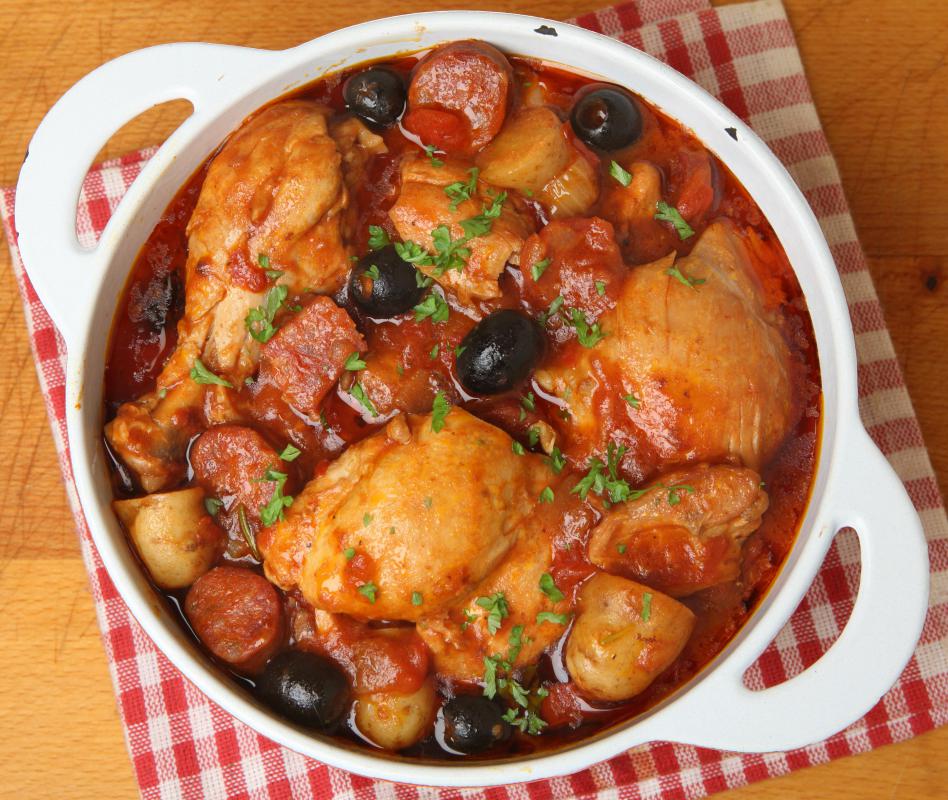
![Like many Italian dishes, chicken cacciatore is flavored with oregano.]() By: Joe GoughLike many Italian dishes, chicken cacciatore is flavored with oregano.
By: Joe GoughLike many Italian dishes, chicken cacciatore is flavored with oregano.


Discussion Comments
Oregano is an herb used in my favorite type of seasoning, herbes de Provence. This seasoning is the perfect mixture of several herbs that nearly everyone has on hand in their kitchen.
Oregano mixes with basil, sage, rosemary, thyme, and marjoram to form this seasoning. I use it on chicken, rice, and potatoes, usually all in one meal. I put it on before cooking the food, and it imparts such a delicious flavor.
I can definitely taste the oregano in the mix. Some of the other herbs fade into the background, but it is always at the forefront.
I will forever associate the flavor of dried oregano with pizza. It's been an ingredient in every pizza sauce I have ever bought, so the two will always be linked in my mind.
I've put oregano on other items because recipes called for it, but I always end up thinking that the food tastes like pizza. Maybe I should try fresh oregano instead. I know that fresh versions of herbs sometimes taste totally different than their dried forms.
Well, I've read all of the above and now I know all about the plant, but I'm not a gardener! This tells me nothing of what 'Oregano' actually is from a 'cooking' point of view, not useful as a chef whatsoever!
The picture and essence of what this site 'suggests' is misleading.
I'm a home cook (Chef) and wanted to know more about the 'herb' and its uses in cooking with a description of its flavor and possibly some dishes (or recipes) that it may be used in. I didn't want to know how to grow it or what plant family it is part of. Clear as mud!
i don't like the taste of oregano, but we found an idea to put extract of oregano on sweet foods to make them easy to eat for children. Yes, that's true. We try it on gelatin. it's so delicious that you don't know that it has an oregano extract.
--sun rose k.
I do not particularly like the taste of oregano, but I have found out that oregano contains a substance that fights inflammation. Since inflammation has been linked to many health problems, including cancer and heart disease, I guess i will slowly begin to "like" the taste of oregano.
Post your comments