
At TheHealthBoard, we're committed to delivering accurate, trustworthy information. Our expert-authored content is rigorously fact-checked and sourced from credible authorities. Discover how we uphold the highest standards in providing you with reliable knowledge.
What is Occupational Therapy for Children?
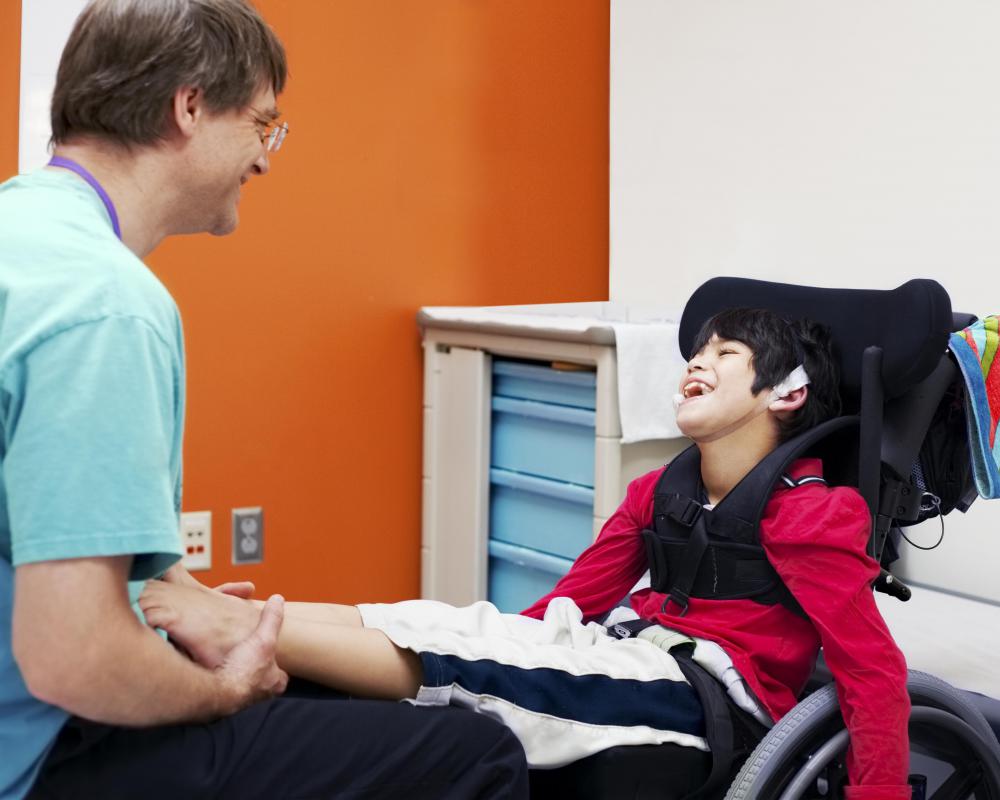
Occupational therapy for children is basically any sort of hands-on, interpersonal treatment between a medical professional and a child or group of children that is designed to help the equip the young participants with the skills needed to participate in everyday activities appropriate for their age. In most cases the specific course of treatment will depend on the child and his or her independent needs. This sort of therapy is very common for kids who have been seriously injured or who have been born with birth defects, but is it is also frequently recommended for people who have certain psycho-social conditions that might impair their ability to perform in school or in social settings. Therapy is often overseen by a medical professional, usually someone with training in sociology and psychology as well as basic care. In many cases the whole family is involved to at least some degree, too, to be sure that the child has a supportive structure at home that can facilitate his or her full integration into society.
Main Goals

The goal here, as it is with many if not most forms of therapy, is wholeness. Any number of conditions may be covered, including birth injuries or birth defects, sensory processing or integrative disorders, broken bones or other orthopedic injuries, and mental health or behavioral problems. No matter the underlying issue, the therapeutic process aims to help young people find fullness, whatever that looks like for their particular situation. Visual and perception skills, cognition, processing the senses, and fine motor skills all usually have at least some role to play. Treatment focuses on children achieving independence while enhancing their self-esteem and sense of accomplishment.
How It Works

Kids are usually referred to occupational therapy by a more general medical practitioner who either diagnoses an underlying condition that may be impeding the child’s development or notices more generalized problems that the child may be having when it comes to reaching certain developmental milestones. The therapists themselves usually have extensive training in exercises and games that can encourage a child’s muscles, brain, and mind to grow properly.

Programs are usually individually tailored to a specific child’s needs, though most regimens follow certain more or less “standard” protocol when it comes to activities, timing, and expectations. Depending on the nature of the issue, therapists may also rely on help from certain assistive devices like walkers and stretching machines. Children who are showing signs of improvement may be recommended for group therapy classes, too, though most programs begin as one-on-one sessions.
Session Specifics

Children getting occupational therapy typically perform a lot of exercises and “games” during the course of their sessions. They may practice writing, cutting, and other fine motor skills as well getting coaching in daily life skills, such as feeding and dressing themselves. When a child's strength and skills cannot be improved, other alternatives are often developed to allow for daily activities. Occupational therapists also evaluate a child's need for equipment such as hearing aids, bathing devices, and wheelchairs.

Therapy often includes fun, educational activities, too, to stimulate the playing and learning part of a child’s brain. Occupational therapists use toys when working on fine motor skills so that children can practice grasping and releasing, for instance, and–eye coordination is usually also a target; this sort of coordination is what is responsible for allowing children to engage in activities such as throwing a ball at a target, hitting a ball with a bat, or copying words written on a blackboard.
Emphasis on Family

Though the affected child is almost always the primary focus, many programs also look for ways of incorporating parents and siblings into care and rehabilitation plans. Therapists frequently offer guidance to family members about safe and effective methods of caring for their child, and may also communicate with the child’s doctors and teachers to ensure appropriate treatment. In this way the counselor acts as something of a liaison and advocate who lobbies for consistent care across the social and familial space.
Special Considerations for Autism

For children with autism, occupational therapy is often sensory-based and helps them integrate their sensory systems within the environment. Therapy works on initiating and sustaining purposeful play and interacting with others. Occupational therapy for children with autism can involve swings, deep touch, and massage. It typically also addresses anger-management techniques like writing about feelings or participating in physical activities instead of acting out or hitting others.
AS FEATURED ON:
AS FEATURED ON:


-
![An occupational therapist may utilize toys when working on a child's fine motor skills and hand-eye coordination.]() By: shootingankaufAn occupational therapist may utilize toys when working on a child's fine motor skills and hand-eye coordination.
By: shootingankaufAn occupational therapist may utilize toys when working on a child's fine motor skills and hand-eye coordination. -
![Occupational therapy may help children develop fine motor skills, like writing.]() By: KalimOccupational therapy may help children develop fine motor skills, like writing.
By: KalimOccupational therapy may help children develop fine motor skills, like writing. -
![Occupational therapy may help children learn how to feed themselves.]() By: zest_marinaOccupational therapy may help children learn how to feed themselves.
By: zest_marinaOccupational therapy may help children learn how to feed themselves. -
![Occupational therapy may teach children daily life skills, such as dressing themselves.]() By: svetamartOccupational therapy may teach children daily life skills, such as dressing themselves.
By: svetamartOccupational therapy may teach children daily life skills, such as dressing themselves. -
![Occupational therapy may help children learn how to interact with one another.]() By: SergiyNOccupational therapy may help children learn how to interact with one another.
By: SergiyNOccupational therapy may help children learn how to interact with one another. -
![Occupational therapy for children may help children build and strengthen muscles.]() By: Jaren WicklundOccupational therapy for children may help children build and strengthen muscles.
By: Jaren WicklundOccupational therapy for children may help children build and strengthen muscles. -
![Occupational therapists may be able to tell if a child needs a hearing aid or other device.]() By: BandikaOccupational therapists may be able to tell if a child needs a hearing aid or other device.
By: BandikaOccupational therapists may be able to tell if a child needs a hearing aid or other device.






Discussion Comments
Sunny27- That is a great idea. My children have sloppy handwriting and I would like to help them write neater. They don’t need a therapist but I think I am going to get that book.
I think that developing the muscles in their hands helps with handwriting coordination. I heard that having them play with modeling clay and play dough really strengthens the hand muscles. I know most kids have problems with handwriting when they are really young.
I know my niece had trouble in kindergarten and then when she reached third grade, her handwriting was better than her mother’s.
Great article- I just want to add that occupational therapists also offer assistance with fine motor skills. Children needing occupational therapy often have problems with manual dexterity.
The therapist assists with handwriting and coordinating the proper stroke to successfully write words. There is a great program called “Handwriting Without Tears” that was developed by an occupational therapist that teaches children with coordination issues how to properly form the letters. The program is used in many schools and is also available in the home-school market. Parents can buy the books as well many colorful manipulatives.
Post your comments