
At AllThingsNature, we're committed to delivering accurate, trustworthy information. Our expert-authored content is rigorously fact-checked and sourced from credible authorities. Discover how we uphold the highest standards in providing you with reliable knowledge.
What is Obsidian?
 Tricia Christensen
Tricia Christensen
Tricia Christensen
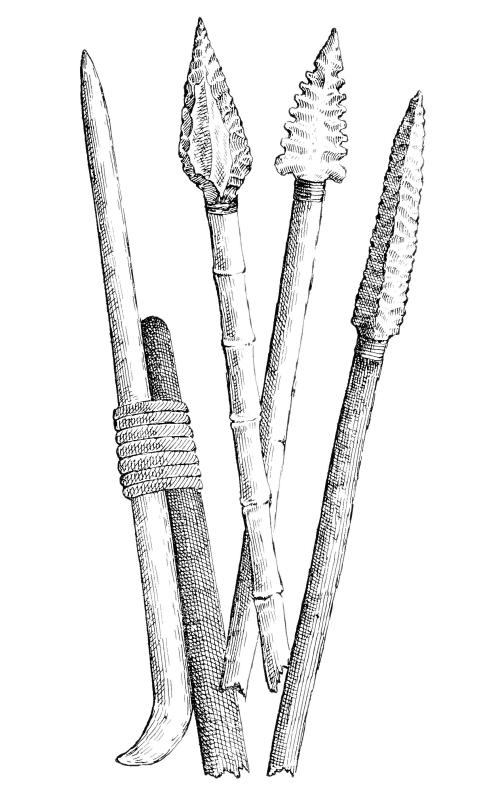
Obsidian is a glassy black substance formed when lava cools in a short amount of time. Due to the rapid rate of cooling, very few crystals can form in the material. This makes obsidian essentially a natural glass, and it has proven useful because of its lack of crystals. In particular, it can be cut to have very sharp edges. It was a favored material for weapons during the Stone Age, and is still used in some surgical instruments today.
It’s not hard to recognize obsidian. It is often black in color, and even in unpolished form it is often quite shiny. It’s made up of about 70% silicon dioxide or more, which accounts for its color. However, if obsidian mixes with some minerals it can take on other colors. For example, a high level of iron or magnesium may cause the rock to appear dark green instead of black. Some has a snowflake pattern that results from cristobalite forming on the top.
In other instances, the substance bubbles and forms into layers. This can create rainbow or golden obsidian. These two variants are more difficult to find in great quantity.

Obsidian is not really a mineral or a rock, because it does not contain crystalline structures. Some refer to it as a mineraloid. A mineraloid is a mineral-like substance that lacks crystal structures. Other examples of mineraloids include opals and pearls.
It is a relatively soft substance, with only a rating of about 5 to 5.5 on the Mohs Scale. However, despite its softness, it was a preferred material for manufacturing weapons since it could be refined to have a very sharp edge. One can still find arrowheads throughout North America made from obsidian. It could also be used for decorative purposes. The stone statues on Easter Island are made from this material.

Some surgeons, particularly cardiothoracic surgeon, use scalpels and surgical knives made of obsidian. The sharper the knife can be, the less damage it does to the tissues when cutting. These special surgical cutting instruments often lessen healing time because of their sharpness.
One can find obsidian in numerous places on the earth, particularly in areas like quarries, or where there has been volcanic activity. However, it does deteriorate into tiny glass crystals over time. There are no examples from earlier than the Cretaceous Period, 145 to 400 million years ago.
Frequently Asked Questions
What is obsidian and how does it form?

Obsidian is a naturally occurring volcanic glass formed when felsic lava extruded from a volcano cools rapidly with minimal crystal growth. It's typically rich in silica and forms when lava with high viscosity cools quickly, often at the edges of a volcanic dome or in the aftermath of a volcanic eruption. Its glassy texture is a result of the rapid cooling which prevents the formation of a crystalline structure.
Where can obsidian be found?

Obsidian can be found in areas with volcanic activity. Notable locations include the Yellowstone Park in the United States, the Eolie Islands in Italy, and various sites in Iceland and Mexico. It's usually discovered in the vicinity of rhyolitic lava flows known as obsidian flows, where the chemical composition promotes the formation of a glass rather than a crystalline structure.
What are the uses of obsidian?
Historically, obsidian was used by early humans to craft tools and weapons due to its sharp edges when fractured. Today, it's valued in decorative items and jewelry. Surprisingly, it also has medical applications; obsidian blades can be sharper than steel and are sometimes used in precision surgical instruments. Additionally, it's a popular material in landscaping and tiling.
Is obsidian the same as black glass?
While obsidian is often referred to as "black glass," it is not the same as man-made black glass. Obsidian is a natural volcanic glass with unique properties and formation processes, whereas black glass is a human-made product. Obsidian contains impurities and may display different colors and sheens, unlike the uniform appearance of manufactured glass.
Can obsidian be found in different colors?
Yes, obsidian can be found in a variety of colors. While black is the most common, it can also appear in brown, tan, green, or even a translucent variety known as Apache tears. The presence of trace elements and inclusions can lead to these color variations. For example, iron and magnesium can give obsidian a dark green to brown hue.
How is obsidian used in crystal healing?
In crystal healing, obsidian is said to have protective qualities, grounding the spirit and warding off negativity. It's often used to promote emotional healing, helping to release anger and tension. Healers may use different colored obsidians for specific purposes, such as golden sheen obsidian for balancing energy fields and snowflake obsidian for purity and balance.
Tricia Christensen
Tricia has a Literature degree from Sonoma State University and has been a frequent AllThingsNature contributor for many years. She is especially passionate about reading and writing, although her other interests include medicine, art, film, history, politics, ethics, and religion. Tricia lives in Northern California and is currently working on her first novel.
Learn more...
Tricia Christensen
Tricia has a Literature degree from Sonoma State University and has been a frequent AllThingsNature contributor for many years. She is especially passionate about reading and writing, although her other interests include medicine, art, film, history, politics, ethics, and religion. Tricia lives in Northern California and is currently working on her first novel.
Learn more...AS FEATURED ON:
AS FEATURED ON:









-
![Prehistoric tools included spears with stone heads that were chipped to gain a sharper edge.]() By: Erica Guilane-NachezPrehistoric tools included spears with stone heads that were chipped to gain a sharper edge.
By: Erica Guilane-NachezPrehistoric tools included spears with stone heads that were chipped to gain a sharper edge. -
![When lava cools in a short amount of time, obsidian is formed.]() By: siimseppWhen lava cools in a short amount of time, obsidian is formed.
By: siimseppWhen lava cools in a short amount of time, obsidian is formed. -
![Scalpels are commonly made of obsidian.]() By: Marina LohrbachScalpels are commonly made of obsidian.
By: Marina LohrbachScalpels are commonly made of obsidian. -
![Surgeons commonly use scalpels and surgical knives that are made of obsidian.]() By: Photographee.euSurgeons commonly use scalpels and surgical knives that are made of obsidian.
By: Photographee.euSurgeons commonly use scalpels and surgical knives that are made of obsidian.


Discussion Comments
Very helpful. It helped my on my project!
I think of iridescent things like opals when I think of rainbows, so this obsidian disappointed me. Supposedly, if you polish it really well, you can see a rainbow of colors in it. Well, all I saw was a hint of purple and green, and that was only if the light hit it just right.
I think snowflake obsidian is much more lovely, because it has obvious white patterns in it that you don’t have to struggle to see. I have a ring made of this, and it is my favorite piece of jewelry. I ended up giving the rainbow obsidian earrings away.
The body of the bird is solid, shiny black, and that is where they obsidian was used. The beak is orange, and I believe it was carved from jade.
Other than the fact that it is super shiny, the toucan is rather realistic looking. I’m sure that toucans are not quite as glassy as obsidian, though.
I could test the hardness and other properties of obsidian, which was actually my favorite piece in the set. It was so shiny, yet it was so smooth and didn’t contain any glittery crystals at all.
I worked with the other stones as well, but my eye was always drawn back to the obsidian. Something about the intensity of the blackness intrigued me.
When you look at a piece of snowflake obsidian, you would think that someone had either etched the patterns into it or painted them on somehow. It is hard to believe that something that perfect could occur as lava cools!
My grandmother has a necklace with a round piece of snowflake obsidian on it, and it is very elegant. She wears it with solid colors and either silky or velvety materials for a dramatic effect.
looking for the value of an approximate 25 pound black with silver obsidian. can you help? Leave a note here if that's OK. ciao.
Post your comments