
At TheHealthBoard, we're committed to delivering accurate, trustworthy information. Our expert-authored content is rigorously fact-checked and sourced from credible authorities. Discover how we uphold the highest standards in providing you with reliable knowledge.
What is Noninvasive Surgery?
Noninvasive surgery is defined as any surgical procedure that does not require penetration into the body either through an incision, cut, or piercing through the skin or by entering into a body cavity. This should not be confused with minimally invasive surgery, which can involve small incisions and instruments entering the body. Surgery that is noninvasive is generally limited in scope.
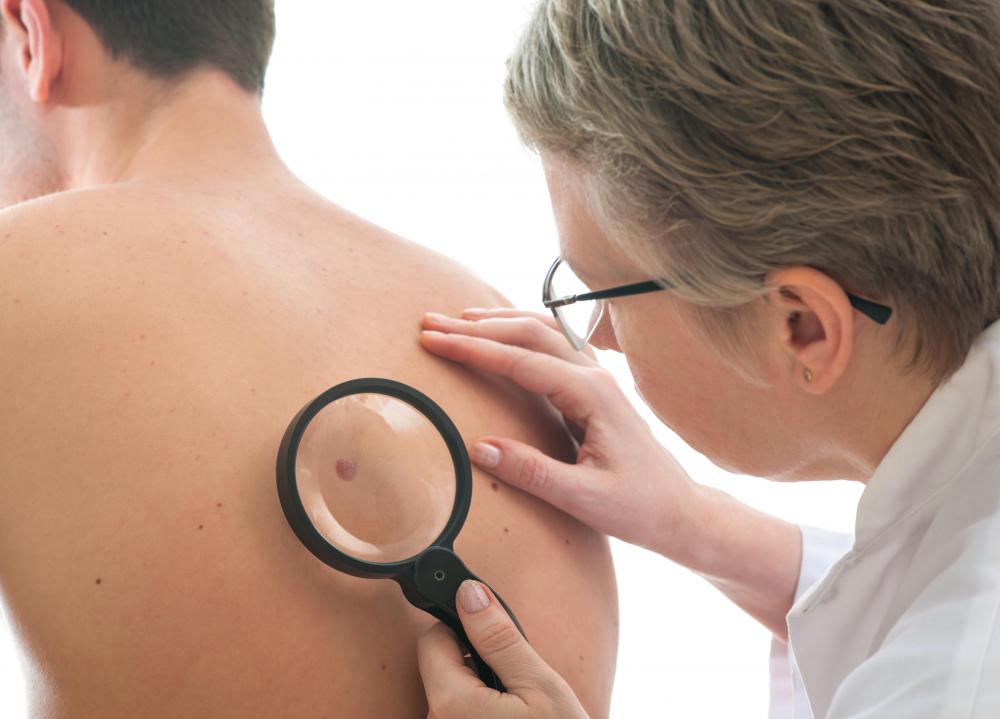
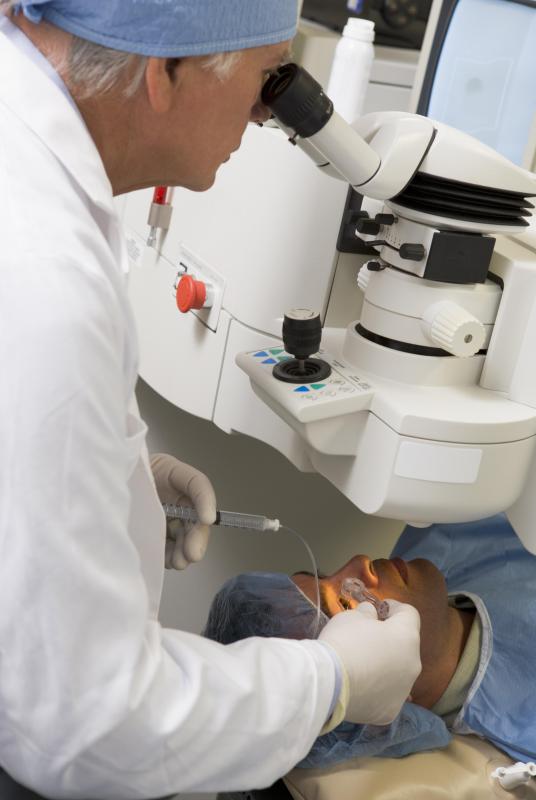
Examples of commonly preformed noninvasive surgery are laser surgery and dermatological procedures. Laser surgery is a surgical procedure in which a laser light beam is used to heat cells or tissue with the intent of manipulating or bursting them. Noninvasive laser surgery can be preformed to shrink tumors; remove moles, warts, and other skin blemishes; remove hair; and reduce wrinkles in the skin. LASIK eye surgery is another form of non-invasive surgery that uses a laser to reshape the cornea to correct vision problems. Lasers are also frequently used in combination with invasive surgical procedures as a way to seal blood vessels and minimize blood loss.

Though this type of surgery is performed to correct small problems rather than life-threatening issues and is typically an elective procedure, it is not risk free. Generally, the surgery is performed either with local anesthesia or no anesthesia, but some procedures may require general anesthesia, which always poses a risk. In most cases, infection is the biggest risk of any operation, but it is minimal compared to other surgical procedures.

Noninvasive surgery, though minor, should always be performed in a sterile environment. Typically, such a procedure can be performed in a physician's office, rather than at a hospital. Because this type of surgery is common in dermatology, most offices are equipped to perform common procedures. In the case of LASIK eye surgery, the doctor usually has a designated facility. Even though the skin is not broken and no body cavity is entered, this surgery still requires the use of preventative measures, such as sterile gloves and instruments, to help prevent the risk of infection afterwards.
AS FEATURED ON:
AS FEATURED ON:


-
![Noninvasive surgery can be performed to reduce wrinkles.]() By: michaeljungNoninvasive surgery can be performed to reduce wrinkles.
By: michaeljungNoninvasive surgery can be performed to reduce wrinkles. -
![Non-invasive surgery does not require the use of a scalpel.]() By: iofotoNon-invasive surgery does not require the use of a scalpel.
By: iofotoNon-invasive surgery does not require the use of a scalpel. -
![LASIK eye surgery is an example of noninvasive surgery.]() By: blueringmediaLASIK eye surgery is an example of noninvasive surgery.
By: blueringmediaLASIK eye surgery is an example of noninvasive surgery. -
![Dermatologists often perform noninvasive surgery.]() By: Alexander RathsDermatologists often perform noninvasive surgery.
By: Alexander RathsDermatologists often perform noninvasive surgery. -
![Laser eye surgery is considered noninvasive.]() By: Monkey BusinessLaser eye surgery is considered noninvasive.
By: Monkey BusinessLaser eye surgery is considered noninvasive. -
![Some types of surgery are more invasive than others and require that the patient is given general anesthesia.]() By: maska82Some types of surgery are more invasive than others and require that the patient is given general anesthesia.
By: maska82Some types of surgery are more invasive than others and require that the patient is given general anesthesia. -
![Noninvasive laser surgery can be preformed to remove skin blemishes.]() By: mkrberlinNoninvasive laser surgery can be preformed to remove skin blemishes.
By: mkrberlinNoninvasive laser surgery can be preformed to remove skin blemishes.




Discussion Comments
@Mor - I think it's more likely that we will get more and more minimally invasive surgeries. There's only so much a doctor can do from the outside. Laparoscopic surgery and robotic surgeries are becoming more and more common now though.
The only exception to this I can think of is if they one day develop a viable nanobot that can do surgeries. But, even then the nanobot will be "invading" the body, even if they aren't entering from an incision.
They would probably be put into a category of their own anyway.
@anon315293 - Yes, I think that counts as well. They use ultrasound waves to break up kidney stones sometimes as well.
I suspect that in the future there will be more and more noninvasive surgeries as we get better and better at manipulating forces like this.
It's also interesting to speculate on whether or not the use of techniques like putting bacteriophages into a person counts as being a noninvasive surgical technique. It can certainly make a difference but it doesn't involve putting instruments into the body either.
What about the fact that ultrasonic waves can be used to treat patients suffering from Parkinson's disease? Isn't that some sort of achievement?
It's true that noninvasive surgery seems mainly to be used to correct small problems rather than life-threatening issues but one exception I can think of off the top of my head is radiation therapy.
Focused Ultrasound is another example of non-invasive surgery. This is an incisionless procedure that can be used to treat fibroids.
Post your comments