
At AllTheScience, we're committed to delivering accurate, trustworthy information. Our expert-authored content is rigorously fact-checked and sourced from credible authorities. Discover how we uphold the highest standards in providing you with reliable knowledge.
What is Motion Physics?
 Mary Elizabeth
Mary Elizabeth
Mary Elizabeth
Motion refers to a change in location. Physics is the scientific study of matter, energy, and the interactions between them. It includes fields such as acoustics, cryogenics, electromagnetism, optics, and mechanics, which refers to the study of how force act on matter or material systems and includes motion physics, the scientific study of movement.
In motion physics, it is typical to speak of the change in location of a “body.” Applied force is the initiator of a change in motion, which can mean starting motion, stopping motion, or changing direction. Without an applied force, bodies tend to resist acceleration and to stay at rest if they are at rest or, when moving in a straight line, to continue moving in a straight line.

Motion is usually described using several typical parameters, including velocity. Velocity is the rate of change in a body’s position, so it refers to both speed — distance covered in a certain amount of time — and direction, and so it is a vector. Despite this, it is often represented by the equation v = d/t, where v represents velocity, d represents distance, and t represents time. It is usually reported in meters per second.
The second parameter is acceleration, which is the change in velocity over time. Like velocity, acceleration is a vector. It is caused by a force applied to the body.

The greater the mass of the body, the more force must be applied to cause a certain amount of acceleration. This relationship is expressed by the equation F = ma where F represents force, m represents mass, and a represents acceleration. The directional aspect of the force is also important. Acting in the same direction as the original velocity of a body, force will only change speed and not direction. Acting in the opposite direction of the original velocity, the speed will be decreased, rather than increased.
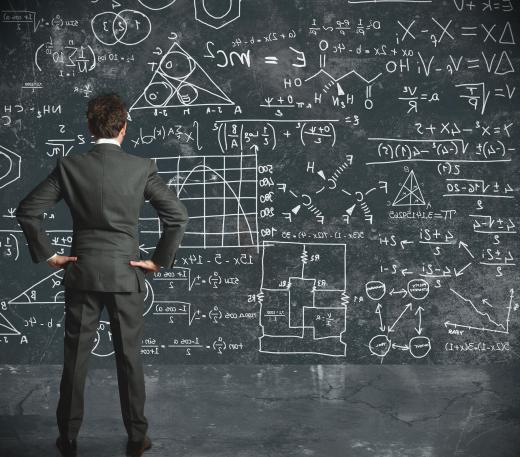
Momentum is another term frequently used in motion physics and, like velocity, it is a vector. As defined in classical mechanics, momentum is the product of the velocity of an object and its mass. It is expressed by the equation p = mv where p represents momentum, m represents mass, and v represents velocity. The directionality of momentum is the same as the directionality of velocity, and the change in momentum when a force is applied is related to both the amount of force and the length of time for which it is applied.
Mary Elizabeth
Mary Elizabeth is passionate about reading, writing, and research, and has a penchant for correcting misinformation on the Internet. In addition to contributing articles to AllTheScience about art, literature, and music, Mary Elizabeth is a teacher, composer, and author. She has a B.A. from the University of Chicago’s writing program and an M.A. from the University of Vermont, and she has written books, study guides, and teacher materials on language and literature, as well as music composition content for Sibelius Software.
Learn more...
Mary Elizabeth
Mary Elizabeth is passionate about reading, writing, and research, and has a penchant for correcting misinformation on the Internet. In addition to contributing articles to AllTheScience about art, literature, and music, Mary Elizabeth is a teacher, composer, and author. She has a B.A. from the University of Chicago’s writing program and an M.A. from the University of Vermont, and she has written books, study guides, and teacher materials on language and literature, as well as music composition content for Sibelius Software.
Learn more...AS FEATURED ON:
AS FEATURED ON:









-
![Motion physics is the scientific study of movement.]() By: Aleksandr BedrinMotion physics is the scientific study of movement.
By: Aleksandr BedrinMotion physics is the scientific study of movement. -
![Motion physics can be applied to many aspects of everyday life, including sports, because it explains velocity and acceleration.]() By: Lario TusMotion physics can be applied to many aspects of everyday life, including sports, because it explains velocity and acceleration.
By: Lario TusMotion physics can be applied to many aspects of everyday life, including sports, because it explains velocity and acceleration. -
![Kinematics is the study of motion and the development of equations to describe the motions of objects.]() By: alphaspiritKinematics is the study of motion and the development of equations to describe the motions of objects.
By: alphaspiritKinematics is the study of motion and the development of equations to describe the motions of objects.


Discussion Comments
"Motion refers to a change in location…"
Yet location would have first to be physically defined.
Then one would have to explain what happens in between two locations!
I thought about motion, and one has to humbly admit that motion, even though a mundane phenomenon, remains a mystery of nature!
Furthermore, according to the "uncertainty principle," the concept of position (location) disappears at micro scales.
First law: A stationary object can begin to move only if a force acted on it. The motion will be in the direction of the force. For instance, a ball on the pitch can only move if you kick it.
Also a moving object can stop only if a force acts on it.
This behavior of objects is called inertia. That means objects do not want to start moving unless they are forced and they do not want to stop moving unless they are forced. You could sat objects are very lazy!
That is what Newton is saying in his first law.
A clear explanation of the laws of motion is in the book by B. Dmitriev "What is motion?"
@ parmnparsley- There are three laws that control motion in physics.
The law of inertia is the first law, and it has two main points. The first part of inertia states a stationary object cannot move unless something exerts a force on that object. The second part is the inverse, stating that a body in motion cannot change velocity unless there is a force applied to it.
The second law of motion describes force, and how it is directly proportional to acceleration. This law establishes the premise that force is equal to the acceleration of a mass. This law allows people to determine the mass, acceleration, or force involved in a motion while only knowing two variables.
The third law describes the reciprocal nature of motion. The law states that the force exerted on an object reciprocates an equal and opposite force.
People use these laws in many different situations to describe the effects of motion. This includes determining the amount of force exerted on the body during an accident.
What are Newton’s laws of Motion? I know they have to do with force, but I do not understand how they work.
The reason I ask is I have a friend who was working on a problem relating to the forces applied on a human body during a car accident. He said he could solve the problem by using Newton’s laws of physics.
He tried to explain them to me, but he had trouble explaining the concept of one of the laws. I also wasn’t paying close enough attention to follow what he was talking about. Can anyone give me a clear explanation of the laws of motion?
Post your comments