
At TheHealthBoard, we're committed to delivering accurate, trustworthy information. Our expert-authored content is rigorously fact-checked and sourced from credible authorities. Discover how we uphold the highest standards in providing you with reliable knowledge.
What is Monovision?
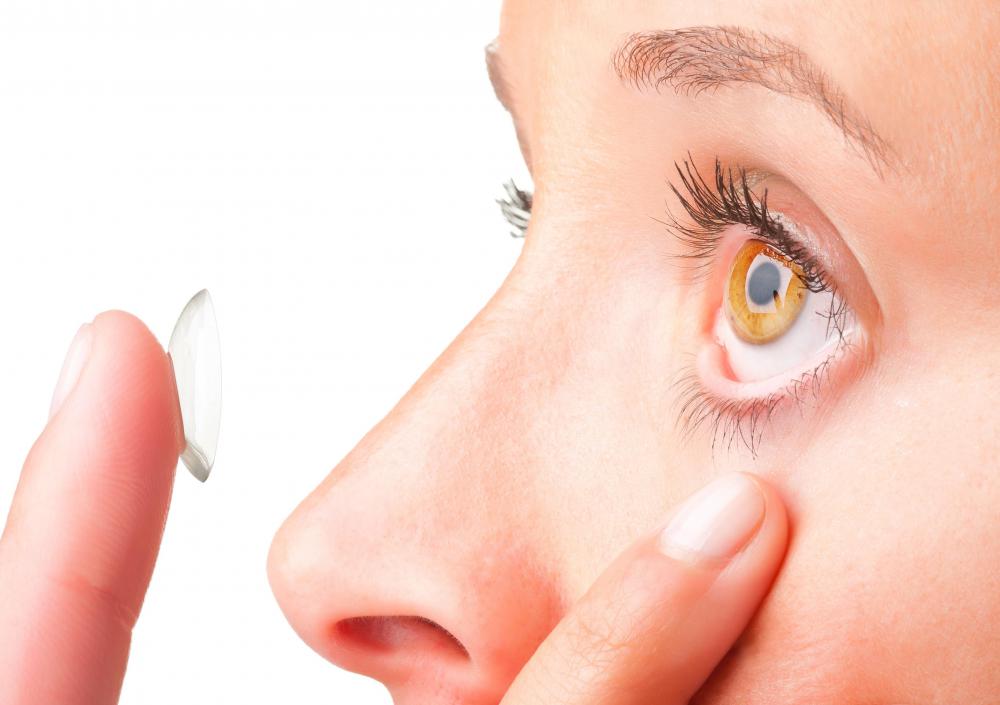
Monovision is the method of using one eye for distance vision and the other eye for near vision. Contact lenses, refractive surgery, and intraocular lenses are all methods used for monovision. When a patient chooses monovision, the dominant eye, or the one that would be used to focus on a camera, becomes the distance eye and the other eye is focused for close vision.
The monovision method works because the brain learns to adapt to which eye sees at which distance. This method is also a form of a concept known as simultaneous vision. There is usually an adjustment period in adapting to this method of vision. Most patients find they are able to adjust. Because surgery is a permanent solution, doctors advise that patients try monovision contact lenses first.

Disadvantages of monovision include a lack of visual sharpness. Persons who require very sharp vision due to a hobby or occupation may not be pleased with monovision results. Another drawback of monovision is that some patients experience decreased depth perception or blurred vision in the eye that focuses on near vision in certain situations.
Some patients report problems with seeing shadows when trying to read small print. Because of these side effects, it might still be necessary to wear prescription glasses for some activities, such as night driving. An advantage of monovision over other options, such as multifocal lenses, is lower cost. Multifocal lenses have separate portions of the lens focused for near vision and for distance vision.

With the popularity of Lasik surgery, which restores a patient’s ability to see without glasses, some patients over 40 years of age may be forced to give up their ability to see close up so that they can see at a distance. Some choose monovision as a compromise.
Presbyopia, the inability of the eye to focus at near, middle, and far distances, occurs in most people around age 45. It is thought to occur because the eye’s natural lens loses its elasticity and the ability to be flexible and focus as it did at a younger age. Presbyopia makes it difficult to read or see at a close distance and usually requires reading glasses. Because presbyopia is a continuous condition, the ability to focus decreases every few years, usually until a person reaches his or her mid-60s.
AS FEATURED ON:
AS FEATURED ON:


-
![Some people use one eye for distance vision and the other for near vision.]() By: Pavel LosevskySome people use one eye for distance vision and the other for near vision.
By: Pavel LosevskySome people use one eye for distance vision and the other for near vision. -
![Doctors often advise the use of monovision contact lenses before surgery.]() By: ruigsantosDoctors often advise the use of monovision contact lenses before surgery.
By: ruigsantosDoctors often advise the use of monovision contact lenses before surgery. -
![Reading glasses are often prescribed for patients with presbyopia.]() By: philip kinseyReading glasses are often prescribed for patients with presbyopia.
By: philip kinseyReading glasses are often prescribed for patients with presbyopia. -
![Some patients over the age of 40 may be forced to give up their ability to see close up in order to see at a distance.]() By: JackFSome patients over the age of 40 may be forced to give up their ability to see close up in order to see at a distance.
By: JackFSome patients over the age of 40 may be forced to give up their ability to see close up in order to see at a distance. -
![Some patients who use monovision experience blurred vision and problems with depth perception.]() By: bellemediaSome patients who use monovision experience blurred vision and problems with depth perception.
By: bellemediaSome patients who use monovision experience blurred vision and problems with depth perception. -
![Monovision is sometimes referred to as simultaneous vision.]() By: FotolEdharMonovision is sometimes referred to as simultaneous vision.
By: FotolEdharMonovision is sometimes referred to as simultaneous vision. -
![Some people with monovision report problems seeing shadows when trying to read small print.]() By: pathdocSome people with monovision report problems seeing shadows when trying to read small print.
By: pathdocSome people with monovision report problems seeing shadows when trying to read small print. -
![Monovision may be utilized after a Lasik procedure has removed the need for glasses or contacts.]() By: Peter Orsaeo SrMonovision may be utilized after a Lasik procedure has removed the need for glasses or contacts.
By: Peter Orsaeo SrMonovision may be utilized after a Lasik procedure has removed the need for glasses or contacts.




Discussion Comments
My wife has had natural monovision since birth, and recently (at 71 years old) had cataract surgery. Because of her age, the doctor preserved her monovision since she would have had extreme difficulty adjusting to having normal binocular vision. Although her near sighted eye doesn't focus quite as close as she always did (she used to hold a paper about 8 inches away to read, and could read the micro-print on the border of checks). she now sees well at about 18 inches.
I have always had visual issues (I'm old now) and I'm quite curious. I was diagnosed with amblyopia as a youth, Identified natural monovision, and stigmatism. I often see double and sometimes, as a child, would seem to see thru items. My eyes were not focusing together and one sees completely different from the other. I had great difficulty reading as I would see the latter part of a sentence before I saw beginning or middle. Transposing was a constant problem. (school stairwell sign always appeared to say" run don't walk"). Glasses would make distant items clear but still too far to read. I usually can read a road sign as I pass it. Ironically, my vision improved a good deal and restrictions were removed from my driver's license, but I really can't see very well. I'm comfortable driving to familiar destinations. Now I'm told cataracts are beginning but not severe enough for surgery. I'd like to believe it will help if I ever get to that point. Would anyone be able to identify a specific problem for my many concerns?
I am 51 years old and I have worn contacts for more than 30 years. Three years ago I began using monovision correction with one contact lens for distance vision, leaving the other eye uncorrected for close vision. (I switch eyes every six months or so.) When I began doing this, my left eye prescription was -3.50 and the right was -3.75. I went without insurance for a couple of years, and just recently went back to the optometrist and my vision in both eyes dramatically improved over the three years since my last exam! I just left the optometrist and my contact lens prescription is -2.25 in both eyes. Has anyone else had dramatic vision improvement as a result of monovision correction?
I had cataract surgery (so far left eye only) with the expectation that I would be corrected for distance and still use readers. It didn't work out that way. I have up close in the left eye and no longer require readers, and, my job requires that I be on a computer all day.
Now it is time for the IOL for the right eye that is my distance eye and I am worried that it may turn out like the left and and up having only near vision acuity.
In short, I am loving the monovision and fear that I may lose it. I guess there is always LASIK for the right eye if I need it.
Just to be clear: throughout my life my left eye was always my dominant eye and that switched in recent years, so shooting and archery were left handed and that is now not an option without corrective lenses. Bummer.
I just had cataract surgery in my left eye. I am nearsighted in my right eye and have a cataract that needs to be surgically removed. I am having a difficult time adjusting to the "monovision" due to this surgery. My optometrist had given me five different prescription strength contact lenses to try to adjust to.
I had previously worn contact lenses in both eyes due to nearsightedness. Any suggestions would be greatly appreciated
I am about eight hours with monovision via contact lenses. I have a reading correction lens in my left eye, and nothing in my right (dominant) eye. I'm loving it! I can read and use the computer without looking for my reading glasses. I am gradually getting used to the difference between each eye. Others state what I have found out: if you think about it, there will be a noticeable difference. If you forget about it, you don't notice. I am delighted with the results.
I've been wearing monovision lenses. These are my regular Acuvues, except my dominant eye has a stronger distance lens and my non-dominant eye has a close correction lens. It's cool how it works. My only issue is the mid-distance like the computer and the grocery store. I'm hoping that gets better, but I can live with it.
I could not live with the bifocal contacts as they gave me really bad headaches even after three weeks.
I am now two hours into monovision with contact lenses. Drove home with them. Testing, reading on my droidx, and watching tv. I have mild eye strain but think this might work! It is so weird that when I remember, things go out of focus and when I forget things are clear.
Monovision is great as long as you aren't expecting perfection. They say presbyopic patients are the most grateful because they can't see clear at any distance. I wore monovision contacts for five years and recently had surgery monovision with lasik.
I'd say my vision is almost exactly as it was with the contacts. Definitely try it with contacts first and give yourself time to adjust. Sometimes when I'm reading, I have tears of joy over the being able to read again without aids. It's really a miracle, Lasik.
I am in my late 50's. I have worn contact lenses since they were introduced and the last couple of years accommodating my vision with readers. This last eye examination, my doctor suggested Monovision. Well, anything is better than readers. Needless to say it's been 2months and I have yet to get used to them. My biggest problem is the feeling of being sleepy. I can focus afar and focus near. Just that sleepy light headed feeling is very annoying.
But like I said anything is better than the readers. I will continue with these lenses and hope that I will someday learn to live with them.
I'm two days into my monos, and my distant vision comes in/out of focus. Near and middle are clear.
First few hours I felt some mild eye strain. Better now.
One silly thing to remember: when you think about it it goes out of focus, as when you forget - it's goes clear! The mind is a funny thing.
I was recently told I naturally have monovision. I didn't know what it was until I searched it on the web. I have one eye that sees good up close and the other one sees good far away. The man who gave me the exam was pretty excited about it. He said people wear contacts or have surgery to have this condition. I would have never known.
I am seriously considering monovision lenses as using reading glasses...where are they? did I leave them at home? etc etc is very annoying and titing....I am looking for input on this as I try to consider this option.....
I have just started with monovision. (about six hours) I can read now without reading glasses, but I am having some problems with far away. My question is ....How long does it take the brain to adjust to this.
I need Customvue PRK on my non-dominant left eye to correct for blurred/mild ghost images but am considering leaving it slightly under corrected for reading without glasses as I age. My work requires reading fine print from a distance of 1-3 feet away and I desperately want to delay the need for reading glasses/contacts as long as possible. I'm 39 years old with -0.5 nearsighted vision with 2 diopeters of irregular astignmatism and thin cornea (430) in my left non-dominant eye. Nine months ago I had Customvue PRK done on my dominant right eye with similar specs and quality results - 20/15 far vision and solid clear near vision for reading fine print as close (but not closer than) one foot away.
Am I right in thinking that less ablation and reading fine print in the one to three feet range should be better preserved if I leave my left eye slightly nearsighted (now it reads fine print clearly only from 6-10 inches away) and correct primarily for astigmatism and higher order aberrations? Or does 20/15 vision in my right eye substantially delay presbyopia's effect as I age in my critical reading distance (1-3 feet) and negate the need to under correct my left eye?
Post your comments