
At WiseGEEK, we're committed to delivering accurate, trustworthy information. Our expert-authored content is rigorously fact-checked and sourced from credible authorities. Discover how we uphold the highest standards in providing you with reliable knowledge.
What is Modulation?
 Malcolm Tatum
Malcolm Tatum
Malcolm Tatum
Modulation is the means whereby a signal of some type is entered into and carried by an electronic signal carrier. Within the scope of modulation, the type of signal or information that is introduced into and carried by the electric or optical signal carrier may vary, depending on the configuration of the carrier and the source. Different types are used with various types of broadcast and communication mediums today.
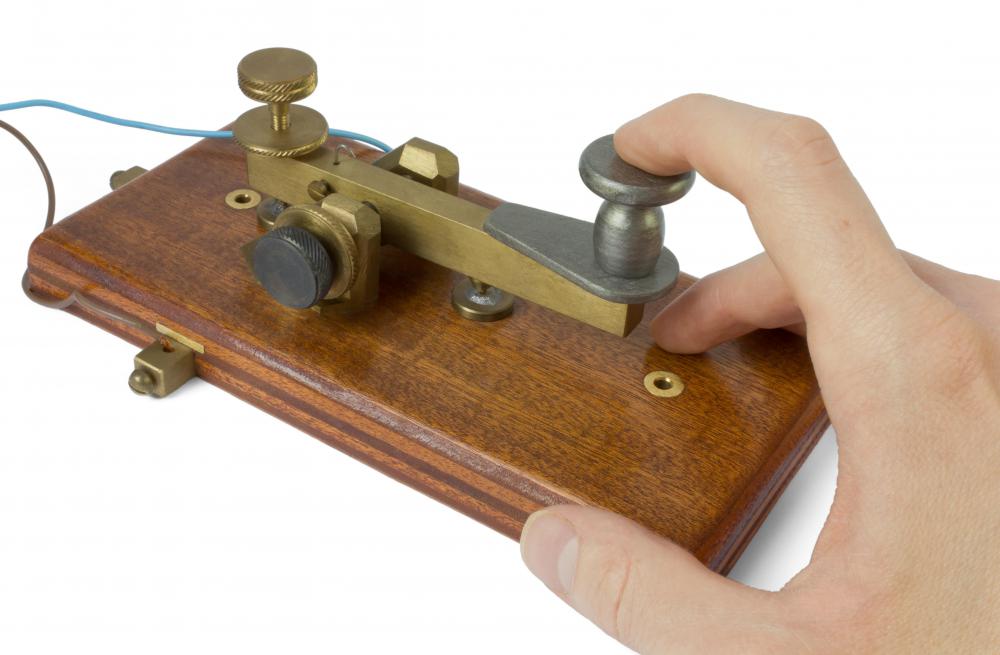
The use of modulation has been part of technology ever since electricity was harnessed and used for communication purposes. An excellent elementary example has to do with early telegraph technology. Using what was essentially binary code, telegraphs would forward a message that could be interpreted at the receiving end, decoded, and presented to the recipient. This form relied upon a more or less stable type of modulation that did not increase or decrease during the signaling process.

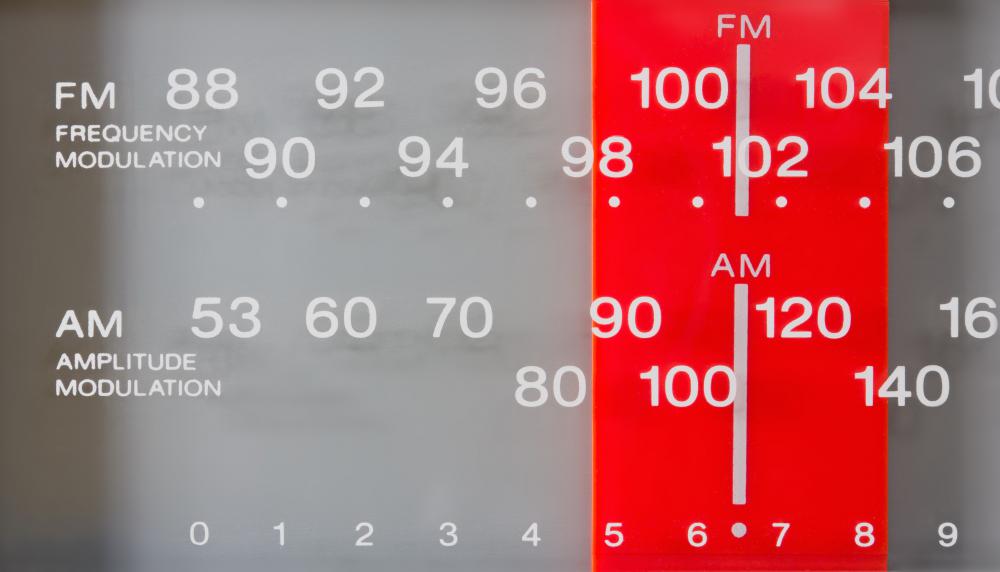
Another common example has to do with the reception of radio transmissions. Modulation helps to define the type of transmissions that are in use for general broadcast purposes, as well as more focused applications such as ham radios. Amplitude modulation (AM) describes a broadcast situation in which the level of voltage that is carried over the medium will vary noticeably over time. Anyone who listens to AM radio stations is usually acquainted with the way signals seem to weaken at night, and a clearer signal is harder to achieve.

Frequency modulation (FM) is also commonly used for radio transmissions. The difference is that the amount of modulation does not vary as dramatically as with AM broadcasts, although there is a small amount taking place. Phase modulation is a third configuration that sometimes will involve delays in the transmission and reception process. Ham radios are a good example of this short but noticeable delay in transmission.
As technology has continued to advance, and communications have become more comprehensive and varied, other constructs of modulation have appeared. Wireless communications and the use of the Internet have resulted in such important signaling tools as multiplexing and modem modulation. Along with the more common forms that are represented by AM and FM broadcasts, there are also some devices that make use of what is known as pulse code modulation, which can be utilized to encode analog and digital signals in a binary pattern.
Malcolm Tatum
After many years in the teleconferencing industry, Michael decided to embrace his passion for trivia, research, and writing by becoming a full-time freelance writer. Since then, he has contributed articles to a variety of print and online publications, including WiseGEEK, and his work has also appeared in poetry collections, devotional anthologies, and several newspapers. Malcolm’s other interests include collecting vinyl records, minor league baseball, and cycling.
Learn more...
Malcolm Tatum
After many years in the teleconferencing industry, Michael decided to embrace his passion for trivia, research, and writing by becoming a full-time freelance writer. Since then, he has contributed articles to a variety of print and online publications, including WiseGEEK, and his work has also appeared in poetry collections, devotional anthologies, and several newspapers. Malcolm’s other interests include collecting vinyl records, minor league baseball, and cycling.
Learn more...AS FEATURED ON:
AS FEATURED ON:









-
![An example of modulation is early telegraph technology.]() By: emmeci74An example of modulation is early telegraph technology.
By: emmeci74An example of modulation is early telegraph technology. -
![A demodulator is typically known as a radio tuner.]() By: emmeci74A demodulator is typically known as a radio tuner.
By: emmeci74A demodulator is typically known as a radio tuner.
Discussion Comments
@David09 - I don’t know much about the AM band, but I bought an RF modulator six months ago to convert the TV signals in my house and push them through coaxial cables into another room.
These little gizmos are gems. You can hook up anything—TVs, DVD players, video games consoles, you name it-and they’ll convert the signal so that they can be transmitted to another location via coaxial cable.
For example, if you have a new DVD player but an old TV set, you can feed the audio video signals from your DVD player into the coaxial input for your TV and it will transmit the signal.
I got mine for under $30 and it works flawlessly.
@miriam98 - Yes, you are correct. It has to do with the atmosphere. During the day the signals bounce around using ground radio waves. After sunset something happens to the ionosphere and the radio signals begin to bounce off the sky, more or less, carried along for hundreds of miles.
That’s as technical an explanation as I’ve ever been given but it works for me. What’s even more impressive is to imagine that there are radio waves sent out to the universe, as part of our space program, and that they will never die. They’ll just keep bouncing along in space, until some alien hears them.
Here’s something I’ve never understood. I listen to AM radio a lot-I mean even on the job (boss allows it). But here’s my question.
At night before I sleep I like to listen to AM radio as well. I notice that in the evening I’m able to pick up distant radio stations, hundreds of miles away.
Why is this? I think I heard an explanation once but forgot. I don’t think there’s any change in the modulation amplitude. The stations, from what I understand, operate at the same broadcast power and frequency.
Post your comments