
At EasyTechJunkie, we're committed to delivering accurate, trustworthy information. Our expert-authored content is rigorously fact-checked and sourced from credible authorities. Discover how we uphold the highest standards in providing you with reliable knowledge.
What is Microfilm?
Originally developed in the 1800s, microfilm did not get put to significant use until the late 1920s. When it was first developed, banker George McCarthy held the patent for the machine capable of creating this film.
The microfilm machine created permanent film copies of bank documents by using a special camera, which took pictures of documents with black and white film. The film records were able to resist deterioration and helped save storage space. The images could be viewed later through a special machine. In 1928, Eastman Kodak purchased the rights to the machine, which helped catapult it into the business market.

In the 1930s, the New York Times began creating copies of their daily newspapers to store for later use. The paper used by the Times to create these copies, however, deteriorated rapidly. Therefore, the newspaper decided to switch to microfilm. After seeing their success with the process, Harvard University began an extensive recording project. This project continues today and involves copying newspapers from around the world onto microfilm, which is then stored in the library at the university.

To make a microfilm, a special camera capable of photographing at a reduced scale is used. Through the technology of these cameras, the document can be reduced 99% from its original size. The image is then printed onto a special black and white film, which looks much like the negative of a photograph. For businesses such as banks, news agencies, financial agencies, and government offices, microfilm can save massive amounts of space when storing information because it can be reduced to such a small size.

There are two primary forms of film used in the creation of microfilm: silver halide film and vesicular film. Silver halide is much like traditional film, and the image is transferred to the film with a process using silver emulsion on a polyester strip. Vesicular film, on the other hand, uses microscopic bubbles to create the image on the polyester strip. This type is inexpensive and can be exposed to daylight without being damaged, making it the more popular choice for most businesses.
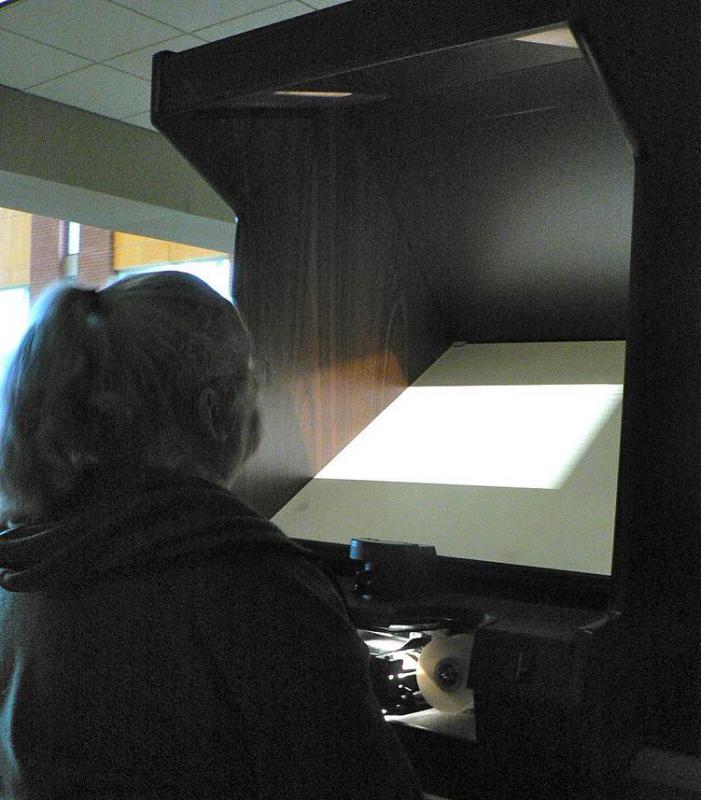
The machine used to view microfilm is similar to a giant microscope. The lens on the machine enlarges the image, which allows the user to read the contents. Microfilm can last up to 900 years if stored within special envelopes and placed in a climate-controlled room.
AS FEATURED ON:
AS FEATURED ON:









-
![Microfilm reel and microfilm storage box.]()
Microfilm reel and microfilm storage box. -
![A file clerk may need special skills like working with older technologies such as microfilm.]()
A file clerk may need special skills like working with older technologies such as microfilm. -
![Woman using a microfilm reader.]() By: ValerieWoman using a microfilm reader.
By: ValerieWoman using a microfilm reader.


Discussion Comments
@SunnySkys - I'm pretty sure the first time I heard about microfilm was in a novel also. It's amazing the things you can learn just from reading fiction, I tell you!
I didn't know microfilm was still in existence today! That's really interesting. I've personally never seen microfilm myself, but I do remember reading about it a lot in those old Nancy Drew novels I used to like to read as a kid.
In the novels, she always needs to research when she's solving a mystery. Usually her research involves looking through old records on (you guessed it) microfilm. Honestly, if it wasn't for those Nancy Drew novels, I don't think I would even know what microfilm was!
@Monika - I think it's good to have physical copies of things. What if something happened and all the computers broke? Plus, digital files can break down over time. Storing a physical copy using microfilm equipment is a much more permanent way to store something.
@anon9755 - That's really cool that there is a way to make do microfilm conversion to digital storage. It seems like a lot of records that are stored on microfilm should be stored digitally also.
And in fact, with all the technology we have, I don't know why places bother with microfilm storage anymore. It seems like it would make more sense (and save a lot more space) to just store all those records digitally.
How much would a library invest to have this microfilm?
Can microfilm be recycled?
what type of data or information is stored on microfilm?
It's actually 900 years!
I believe there are three primary forms of microfilm; silver halide, vesicular and diazo.
Vesicular and Diazo are not used in the original capture of an image but only in duplication/distribution of silver halide film.
The life expectancy of Vesicular and Diazo films is considered to be 100 years.
Microfilm records can now be scanned to digital through a process of Microfilm Scanning and Indexing.
Post your comments