
At TheHealthBoard, we're committed to delivering accurate, trustworthy information. Our expert-authored content is rigorously fact-checked and sourced from credible authorities. Discover how we uphold the highest standards in providing you with reliable knowledge.
What Is Melanonychia?
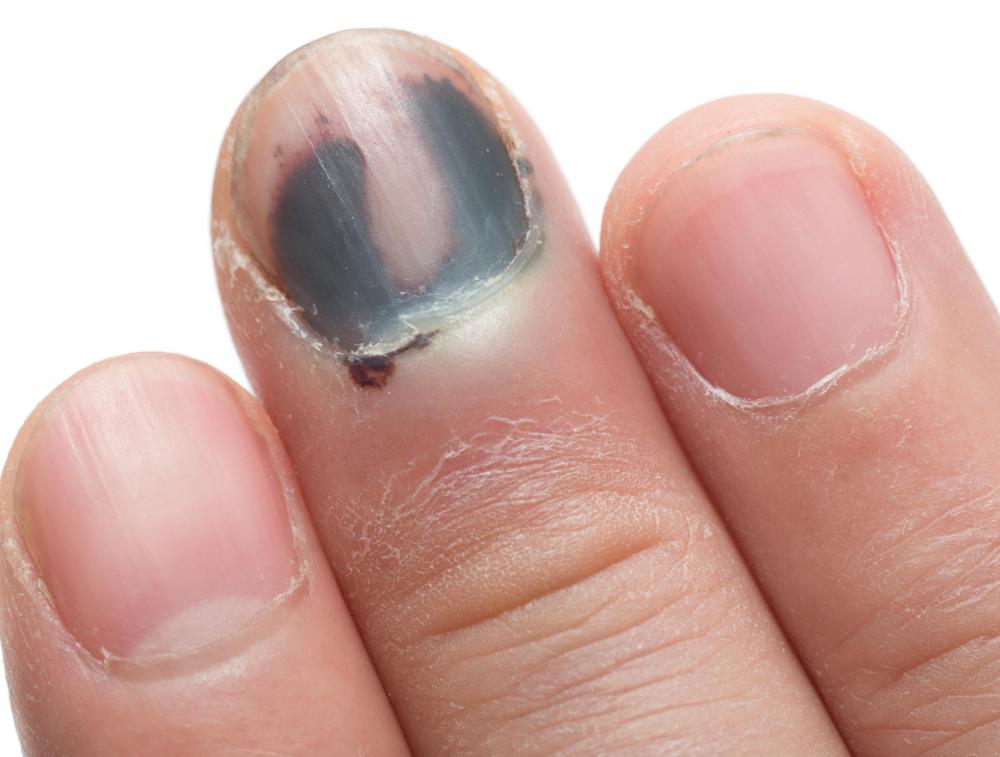
Melanonychia refers to a band of brown or black discoloration of finger or toe nails. The condition may be benign or indicative of a type of cancer. Certain non-cancerous medical conditions may cause the abnormality, along with some medications. Health care providers usually require a complete medical history and a physical assessment to rule out possible contributing factors.
Discoloration usually develops longitudinally, running from the cuticle to the tip of the nail. The cuticle may or may not be included in the coloration. The bands or stripes associated with this condition may appear as a single line or completely cover the nail. The forefinger, thumb and great toe are the most common sites of the affliction but more than one digit may be involved.

The band may appear as one solid color or graduate from one shade of brown to another. Thin, regular or irregular lines sometimes appear. The line of coloration may have parallel borders or be irregular. Symptoms may also appear as purplish blue to brown dots or blotches of dried blood beneath the nail.
Abnormally large deposits of melanin often occur in the nails of people who have dark skin. Studies indicate that 77% of individuals of African descent experience melanonychia. The condition may also occur in people of Asian heritage 10% to 20% of the time. Only 1% of people with Caucasian ancestry experience this cutaneous condition.

Trauma to fingers or toes commonly produces nail discoloration, and bacterial and fungal infections may also cause melanonychia. Many medical conditions, including Addison's disease and psoriasis, produce nail discoloration. The rare syndrome known as Langier-Hunziker typically causes oral hyperpigmentation, and individuals that have this acquired disorder may also develop excess coloration under finger or toenails.

Side effects associated with chemotherapy, radiation, and warfarin can cause melanonychia. Other medications that might contribute to abnormal pigmentation are hydroxyurea, minocycline, and zidovudine. The discoloration generally subsides once treatment ends or causative medications are no longer required.
Melanonychia can also indicate a serious type of skin cancer. Left undiagnosed and untreated, the malignancy can metastasize to the bone, central nervous system, and body organs. Physicians may perform a biopsy to identify possible malignant cells associated with melanoma.
Dermatologists suspecting malignancy can obtain samples by shaving a thin layer of tissue. Physicians can also access tissue by punch biopsy or surgical excision. A positive malignant diagnosis generally requires the affected area undergo surgical removal.
AS FEATURED ON:
AS FEATURED ON:


-
![77% of people of African descent may experience melanonychia.]() By: Hogan Imaging77% of people of African descent may experience melanonychia.
By: Hogan Imaging77% of people of African descent may experience melanonychia. -
![Black discoloration of finger or toe nails may be referred to as melanonychia.]() By: ducdaoBlack discoloration of finger or toe nails may be referred to as melanonychia.
By: ducdaoBlack discoloration of finger or toe nails may be referred to as melanonychia. -
![10% to 20% of people of Asian descent may experience melanonychia.]() By: blvdone10% to 20% of people of Asian descent may experience melanonychia.
By: blvdone10% to 20% of people of Asian descent may experience melanonychia.


Discussion Comments
I'd never heard of cancer showing up as a dark streak on the fingernail. The scary part is the part about "the affected area may be removed." That means losing a finger. Not a pleasant thought.
I have thyroid issues and can track how well my medication is working by the vertical ridges on my thumbnails. When the ridges start becoming pronounced, it's time to adjust my meds, usually by increasing them.
It's just another bit of evidence that a lot can be learned about a person's overall health by looking at their fingernails. Certainly, it's something to be aware of.
Post your comments