
At DelightedCooking, we're committed to delivering accurate, trustworthy information. Our expert-authored content is rigorously fact-checked and sourced from credible authorities. Discover how we uphold the highest standards in providing you with reliable knowledge.
What is Manchego?
 Mary McMahon
Mary McMahon
Mary McMahon
Manchego is the most famous cheese export of Spain, originating in La Mancha, which also happens to be home of Don Quixote, Spain's most famous literary export. True Spanish Manchego is made from the milk of sheep, because the rocky and hostile terrain of that part of Spain did not permit the cultivation of cattle. It is a delicious, firm cheese that is sold in both young and aged forms, with a varying intensity of flavor depending on how aged the cheese is. It is also crumbly and dry. Being made from sheep's milk, it has a higher fat content than cow's cheese, which is in turn fattier than that made from goat's milk.
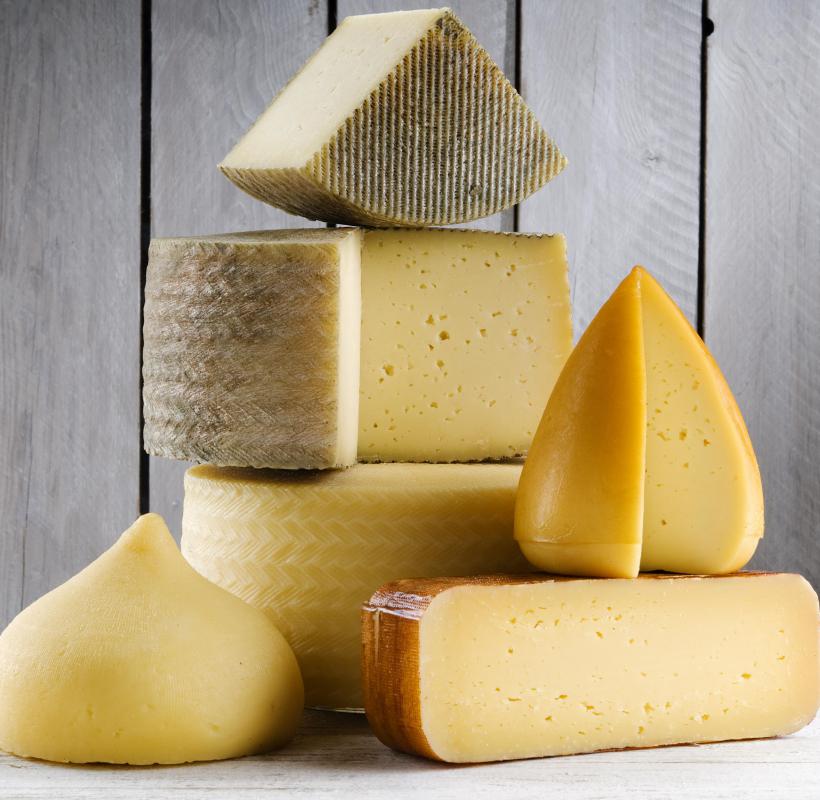
This cheese has a characteristic crosshatched rind that it traditionally receives from the basket it was aged in. The rind is typically wrapped in black wax, revealing a creamy white to pale yellow cheese inside, which tends to be flaky and pockmarked. Young Manchego, also called cured Manchego, has a mellow flavor, while aged cheese has a distinct peppery bite.

Manchego is made by heating milk with rennet and special cultures so that the milk curdles. The milk curds that are formed are subsequently pressed to remove the whey, and then brined to encourage the cheese to form a hard rind. After brining, it is allowed to age after being smeared with olive oil to prevent the development of harmful bacteria. After 13 weeks, it can be sold as cured Manchego, and after three months or more, it is considered to be aged.

Because Manchego is made from the milk of sheep, it has several distinct characteristics that separate it from similar brined cow's milk cheeses. Manchego tends to have a much more assertive bite. It also tends to taste more strongly of the diet of the sheep, having notes of herbs and plants in the final product, along with a lanolin scent. When the cheese is unwrapped, it often smells strongly of sheep, suggesting the scent of roast lamb to some consumers.

Manchego is considered to be a superb cheese by many people, and may complement any meal. It goes well with robust red wines and crisp fruits such as apples. It also takes well to grilling and baking, although it will not fully melt like some cow's milk cheeses do. The flavor is strong and will linger on the taste buds, developing additional flavors if the cheese consumer savors it. For this reason, some people do not enjoy this cheese — the "sheepish" flavor is not to everyone's liking. Manchego is well worth a try, however, and can be found in cheese markets all over the world.
Mary McMahon
Ever since she began contributing to the site several years ago, Mary has embraced the exciting challenge of being a DelightedCooking researcher and writer. Mary has a liberal arts degree from Goddard College and spends her free time reading, cooking, and exploring the great outdoors.
Learn more...
Mary McMahon
Ever since she began contributing to the site several years ago, Mary has embraced the exciting challenge of being a DelightedCooking researcher and writer. Mary has a liberal arts degree from Goddard College and spends her free time reading, cooking, and exploring the great outdoors.
Learn more...AS FEATURED ON:
AS FEATURED ON:


-
![Manchego cheese pairs well with fresh apples.]() By: tesgroManchego cheese pairs well with fresh apples.
By: tesgroManchego cheese pairs well with fresh apples. -
![The fictional character Don Quixote came from the same place as manchego originates.]() By: Pavel LosevskyThe fictional character Don Quixote came from the same place as manchego originates.
By: Pavel LosevskyThe fictional character Don Quixote came from the same place as manchego originates. -
![Sheep's milk is used to make true Spanish Manchego.]() By: dinosmichailSheep's milk is used to make true Spanish Manchego.
By: dinosmichailSheep's milk is used to make true Spanish Manchego. -
![Spanish Manchego pairs well with full-bodied red wines.]() By: Irina RedkoSpanish Manchego pairs well with full-bodied red wines.
By: Irina RedkoSpanish Manchego pairs well with full-bodied red wines. -
![A type of firm cheese, Spanish Manchego is made of sheep's milk.]() By: MIGUEL GARCIA SAAVEDA type of firm cheese, Spanish Manchego is made of sheep's milk.
By: MIGUEL GARCIA SAAVEDA type of firm cheese, Spanish Manchego is made of sheep's milk.




Discussion Comments
@fify-- That's right. "Queso" means "cheese" in Spanish. Manchego cheese is called "manchego queso" or "quesos manchego." And if you want to say cured manchego, you can say "manchego curado."
Traditionally, manchego is eaten with bread and olives, along with a glass of red wine. But really there are no rules when it comes to how you want to have it. I don't think it's a bad idea to use it for pizzas and quesadillas. You can also use it in appetizers, to stuff meats and on top of salads or vegetables too.
It can even accompany something sweet, like quince jam for example, which is quite popular in both Spain and South America.
@simrin-- Is manchego cheese usually eaten with bread or crackers? In what other recipes can it be used?
I have a nice big piece of manchego in my fridge that I picked up from the organic market. I do enjoy having it with some crackers, but I have far too much of it left to be eaten that way.
Unfortunately, I don't know anything about Spanish cooking. Do you know any good recipes that call for manchego?
And is it a good idea to experiment with this cheese in other recipes? Would it be a horrible thing if, for example, I used this cheese on top of homemade pizza or in a quesadilla?
Oh and just curious, does the queso in "manchego queso" mean cheese? I'm assuming so.
When I visited Spain, manchego cheese was available in all the markets and it was often served in restaurants with appetizers or following a meal. I think along with being the most popular Spanish cheese, it's also the most commonly eaten one.
I had a Spanish friend of mine take me around Madrid and one day we were at a cheese market where we talked for close to half an hour about "el queso manchego". He was telling me about how the real manchego cheese comes from the milk of sheeps from La Mancha region. Apparently, since it's so popular, manchego is also produced commercially now to meet demand. But the commercial type isn't considered as good.
I had the opportunity to taste both the younger type of manchego and the aged one and I like the aged one better. The one I tasted was almost two years old! It was really firm, sharp and crumbly. Very delicious!
Post your comments