
At TheHealthBoard, we're committed to delivering accurate, trustworthy information. Our expert-authored content is rigorously fact-checked and sourced from credible authorities. Discover how we uphold the highest standards in providing you with reliable knowledge.
What is Lumbar Spondylosis?
 Mary McMahon
Mary McMahon
Mary McMahon
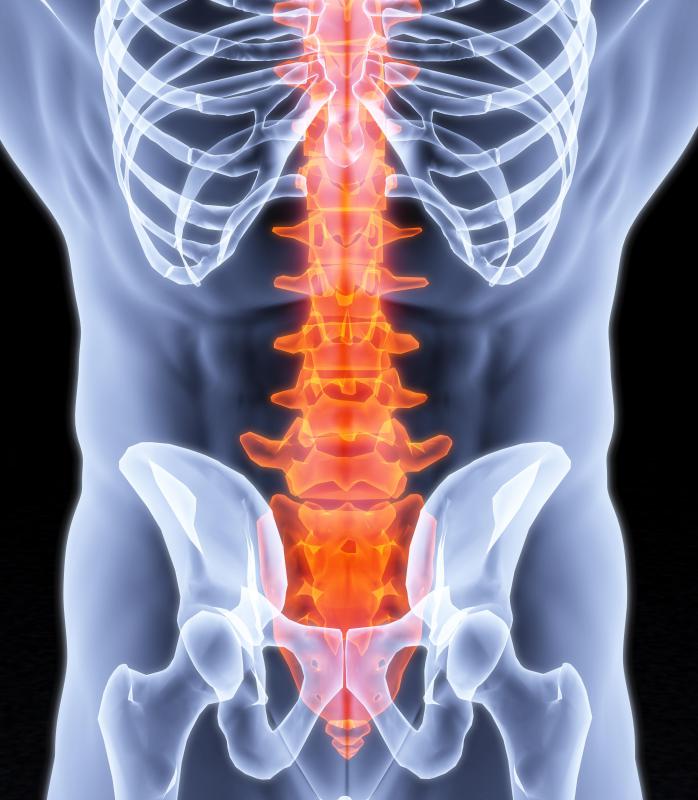
Lumbar spondylosis is a degenerative condition which affects the lower spine. In a patient with lumbar spondylosis, the spine is compromised by a narrowing of the space between the vertebrae, causing a variety of health problems ranging from back pain to neurological issues. This condition is usually caused by old age, as the spine undergoes changes as people grow older, and many of these changes contribute to degeneration of the vertebrae. Spondylosis, which can appear in the cervical and thoracic vertebrae as well, is also known as spinal osteoarthritis.
In a classic case of lumbar spondylosis, the space between discs in the lumber spine becomes narrowed. As a result, the patient develops numbness, tingling, and pain which seem to radiate out from the area. These symptoms are the result of pressure on the nerves as they exit the spinal cord. If the spondylosis is allowed to progress, it can lead to a narrowing of the spinal canal, resulting in impingement of the spinal cord, which can cause poor bladder control, unsteady gait, and other severe neurological problems.

Over the course of the development of lumbar spondylosis, the vertebrae tend to become stiff, and they must fuse or immobilize. This leads to decreased flexibility and increased back pain as the patient's spine may become contorted or compromised by the immobilized vertebrae. Lumbar spondylosis can also be characterized by the development of bone spurs and bony overgrowths around the spine which can pinch nerves.

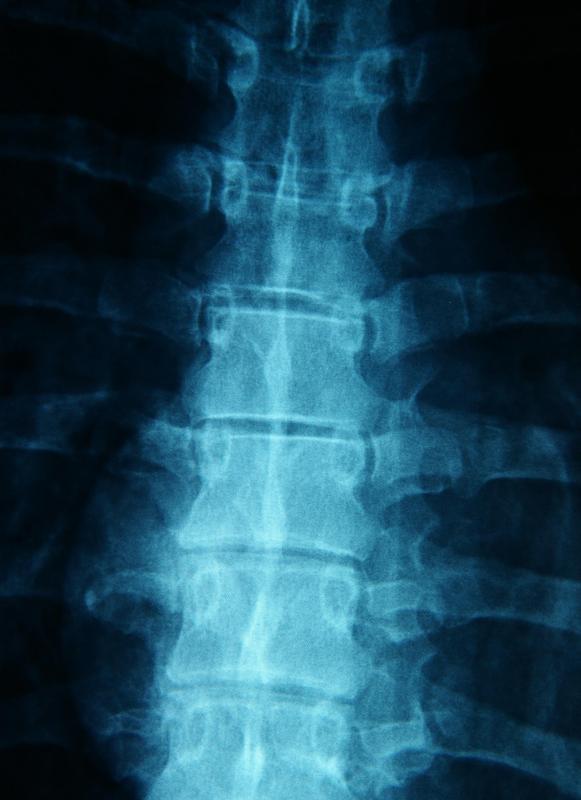
This condition is usually diagnosed with a manual exam and x-ray imaging of the spine. A neurological exam may also be administered to determine whether or not the lumbar spondylosis has caused problems in the spinal canal. Once a doctor has assessed the situation, he or she can work with the patient to develop an approach to treatment. Treatments are based on the severity of the lumbar spondylosis, along with the age of the patient; in a 90 year old patient, for example, surgery would not be advised, but in a 60 year old, surgery to correct the problem might be well worth the risk.

For mild cases, medications can be used to manage the pain caused by lumbar spondylosis, and physical therapy may be used to increase flexibility and strengthen the spine. Patients are sometimes advised to adopt a diet and exercise regimen which promotes general physical health. In extreme cases, a patient may be referred to a spinal surgeon for a surgery to correct the condition and stabilize the spine.
Mary McMahon
Ever since she began contributing to the site several years ago, Mary has embraced the exciting challenge of being a TheHealthBoard researcher and writer. Mary has a liberal arts degree from Goddard College and spends her free time reading, cooking, and exploring the great outdoors.
Learn more...
Mary McMahon
Ever since she began contributing to the site several years ago, Mary has embraced the exciting challenge of being a TheHealthBoard researcher and writer. Mary has a liberal arts degree from Goddard College and spends her free time reading, cooking, and exploring the great outdoors.
Learn more...AS FEATURED ON:
AS FEATURED ON:


-
![An illustration of a healthy spine and one with spinal osteoarthritis, which is also called lumbar spondylosis when it occurs in the lower back.]() By: peterjunaidyAn illustration of a healthy spine and one with spinal osteoarthritis, which is also called lumbar spondylosis when it occurs in the lower back.
By: peterjunaidyAn illustration of a healthy spine and one with spinal osteoarthritis, which is also called lumbar spondylosis when it occurs in the lower back. -
![Early signs of lumbar spondylosis include pain and numbness that radiates out from the lumbar spine.]() By: milan2099Early signs of lumbar spondylosis include pain and numbness that radiates out from the lumbar spine.
By: milan2099Early signs of lumbar spondylosis include pain and numbness that radiates out from the lumbar spine. -
![Untreated lumbar spondylosis may result in an unsteady gait.]() By: WavebreakmediaMicroUntreated lumbar spondylosis may result in an unsteady gait.
By: WavebreakmediaMicroUntreated lumbar spondylosis may result in an unsteady gait. -
![Lumbar spondylosis causes an unsteady gait, mobility issues and other problems for seniors.]() By: GVictoriaLumbar spondylosis causes an unsteady gait, mobility issues and other problems for seniors.
By: GVictoriaLumbar spondylosis causes an unsteady gait, mobility issues and other problems for seniors. -
![In a classic case of lumbar spondylosis, the space between the discs of the lower spine becomes narrowed.]() By: dimdimichIn a classic case of lumbar spondylosis, the space between the discs of the lower spine becomes narrowed.
By: dimdimichIn a classic case of lumbar spondylosis, the space between the discs of the lower spine becomes narrowed. -
![Lumbar spondylosis is diagnosed with an X-ray image of the spine.]() By: zimmytwsLumbar spondylosis is diagnosed with an X-ray image of the spine.
By: zimmytwsLumbar spondylosis is diagnosed with an X-ray image of the spine.




Discussion Comments
Has anyone tried a TENS unit? It gives a small electrical shock to the location of the pain which counteracts the pain. It contains two electrodes to stick onto the pain area and can be dialed up or down to increase the effect. It helped me. It is not recommended if you have a pacemaker. Check with your doctor.
Why do they call it lumbar spondylosis if, as doctors have told me, it is osteoarthritis?
I am a 29 year old woman, and like many of you, I have suffered with the effects of lumbar spondylosis for years. I was 16 when it first starting causing problems. In my experience, physiotherapy doesn't always help and can in fact, increase the pain, pain killers are generally useless and there doesn't appear to much help available from health professionals.
I am now unable to walk more than 10 meters without feeling extreme pain which brings me to tears every time and I usually have a high pain tolerance. Having this has literally taken quite a bit of my independence away from me.
After reading everyone's stories I must say I have and still am going through what you are all going through. I will add that exercising through this debilitating pain is so very worth it. Remember, i you don't use it, you lose it. I was diagnosed with Lumbar spondylitic changes as well as Pars Defect with disc involvement at the L5/S1. To top it all off I was also diagnosed with Scoliosis. Pray and walk through your pain. Have faith that you can walk longer distances like me .
I have lumbar spondylosis, and can't stand or walk for more than 10 minutes. It's gotten very hard to stand up due to stiffness and pain. Has anyone ever checked with the Laser Spine Institute?
My advice to all. Don't do the surgery. One word: look up sutherland.
I have had back problems since I was a teenager, and was first with lumbar spondylosis at age 30. Ten years ago, I was informed that I had two conflicting problems in my lower back and that immediate surgery was the only answer. Rejecting his advice, I sought the help of a good and rational chiropractor. His occasional adjustments and recommendations for exercise, massage and at times physical therapy have kept me mostly free of severe pain and flare-ups until very recently.
Faced with a seeming inability to overcome newly acute pain and spasms he has referred me back to physicians to determine the exact location and cause of comfort. The physicians insist on treating the spondylosis as a newly acquired condition caused by age. Yeah, right. The only treatment other than surgery they promote is cortisone shots.
Spine and other skeletal and joint issues are extremely common in my family. Spinal fusions have resulted in increased problems and I have watched extremely painful cortisone injections result in pain relief for only very shot periods of time and family members hating the shots giving them more and more side effects and less and less relief, being essentially addicted to the shots awaiting and begging for the next injection.
My strong advice: do not let physicians push early, severe and ineffectual treatment on you or your loved ones. Accept that life holds occasional and/or mild pain. Accept and work through lesser problems with reasonable and natural practices and treatments as long as you possibly can.
My husband was in very bad pain with lumbar spondylosis. He tried a herbal medicine called devils claw. His pain was reduced so much he no longer needed the strong painkillers from doctors. Give it a try.
I'd like to respond to all the people who are posting comments stating that exercise would seem to be the best option:
I'm 27 years old and I've suffered with lumbar spondylosis for the last eight years or so. Exercise aggravates the condition, as I found out through physio when it left me bedridden for three days due to the pain it caused. Lumbar spondylosis is a form of arthritis which has nothing to do with muscles! (so core exercises are rendered virtually useless!)
I really do feel sorry for anyone else who suffers from this as I have yet to find a way to manage my pain. I cannot walk around for longer than a few minutes without needing to either sit down or lean on something and standing up for any amount of time is literally out of the question.
Just doing everyday things such as housework or being able to prepare or cook a meal or even getting dressed myself has become impossible for me, but thankfully, I have a wonderful husband who does all of this (which pains me to see because I feel I’m such a burden).
Surgery is only used as a last resort and physio is the doctors trying to dig out the liars!
It really digs at me to see so many people suffering from the same thing and nothing is being done about it!
I also have lumbar spondylosis and was told by consultant to lose weight and do regular exercise. I can't stand for more than 10 minutes and cannot walk very far. I am going to join a gym that has specialist trainers to help me use the equipment safely.
My husband was diagnosed with chronic lumbar spondylosis with spinal nerve spondylosis. He is in pain constantly and he is on pain meds, anti-inflammatory meds and also muscle relaxers. He also has high blood pressure and diabetes. He became diabetic after the back injury because of not being able to exercise properly because of the pain, so he has put on some excess weight.
It has been a horrible time since his diagnosis, but he is trying to cope with it. The doctors tell him there is nothing they can do for it. No surgery. They sent him for physical therapy, which did not help in the least. He had had a lower lumber spinal injection which also did not help, except for about a week. His legs have given out on him, and he has fallen down a flight of stairs. He gets pain and numbness in his legs a lot and also his hands and fingers go tingly and numb on him frequently.
He applied for Social Security Disability and he got it, but it took almost a year to get it approved, and he had to appeal his case, but the good news is that he did get it. He would much rather be able to work, but he cannot because of the pain. The doctors told him this is a progressive disease and that eventually he will end up in a wheelchair and will eventually loose control of all functions on the lower part of his anatomy. So, looking forward, he will probably be in adult diapers.
Hopefully this will be many years from now. He is now only 56 years old. Sorry to tell you all the bad news, but having gone through this with him and watching him living with this has been a really hard life to live. His meds make him sleep most of the time. So I have to do everything on my own. I love my husband very much but we just do not have much quality of life.
I was diagnosed with spondylosis over 8 months ago and get mild to painful sciatica attacks that can last three to four days at a time. I keep getting burning sensations in my shoulders that can get very annoying also, like a crawling feeling. Has anyone experienced this, and what have you been told by your doctors about it? I have yet to speak to my doctor about it, but I want your views on it.
I have osteoarthritis on my back plus bone spurs, Lumbar Spondylosis, disk protrusion on L4 L5, disk protrusion on L5-S1 and degenerative changes on my lumbosacral spine. Can I qualify for SSDI?
Anything, including pain, that prevents a person from working is a disability. Get your doctor to file the papers needed for SS or SSI and if needed, get a lawyer.
Numbness is due to nerve compression and a lack of blood supply. As a physiotherapist, I suggest you do wax therapy.
My mother is 70 years old. Her left leg is hurting, and as a result, she can't walk long distance. She is not getting sensation in her left leg. Is there any remedy for reducing her pain? Please help me to reduce my mother's pain.
Is lumbar spondylosis a disability? Does anybody out there who has the disease receive social security disability?
Can you fly with it, please?
Is it possible that if a man has lumbar spondylosis it will cause him to become paralyzed?
I have three bulging disks, arthritis and spurs in my back and I have also been diagnosed with lumbar spondylosis! I can't stand or sit for a long period of time because it's hard for me to get up or even stand up straight. My legs are giving out on me. Any suggestions? Please help. Does anybody know if this is considered a disability? My god I can't even work because I hurt all the time! I am stressed out!
My boyfriend had the surgery for spondylosis when he was 11, recovery took months. Now he is 43 and has had symptoms for the past 10 years. It has been pain in the lower back about three to five times a year which lasts one to four days. Lately. it seems it's happening more often.
He hasn't been to the doctor in years to have it re-checked. Has anyone else had the surgery as a child and is now experiencing pain?
In august 2011, I fell on the floor with my right side of the body hitting the floor first. But prior to that, I already experienced back pains. The pain worsened after I fell down on the floor. I often feel pain in my right leg, back and hips, especially when I'm standing. Sitting down eases the pain a little bit. I can't sleep flat on the bed at night because my back is painful. I sleep leaning on five or more pillows to support my back just to feel a little comfort. The result of my x-ray lumbosacral spine APL) states: "There is normal spinal-alignment with no evident spondylosis nor spondylolisthesis. Disc spaces and pedicles are preserved. Vertebral bodies show normal height. Anterior lippings are appreciated in the lower lumbar vertebrae. Line of weight bearing is within normal. Impression: Mild lumbar spondylosis.?
What does this mean? What is my ailment? Please help me ease the pain.
my age is 36 years and from the past few weeks i am suffering from lumbar spondolysis, and have back pain and even in the last two days, I've pain in left and right side of lower stomach. I am visiting a nuero doctor. kindly advise me.
I am 36 years old, and I am suffering from c7 and l3,l4 and l5 spine problems for the last eight months. Two months and 15 days ago, I had c7 surgery completed. My left leg is a problem. Please help me.
The pain of the spine makes people request medical help and in most, they medicate with vicodin or hydrocodone to ease the pain.
I am 52 years old and after a work place accident to my lower back, was found to have Lumbar Spondylosis. They say the injury is fine now but the spondylosis is symptomatic. This is another way of saying I am going to be in constant pain and it doesn't look to be getting any better in the future.
I had no pain before the accident. They say the accident aggravated the spondylosis. I am exercising and trying to keep my core strengthened but the pain is always there. I don't really want to have an operation and no-one has suggested it yet. My back will get worse though. My feet have pins and needles in them at all times and my back is always cold.
Luckily I live in the tropics, so the weather is on my side. What exercises will make it better, is there anything that will make it go away. I am too young for this. I feel like I have been robbed of my activities. Can anyone help?
I am a 75 year old woman and was diagnosed with lumbar Spondylosis four years ago. I underwent surgery for spinal stenosis in 2009. Didn't help at all. Can't stand for more than 10 to 15 minutes w/out pain and my gait is terrible.
My doc is managing my pain very well. I retired from work at age 72 and was reasonably active. Now I wish there was some magic elixir out there that would help! Other than morphine sulfate and oxycodone. Just wishful thinking I'm sure. Good to know I'm not alone. Spines are such tender, tricky parts of our bodies. Thanks for at least reading my post. Live well.
When I was about 12 years old, I jumped to attack a ball with my head during a game of soccer. I landed on my backside, or so I thought. In fact, I had landed on my lower back.
Long story short, since that day (20 years ago) I have lived with lower back pain, plus pain shooting down my left leg from time to time. I never properly got it looked at, and just lived with the pain.
Recently I saw an orthopedic specialist, who took a quick look at an X-Ray of my back to tell me I had spondylosis of the L5 vertebrae suggested "back-strengthening exercises" and I have been referred for physiotherapy. Honestly, I don't see how strengthening back muscles can ease a condition which has nothing to do with muscles and is related moreover to the spine bone and its discs.
Two things that make the pain much worse: (i) standing in one position for a long period of time, and (ii) sleeping with my knees curled up to my chest. If I do either of these, pain arrives and lasts for the rest of the day.
My biggest worry is that this could degenerate into something that could cause a limp or restrict my mobility. Like I said, I have lived with the pain so far - I would be happy to bear further pain if that's all it was - just pain.
I'd be grateful if others could post with similar stories, and how they have progressed (or not), plus advice on treatment.
My mom is suffering from lumbar spondylosis wherein there is reduced disc space between L5-S1 and because of it, she is getting unbearable pain -- so much that she is not able to walk.
The doctor has given her medicines and has advised her to do massage, but this further increases her pain. Also, there is minimal mineralization as well as minimal osteophytic changes in the lumbar space happening. what can i do to ease her pain?
what are the exercises for lumbar spondylosis?
Just watched a guy on Emmanuel Television who claims to work in the US embassy in Equatorial Guinea, Africa, get instantaneous healing from spondylosis of the lumber spine in just minutes from the Ministry of Prophet T.B. Joshua (Nigeria) and I sincerely don't know what to make of it!
My husband has a long history of severe cervical and lumbar spondylosis. Over the past 10 to 15 years he has been advised by three totally unrelated doctors, at different times to not allow any doctors to ever touch his back or neck surgically.
He was told by the last doctor that his chances of becoming paralyzed were too high, so he lives in constant pain and takes large amounts of narcotic pain meds just to cope with the minimal amount of movement. He is 57 years old, and has been permanently disabled since he was 49 years old.
Can anyone elaborate on why other people seem to do so well after back surgery, but my husband has been so strongly advised against it. Severe and early onset of arthritis does run in his family, but out of his three siblings, he has the most advanced condition, even though he's the second youngest. There has to be more medical help available to him than just narcotics, and now having to use a walker. Any advice that can help me understand this condition better is appreciated. --Amud
Hmm, sounds like a lot of young get this. I would think working with some mild core training, a good chiropractor (and I do mean good, not some schmuck), and gentle yoga exercises along with PT would go along way to help with mobility and pain control. Of course all under a doctor's supervision.
Our son has just turned 17 years old and was recently diagnosed with lumbar spondylosis on both sides of his spine.
He is very active in basketball and has a whole community of health professionals all working with him to develop a program to help him deal with and live with this new obstacle. The key solution to being able to cope is for him to strengthen his core ! It is stressed over and over again by everyone who has seen him and from what I am reading.
I just wanted to mention that it is not just old age that causes this. This article said nothing about young patients with this conditions. I am 18 now and was diagnosed with this when I was 14.
Unfortunately, it has become very severe and debilitating and I am online looking at different surgical treatments as this is what it has come to. If anyone has any information that could help my please comment. Thank you.
You can get this when you're young. I am only 13, and I do competitive gymnastics. I have been having chronic back pain in my lower mid spine, and I've been going to the chiropractor, for a year now.
Consult a chiropractor that offers corrective therapy. They may be able to help. Also, physical therapy can help to relieve the pain.
i am 24 years old and doctor has discovered symptoms of lumbar spondylosis in me. Can this be cured?
I'm 31 and I read my MRI results that say I have spondylosis. what is the difference between this and DDD? isn't there a chance I have this as opposed to spondylosis? or can young people get this too? I was in the army and fell off a rope during basic and have had issues ever since.
one month ago i was told i have myofascial pain, degenerative disc disease and lumbar spondylosis. I can't stand for more than fifteen minutes because of the pain in my right hip and right leg. just a few days ago my left foot and right foot were hurting so bad, i couldn't sleep for more than a couple of hours without meds. please help.
I am 44 year old lady suffering from cervical and lumbar spondylosis foe 10 years. I have diabetes and high blood pressure also. I take pain killers and physiotherapy sometimes. I always feel pain in both legs and right hand and low strength in lower parts of the body. I can't walk or stand for 15 minutes at a time. I always feel weak and tired. It's hampering my daily household works.
I am 70 kg. I can't reduce my weight as i can't walk or stand for long time. My muscles get tight very quickly. what type of measures should i take to get active again? I miss my past life activities. Please guide me. Thanks.
I was diagnosed with lumber spondylosis some three years back when i reported to the clinic to complain about persistent lower back pain and inability to sit comfortably in upright position, and sagging after some efforts.
I was told that there is no permanent cure and referred for physio, the pain has continued until now. I need your advice. I am aged 53.
my mother who is 68 years old, is suffering from lumbar spondylosis. she has severe pain in her right leg nerves at the back of the knee. she can't even bend her knee, let alone walk. any help or suggestions will be welcome.
I am 43 year old female who is otherwise fit and healthy and have just been diagnosed with lumbar spondylosis. Realistically, what are my options to avoid further deterioration and are there any options for a long lasting "cure"? I have been referred for physio but have to say that despite the pain I am quite fit with reasonable core strength. Advice would be welcome.
i need your help for treatment please.
Could standing in one position all day every day on concrete floor take mild lumbar spondylosis to an extreme case in six months?
My understanding is that, in most cases, surgery is not used to treat this condition. Exercises to strengthen the back muscles, which provide support to the spine, can be of great help.
Post your comments