
At DelightedCooking, we're committed to delivering accurate, trustworthy information. Our expert-authored content is rigorously fact-checked and sourced from credible authorities. Discover how we uphold the highest standards in providing you with reliable knowledge.
What is Lovage?
 Mary Elizabeth
Mary Elizabeth
Mary Elizabeth
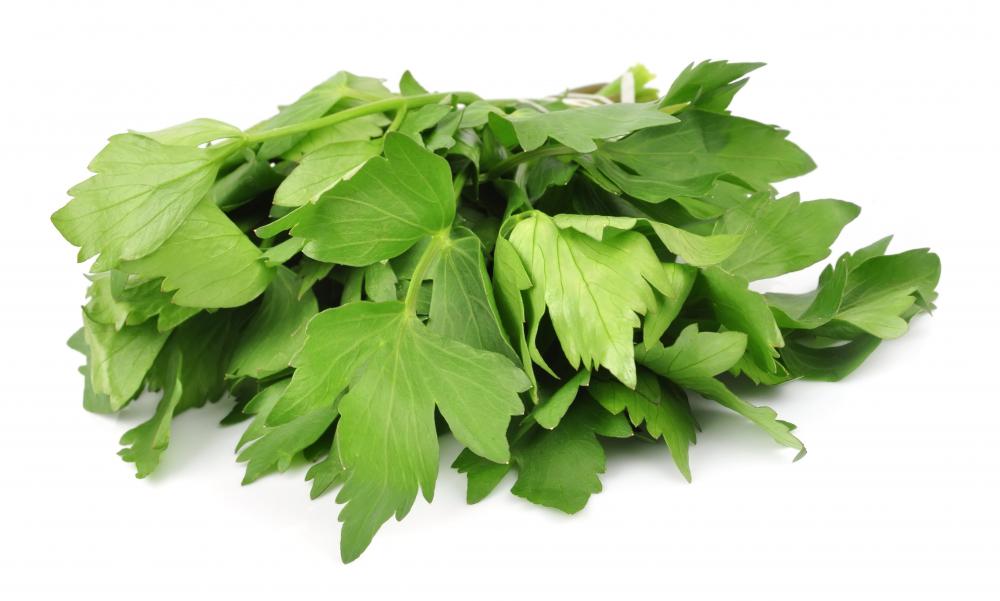
Lovage, Levisticum officinale, is a perennial herb that looks like parsley and is in the parsley, or Apiaceae, family, like anise, dill, caraway, cumin, and fennel. It is native to mountainous areas of southern Europe and Asia Minor. It is sometimes called sea parsley.
History
One of the herbs mentioned by the Emperor Charlemagne, he said lovage deserved to be grown in every imperial garden. It was also grown in Benedictine monastery gardens.
Description
Lovage can reach a height of 3 to 6 feet (0.9 – 1.8 m) high, but it takes three years to reach its full size. It sends up a flower stalk in early to mid summer, and the flowers are small and yellow.
Gardening
This pant prefers good soil and plenty of sunlight. To grow lovage, gardeners can either buy plants or plant seeds. If seeds are planted, they can be started indoors and then transplanted.

Once established, lovage can be propagated by division. Gardeners should make sure that it has sufficient room to spread, as it grows wide, as well as tall, and puts out an extensive root system. To produce more leaves, the flower stalk should be cut back.
The leaves should be dried slowly and stored in an airtight container. They should be harvested after they have turned brown. These, too, should be dried. Fresh lovage leaves can be stored in plastic in the refrigerator crisper or hydrator for four or five days.
Food and Other Use

Lovage is similar to celery in both flavor and appearance, but taller and stronger in taste. The roots, stem, leaves, and flowers all edible. Typically, the young leaves are used in salad, and some consider them a good addition to dishes with strongly flavored fish or seafood.
Older leaves can be used in soup or stew and cooked slowly. The seeds are used as a garnish and in pickles. In some Italian recipes, lovage is used as a flavoring in bread and biscuits. Dried leaves are used as a flavoring and in preparing herbal tisanes.

Because some people who are not accustomed to eating lovage have reported a strong reaction to an initial use of a large quantity, people may wish to introduce it to your diet slowly. It is also used in some bath and deodorant preparations. Because the stems are hollow, they may also be dried and used as drinking straws.
Mary Elizabeth
Mary Elizabeth is passionate about reading, writing, and research, and has a penchant for correcting misinformation on the Internet. In addition to contributing articles to DelightedCooking about art, literature, and music, Mary Elizabeth is a teacher, composer, and author. She has a B.A. from the University of Chicago’s writing program and an M.A. from the University of Vermont, and she has written books, study guides, and teacher materials on language and literature, as well as music composition content for Sibelius Software.
Learn more...
Mary Elizabeth
Mary Elizabeth is passionate about reading, writing, and research, and has a penchant for correcting misinformation on the Internet. In addition to contributing articles to DelightedCooking about art, literature, and music, Mary Elizabeth is a teacher, composer, and author. She has a B.A. from the University of Chicago’s writing program and an M.A. from the University of Vermont, and she has written books, study guides, and teacher materials on language and literature, as well as music composition content for Sibelius Software.
Learn more...AS FEATURED ON:
AS FEATURED ON:


-
![Lovage requires a good deal of sunlight.]() By: miikoLovage requires a good deal of sunlight.
By: miikoLovage requires a good deal of sunlight. -
![Lovage looks like parsley and may be used in salads.]() By: alex555Lovage looks like parsley and may be used in salads.
By: alex555Lovage looks like parsley and may be used in salads. -
![Lovage is sometimes found in bath products.]() By: Anton MaltsevLovage is sometimes found in bath products.
By: Anton MaltsevLovage is sometimes found in bath products.


Discuss this Article
Post your comments