
At EasyTechJunkie, we're committed to delivering accurate, trustworthy information. Our expert-authored content is rigorously fact-checked and sourced from credible authorities. Discover how we uphold the highest standards in providing you with reliable knowledge.
What is Load Balancing?
Load balancing is the process by which inbound Internet protocol (IP) traffic can be distributed across multiple servers. This enhances the performance of the servers, leads to their optimal use, and ensures that no single server is overwhelmed. The practice is particularly important for busy networks, where it is difficult to predict the number of requests that will be issued to a server.
Typically, two or more web serves are employed in a load balancing scheme. In case one of the servers begins to get overloaded, the requests are forwarded to another server. This process brings down the service time by allowing multiple servers to handle the requests. Service time is reduced by using a load balancer to identify which server has the appropriate availability to receive the traffic.
The process, very generally, is straightforward. A webpage request is sent to the load balancer, which forwards the request to one of the servers. That server responds back to the balancer, which in turn sends the request on to the end user.

Load balancing allows service to continue even in the face of server down time due to server failure or server maintenance. If a company is using several servers and one of them fails, its website or other services will still be available to its users, as the traffic will be diverted to the other servers in the server farm. In Global Server Load Balancing (GSLB) the load is distributed to geographically scattered server farms, depending on their load, health, or proximity.

There are several methods by which loads can be balanced. If the servers are similar in hardware specifications, the Perceptive (which predicts the server based on historical and current data) and the Fastest Response Time methods can be the best to use. On the other hand, if the hardware specifications are different, the Weighted Round Robin method, which assigns requests to servers in turn according their weights, may be a better solution because it can assign more requests to the server that can handle a greater volume.
AS FEATURED ON:
AS FEATURED ON:









-
![Load balancing enables network service to continue despite server down time from maintenance.]() By: Eimantas BuzasLoad balancing enables network service to continue despite server down time from maintenance.
By: Eimantas BuzasLoad balancing enables network service to continue despite server down time from maintenance. -
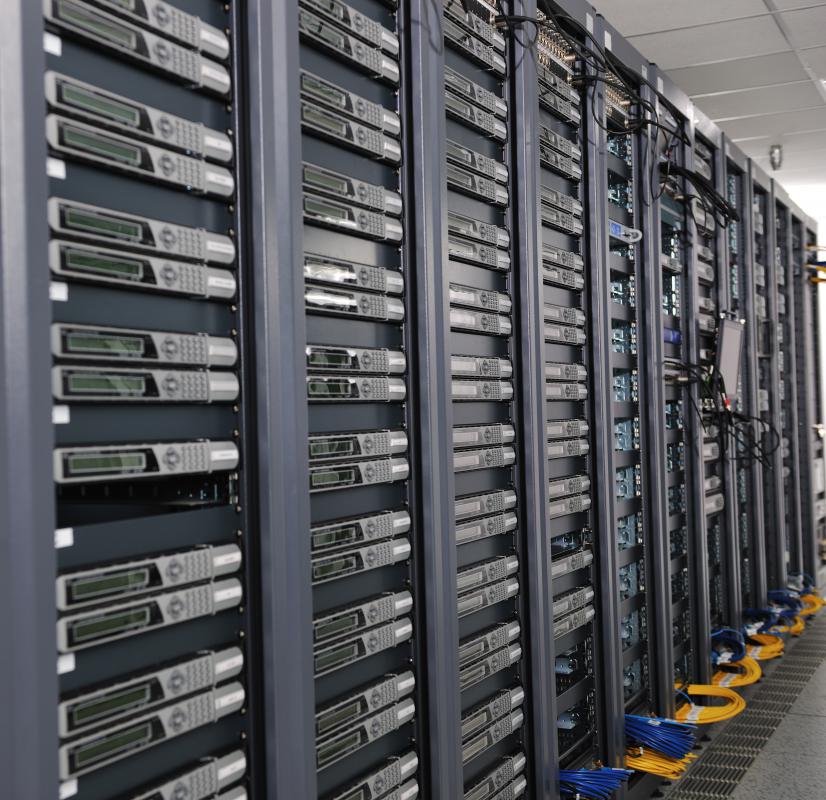
![Racks of servers.]()
Racks of servers. -
![Computers connected to a server.]() By: ScanrailComputers connected to a server.
By: ScanrailComputers connected to a server.


Discussion Comments
How is math used in load balancing? What kind?
@anon46463: Have you tried jetNEXUS, They have a feature set similar to F5 but a price point closer to Kemp (although a little more expensive).
What happens if the load balancer goes down?
how can we implement load balancing using sensor networks?
@Anon107606: Think of a load balancer in terms of your Lit 101 Class. It's kind of like the Little Dutch Boy (not the painter) who comes across a dike with leaks popping out in a hundred different places.
Except this Dutch Boy has more arms than the Hindu Goddess Kali and enough fingers to plug 100 holes.
The given info is good, but i want more info about load balancing. How can I find it? This topic is for our BE project. please give extra information. Thanks.
excellent explanation.
how to route a web page request from the client to the server connected to the internet and to get back the response from the server to client. both client and server connected in lan. please can you tell the settings or need to be done. please.
Very nice and clear explanation about load balancing. now i can do my project. thanks.
Does it mean that what ever service the user wants in spite of server failure that the data is stored on all the servers?
Good stuff.
A very informative article.
I couldn't order the LoadMaster 1500, looks like they discontinued it, I got the 2000, it works pretty good. I would love to use perlbal, just to much work for setup and maintenance, rather spend that time on my application development. Wish I had the budget for the F5, even though I know I'll only use 5 percent of the features.
Kemp load balancers are fine, but the base 1500 isn't great hardware and they aren't as flexible as they could be. The Loadbalancer R16 is high spec'd but license restricted. Coyote is sound but restricted and if you have the money F5, open source solutions are LVS and haproxy.
Is there any difference b/w "network load balancing in TCP/IP" and "dynamic load balancing in distributed system in the presence of delay"
If related... in what way?
How we can implement for the web server?
This exactly what I need, I am going to buy a load balancer from KEMP. Anyone use them, they seem to have a great price to feature ratio?
Excellent explanation about LOAD BALANCING. This one is very clear, simple and easy to understand
Post your comments