
At WiseGEEK, we're committed to delivering accurate, trustworthy information. Our expert-authored content is rigorously fact-checked and sourced from credible authorities. Discover how we uphold the highest standards in providing you with reliable knowledge.
What is Integrative Manual Therapy?
 Karyn Maier
Karyn Maier
Karyn Maier
Integrative manual therapy (IMT) is a form of bodywork employed to diagnose and treat dysfunction of the body’s various systems and restore whole health. As the name implies, it is an integrative therapy model based on the concept that these systems are interdependent and related. Developed by physician and physical therapist, Sharon Weiselfish-Giammatteo, this therapy uses non-invasive, hands-on techniques to achieve and maintain optimum wellness of the whole person. In addition, like many other somatic modalities, it proposes that the body is programmed for self-healing.
IMT techniques primarily target the joints, connective tissue, reflex points, and the circadian rhythms unique to each system of the individual. To that end, this therapy incorporates the principles of acupuncture, reflexology and osteopathic techniques. Of course, it also embodies various advanced massage techniques.

The objective of the integrative manual therapy practitioner is to identify and isolate areas of dysfunction within the body and its various systems. This is a process that typically begins with an initial interview with the individual, as well as a review of his or her medical history. At this time, the therapist will learn how the client views his or her own health status based on the labels used to define previous conditions or concerns. However, the practitioner will then move toward the diagnostics phase of treatment to reveal the true origin of disease or discomfort.

While IMT certainly takes functional and structural theory into consideration, it is by no means limited to either. In fact, integrative diagnosis attempts to discover how the various body systems channel and communicate with each other. To access this information, the practitioner applies a series of gentle taps with the hands known as palpations. By doing so, the therapist can "listen" for signals of impairment or restriction by detecting disturbances of the circadian rhythm associated with each system. This listening extends from surface areas of the muscles, joints, and bones to the immune system, circulatory system, lymph system, etc.

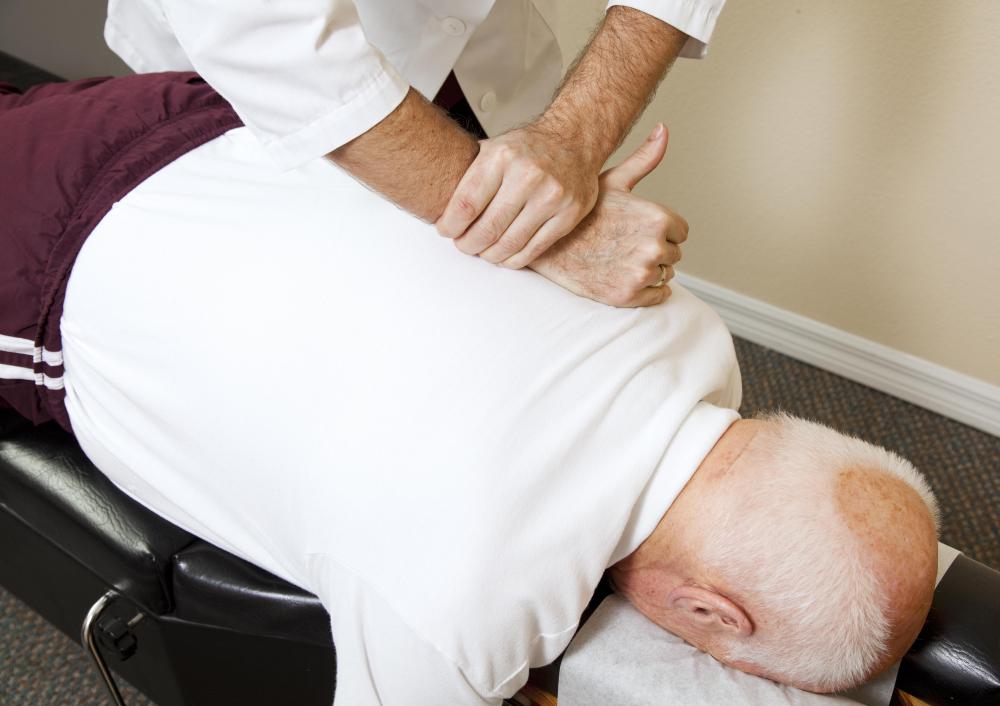
Based on the diagnostic results, the practitioner will then recommend a whole body treatment to correct any imbalance. Treatment often includes dietary and lifestyle changes and, perhaps, detoxification of environmental toxins. The key to treatment, however, is whole body orientation. For instance, integrative manual therapy doesn’t generally address neck or back pain directly. Instead, treatment is focused on restoring balance to secondary systems that may be transferring stress to those areas to manifest as pain.
Karyn Maier
Contributing articles to WiseGEEK is just one of Karyn’s many professional endeavors. She is also a magazine writer and columnist, mainly for health-related publications, as well as the author of four books. Karyn lives in New York’s Catskill Mountain region and specializes in topics about green living and botanical medicine.
Learn more...
Karyn Maier
Contributing articles to WiseGEEK is just one of Karyn’s many professional endeavors. She is also a magazine writer and columnist, mainly for health-related publications, as well as the author of four books. Karyn lives in New York’s Catskill Mountain region and specializes in topics about green living and botanical medicine.
Learn more...AS FEATURED ON:
AS FEATURED ON:









-
![Reflexology is included in the techniques used by integrative manual therapy practitioners.]() By: lunamarinaReflexology is included in the techniques used by integrative manual therapy practitioners.
By: lunamarinaReflexology is included in the techniques used by integrative manual therapy practitioners. -
![Integrative manual therapy integrates the principles of acupuncture and reflexology.]() By: Alfred WekeloIntegrative manual therapy integrates the principles of acupuncture and reflexology.
By: Alfred WekeloIntegrative manual therapy integrates the principles of acupuncture and reflexology. -
![Reflexology is a massage technique where the pressure points on the hands, feet and ears are manipulated to positively affect other parts of the body.]() By: Mercedes FittipaldiReflexology is a massage technique where the pressure points on the hands, feet and ears are manipulated to positively affect other parts of the body.
By: Mercedes FittipaldiReflexology is a massage technique where the pressure points on the hands, feet and ears are manipulated to positively affect other parts of the body. -
![Integrated manual therapy often uses a combination of techniques together in order to address the client's individual needs.]() By: Lisa F. YoungIntegrated manual therapy often uses a combination of techniques together in order to address the client's individual needs.
By: Lisa F. YoungIntegrated manual therapy often uses a combination of techniques together in order to address the client's individual needs. -
![Integrative manual therapy doesn't generally address neck pain directly.]() By: aceshotIntegrative manual therapy doesn't generally address neck pain directly.
By: aceshotIntegrative manual therapy doesn't generally address neck pain directly.



Discussion Comments
@ceilingcat - I share your concerns for the overall health of our citizens, but I don't think that integrative manual therapy is the answer. In fact, it kind of sounds like a crock to me.
How are they supposed to make any kind of diagnosis without using medical imaging? Just by "listening" to the patients body? That sounds a little out there to me.
I would have no problem with people having more access to holistic therapies-provided they were actually effective!
I think a whole-body discipline like integrative manual therapy sounds awesome. However, most insurance companies don't cover stuff like this.
I actually looked into visiting an IMT practitioner awhile back, and I was so put off by the price. It was $75 per visit, no insurance accepted.
I really think that this country is unhealthy on the whole. We have so many chronic illnesses and other afflictions that could be prevented by a healthier lifestyle. I think a big step in changing this countries health would be giving people access to IMT practitioners and other holistic medical professionals.
@Mammmood - I am glad to hear that. I am a great believer in whole body approaches to healing and wellness. Diet plays as much a role as anything else in helping to relieve the pain of the sufferer.
You can get back therapy to relieve muscle aches and strains, for example, but if you’re overweight, your excess weight will place pressure on your back.
Lose the weight, and I think you’ll have less pain. I realize I’ve oversimplified things a little, but you get the point.
My son has played tennis at the tournament level for the past three years. He loves the sport so much, and that’s why he was so disheartened when he started developing tennis elbow.
We had him use ice packs to help out, and that was mildly successful but it didn’t bring lasting results. The moment he went out on the court and started playing again, the pain came back.
Finally we went to specialist. He started my son on a regimen of tennis elbow therapy, which involved using these hand held reflexive devices to strengthen his tendons and his wrists.
He had to do it several times a day. Over the course of several weeks, the pain has drastically diminished, and more importantly, his muscles have been strengthened so he can play at the tournament level again without losing any of his momentum.
Post your comments