
At DelightedCooking, we're committed to delivering accurate, trustworthy information. Our expert-authored content is rigorously fact-checked and sourced from credible authorities. Discover how we uphold the highest standards in providing you with reliable knowledge.
What is Immersion Freezing?
 Malcolm Tatum
Malcolm Tatum
Malcolm Tatum
Immersion freezing is a method of commercially preparing frozen foods so that the product remains suitable for consumption over a long period of time. The process helps to lock in moisture as well as maintain the flavor and taste of the processed food. This method has proven to be quite successful in the food industry.
One of the chief applications of immersion freezing has to do with the preparation of meats and poultry for use in frozen foods, such as frozen entrees and cuts of meat. Essentially, the meat is exposed to liquid nitrogen for somewhere between six and ten seconds. This type of flash freezing helps to lock in important vitamins and nutrients as well as delay the process of decomposition. Meats and poultry that have been prepared for use in frozen dinners are normally cooked to specifications, then subjected to this form of freezing. Such items as uncooked chicken tenders and beef patties may also be preserved this way.

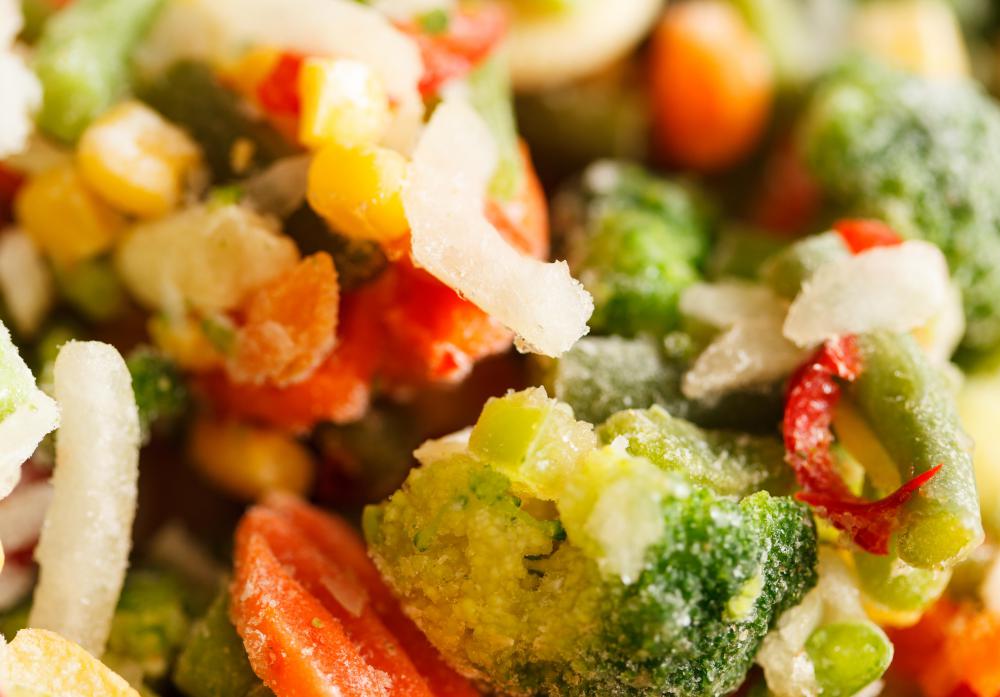
Both raw and cooked fruits and vegetables are often preserved with immersion freezing. The rapid freeze allows the foods to retain their color and texture for long periods of time. They also help to maintain the nutrient content of the vegetables, making them similar to fresh products when it comes to steaming, braising, or broiling. Combinations of cooked vegetables, such as in frozen soup mixes, are also often preserved using this process.

Another advantage of this preservation method is that the process helps to prevent the escape of steam after the food has been cooked. This is important when a food manufacturer is preparing packaged dinners, as steam could cause the container to burst or tear after the product has been packaged. With this preparation, there is no chance for pressure from within the package to burst the container and expose the product to the open air.

Immersion freezing has made it possible to mass-produce a wide variety of frozen foods that can serve as an alternative to canned and fresh. The process makes it possible for food to retain their color, texture, and nutritional value, so many people prefer to use foods prepared in this way. This is especially true with seasonal foods that are not widely available at all times of the year.
Malcolm Tatum
After many years in the teleconferencing industry, Michael decided to embrace his passion for trivia, research, and writing by becoming a full-time freelance writer. Since then, he has contributed articles to a variety of print and online publications, including DelightedCooking, and his work has also appeared in poetry collections, devotional anthologies, and several newspapers. Malcolm’s other interests include collecting vinyl records, minor league baseball, and cycling.
Learn more...
Malcolm Tatum
After many years in the teleconferencing industry, Michael decided to embrace his passion for trivia, research, and writing by becoming a full-time freelance writer. Since then, he has contributed articles to a variety of print and online publications, including DelightedCooking, and his work has also appeared in poetry collections, devotional anthologies, and several newspapers. Malcolm’s other interests include collecting vinyl records, minor league baseball, and cycling.
Learn more...AS FEATURED ON:
AS FEATURED ON:


-
![Vegetables may be preserved with immersion freezing.]() By: Maksim ShebekoVegetables may be preserved with immersion freezing.
By: Maksim ShebekoVegetables may be preserved with immersion freezing. -
![Immersion freezing is needed for mass producing frozen food, such as TV dinners.]() By: KelpfishImmersion freezing is needed for mass producing frozen food, such as TV dinners.
By: KelpfishImmersion freezing is needed for mass producing frozen food, such as TV dinners. -
![Immersion freezing is often done with liquid nitrogen.]() By: markaraImmersion freezing is often done with liquid nitrogen.
By: markaraImmersion freezing is often done with liquid nitrogen.


Discussion Comments
When my strawberry and raspberry plants produce a good crop, I use what I call flash freezing; but it isn't the same thing as food processors use. I don't use the liquid nitrogen.
I just place firm and solid berries on a cookie sheet and put them in the freezer until they are solidly frozen. Then, I put them in Ziploc bags and store them in the freezer until ready to use. When I defrost them, they get somewhat gushy, but they still taste good.
I don't know how many nutrients are locked in using this method.
This is a very good article. It thoroughly explains how immersion freezing takes place and spells out the many advantages of this method of food preservation.
Flash freezing aids in preserving nutrients, helps to maintain moisture, color, and texture.These frozen meats, vegetables, and fruits are far superior to canned foods and even some fresh foods. I have found that some frozen dinners, frozen vegetables, and particularly frozen berries and fruit are superior to those processed just a few years ago.
Post your comments