
At TheHealthBoard, we're committed to delivering accurate, trustworthy information. Our expert-authored content is rigorously fact-checked and sourced from credible authorities. Discover how we uphold the highest standards in providing you with reliable knowledge.
What is Hypoplastic Left Heart Syndrome?
 Tricia Christensen
Tricia Christensen
Tricia Christensen
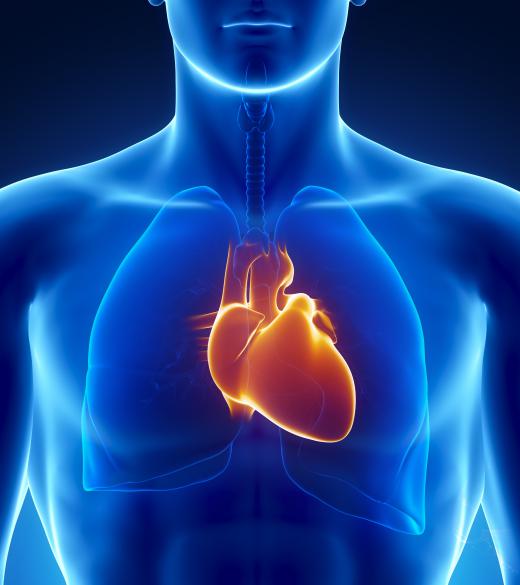
Hypoplastic Left Heart Syndrome (HLHS) is a serious and rare congenital heart condition. In this syndrome, the fetal heart does not develop normally, so the left ventricle is undersized and far too weak to pump blood to the body. Some children survive a few weeks with this condition, but without surgical intervention, heart failure is inevitable.
Often, hypoplastic left heart is diagnosed through routine sonograms. The tiny size of the left ventricle is a sure indication of the condition to most experienced radiologists. Diagnosis is confirmed through fetal echocardiogram, which is similar to a sonogram, but looks more specifically at the fetal heart. Early diagnosis is valuable to parents, though stressful, because it gives them the opportunity to make decisions about what type of care to pursue.

Just a few decades ago, many parents were told that their children with hypoplastic left ventricles could not survive. However, greater numbers of children are now surviving and living with this condition. Unless complications occur, a child with Hypoplastic Left Heart Syndrome can often enjoy many years of activity before additional interventions become necessary.

When parents are faced with a diagnosis of Hypoplastic Left Heart Syndrome, there are three options for treatment. The first is to do nothing, called compassionate care. Until recently, most cardiologists felt that compassionate care was truly the best choice for children with HLHS. Instead of putting the child through multiple surgeries, the child was simply allowed to die naturally. Cardiologists and parents who have chosen this option felt that letting children go without subjecting them to risky treatments gave dignity to their death and was easiest for all concerned, though heartbreaking.

However, improved survival rates of surgery have radically changed the opinion of many cardiologists, although the value of compassionate care is still hotly contested. The development of the Fontan surgery, a set of staged surgical procedures performed over 3-4 years, provides the second option for parents who do not want compassionate care. Though it alleviates the symptoms of HLHS, Fontan surgery cannot "fix" the heart. It merely buys time, as much as 30 years, before transplantation.
The Fontan surgery was initially performed as a single surgery, in which the inferior and superior vena cavae were connected through a tunnel built through the heart. The superior cava was then connected to the pulmonary arteries, which established passive blood flow to the lungs. The heart would then pump blood only to the body through the right ventricle, making the hypoplastic left ventricle no longer necessary.

Early survival of Fontan patients was not favorable. To increase survival, surgeons began to break up the steps of the surgery. In time, three steps became the preferred method. First, a shunt would be placed shortly after birth to help the heart. In about 3-4 months, the Glenn procedure would connect the superior vena cava to the pulmonary valve, and finally at 2-5 years, the Fontan procedure connected the inferior and superior vena cavae.
Many surgeons began replacing the intra-cardiac tunnel with an extra-cardiac shunt (ECC). Though some surgeons still prefer the traditional tunnel, the ECC is performed on a warm beating heart and has far fewer complications. It is becoming the preferred method for the Fontan procedure, as studies show it to be as effective as the tunnel.
Many parents wish to avoid the multiple surgeries and choose transplant instead. A successful heart transplant means relatively few limitations and total heart health. However, availability of hearts for transplantation is variable. Further, life expectancy is far lower than for those with the Fontan surgery.
With Fontan surgery, there is still the future possibility of transplantation when the heart fails. The solution to a failing transplanted heart is another transplantation. If the initial heart has been rejected, second transplants have an even lower success rate.
The decision of how to address hypoplastic left heart syndrome in a child is highly personal and should be well-informed. If fetal diagnosis is made, parents may have 20 weeks in which to find the best hospital, decide what the best surgical procedure is, and find support from other parents. Though hypoplastic left ventricle was once an unviable condition, improving survival rates give hope to all those who may be faced with this diagnosis and the difficult decision it engenders.
Tricia Christensen
Tricia has a Literature degree from Sonoma State University and has been a frequent TheHealthBoard contributor for many years. She is especially passionate about reading and writing, although her other interests include medicine, art, film, history, politics, ethics, and religion. Tricia lives in Northern California and is currently working on her first novel.
Learn more...
Tricia Christensen
Tricia has a Literature degree from Sonoma State University and has been a frequent TheHealthBoard contributor for many years. She is especially passionate about reading and writing, although her other interests include medicine, art, film, history, politics, ethics, and religion. Tricia lives in Northern California and is currently working on her first novel.
Learn more...AS FEATURED ON:
AS FEATURED ON:


-
![The Fontan surgery was initially performed as a single surgery, in which the inferior and superior vena cavae were connected through a tunnel built through the heart.]() By: stockshoppeThe Fontan surgery was initially performed as a single surgery, in which the inferior and superior vena cavae were connected through a tunnel built through the heart.
By: stockshoppeThe Fontan surgery was initially performed as a single surgery, in which the inferior and superior vena cavae were connected through a tunnel built through the heart. -
![Most who survive childhood with HLHS will need a heart transplant during early adulthood.]() By: sudok1Most who survive childhood with HLHS will need a heart transplant during early adulthood.
By: sudok1Most who survive childhood with HLHS will need a heart transplant during early adulthood. -
![A heart transplant is sometimes the preferred treatment for hypoplastic left heart syndrome.]() By: VILeviA heart transplant is sometimes the preferred treatment for hypoplastic left heart syndrome.
By: VILeviA heart transplant is sometimes the preferred treatment for hypoplastic left heart syndrome. -
![HLHS is a serious and rare congenital heart condition.]() By: CLIPAREA.comHLHS is a serious and rare congenital heart condition.
By: CLIPAREA.comHLHS is a serious and rare congenital heart condition. -
![Early diagnosis of hypoplastic left heart syndrome gives parents the opportunity to make decisions about what type of care to pursue.]() By: Tyler OlsonEarly diagnosis of hypoplastic left heart syndrome gives parents the opportunity to make decisions about what type of care to pursue.
By: Tyler OlsonEarly diagnosis of hypoplastic left heart syndrome gives parents the opportunity to make decisions about what type of care to pursue.


Discussion Comments
My daughter had all 3 surgeries for HLHS and was doing really well. But now is getting really tired all the time. They did take her off of Sildenafil medicine recently which is for lowering lung pressure. Anyone have this experience?
May God bless you all. It is painful to know what you all have gone through or are going through. It seems that all of you are very strong and are there for your kids, are not giving up, and that is the real spirit of life.
I wish you all good luck. May your kids grow up healthy, and may God help you all. --Dr. M. Ahmad, India
My name is Sylvie and I have a son with HLHS. He will be 18 years old in May and he is doing very well. Of course, it has been a long road from the beginning with multiple surgeries and doctors' appointments and medications and traveling to and from the hospital, but I would not change him for anyone or anything.
He has restrictions, like no heavy lifting and can't exert himself, and is behind in school due to all the lack of oxygen to his brain, but works at his own pace. He is a wonderful, polite, shy, friendly young man and has nothing but love to give to anyone.
I have a wonderful husband who has been there for us from the first day of his life and he's a wonderful father to our son. Of course, Scott is very spoiled because we never know when the last day might be, so we enjoy him and love him so much.
So for those who have this disease, don't let anything stand in your way because life is so precious and you deserve the best. Never give up!
I'm 20 years old and I have HPLH, and when I tell people no one believes me unless I take my shirt off and show them the scars of the operations I had. I live in California.
I go to the gym, did some martial arts and more things. I live a pretty normal life, except I take medicine daily and see the doctor once a year, but other than that, I'm fine.
My sweet HLHS 16 year old boy is a such a joy to me, and to all who know him. The first year of his life was really difficult, but also wonderful in so many ways. My husband and I were just married when I got pregnant, and the struggles we went through forced us to truly commit ourselves to each other and to our precious boy.
He had his Glenn at seven months and then did well until he needed the Fontan at age five. He developed PLE a few months later. We were able to control it for many years with steroids (prednisone). He has had many developmental delays (both physically and mentally), but overall, our life has been fairly normal until a few months ago when he quit responding to the steroids.
His heart is still working just great. It's just that dang PLE. So a few weeks ago he went on the heart transplant list. I worry about him, but I am so thankful that he is my boy. I consider being his mother as one of the great privileges in my life. By the way, I am up browsing the Internet waiting for him to get home from his second date. Life is good.
My son was born in 2001 with HLHS. He is now a thriving 11 year old. He went through all three of the surgeries with no problems. I thank God everyday for this little man. If it were not for my husband, I would have let him go in peace. I am so glad that one of us wanted to give him a chance.
He is the apple of my eye and brings so much pleasure to all of us. He is the most loving, kindest young man. I wish everyone lived their lives like him. He has three brothers and two parents that love him very much. I look forward to every day we have with him and would not trade the time we have already spent with him for anything in this world.
I have a 15 week old son named romeo. He has HPLH and I am only 23 and have a 4 year old as well. He doesn't have it. Reading this page has given me and my partner hope that my son will survive and live his life. I had never heard of it before and I am still trying to teach myself more about it every day. Thank you all for telling your stories. Thank you for the hope.
My daughter Blaire was born December 2011, at home. She was diagnosed with Hypoplastic Left Heart Syndrome and Aortic Valve Stenosis the next day, when we brought her to the Primary Children's Hospital because of trouble eating, labored breathing and pale skin color. There were three options we could choose from for her particular situation. One of the options was doing "compassionate care" and letting her die naturally, but it was thrown out immediately.
Our surgeon told us that if we chose to do the three stages, the first one would be reversible if her left ventricle grew a significant amount in between the first and second surgeries, and that there was a chance they would be able to convert her heart back to a two-ventricle heart (a very slight chance). He said it has happened before, but not very often. We had a lot of faith, and we decided to go in that direction.
She went into her first surgery (the Norwood procedure, the riskiest of the three) when she was five days old, and she did great! The surgeon said it went with no complications, and she came home 23 days later with an NG tube, 0.03 liters of oxygen, and five medications.
About three months later, she went back for a cardiac MRI to look at the size of the LV, and it had only grown less than a centimeter. It was a third of the size of the RV. We had to move on to the Glenn, and forget about converting back to a two-ventricle heart.
A couple hours out from the Glenn, the left side of her body went into a seizure that lasted for 10 minutes. They did a lot of tests, but they never found the cause. It had been about a week since she had her Glenn, and she wasn't getting better. They did some investigating and found out that she had some fluid that collected around her heart. Some 15 days out from the second operation she had to have an open-chest surgery to clean out the sternal infection that she developed. After that, she was finally getting better and got to come home after 30 days in all, with a PIC line, NG tube and 0.50 liters of oxygen. She was on antibiotics for six weeks and then got the PIC line pulled out at home.
Watching her go through those surgeries was very hard, but definitely worth it to have her here. I think the thing that helps the babies the very most is knowing that they have people who love them, and knowing they are important to them. I quit my job to be there with her every single day, comforting and reassuring her, and I know that helped her to get through everything. Something that will help yourself a great deal is to think positively! Positive thoughts create a chain reaction of positive thoughts and positive outcomes.
Now she is eight months old, and she is very chubby, active, attentive and happy. The only “abnormal” requirements she has are oxygen at night, and two oral medications. You wouldn't even be able to tell that she has a heart condition unless you saw her scars. We are still waiting on the Fontan, and hoping there will be some kind of technological advancement that will be to her (and everyone else with this condition)'s advantage.
Coincidentally, my husband was and is still going to school to be a doctor, and he hopes to further improve the treatments for HLHS.
Just to let you all know, I'm 46 and have HLHS and I'm still here. I have just a few breathing problems but they only just started.
My 20 year old son has HLHS. He also developed PLE after the Fontan procedure. I'm so thankful I found this site. It's great to see that there are survivors out there who are older than my son.
@Post 154: I actually struggled when I moved from sea level to Utah for several months. I was hooked up to an oxygen machine around the clock, and then eventually I only had to sleep with it. I don't have to use it at all anymore, and my blood tests show that I have an abnormally high cell count, undoubtedly as a response to the circumstance. Either way, I finish up my degree there in December, and I have never been in better health. --JRM
@anon254842: Since you're in Arkansas, check with Le Bonheur Children's Hospital in Memphis, Tenn. It's a great facility. You might also look at Vanderbilt Children's Hospital in Nashville or St. Louis Children's Hospital. These are all fine facilities. You might also contact your surgeon in Denver and ask him/her for a referral in your area. He should know where your son can get his next surgery from a good physician.
My son is 14 months old and will be having his third surgery next year because there is a leakage. I've have been searching for amazing surgeons around Arkansas but I will travel across the globe if I have to. His first two surgeries were done in Denver, Colorado.
My daughter Jade was born in 1991 and will turn the big 21 this summer. She has HLHS with Blaylock Tussing Shunt placed at six days old and and again at 18 months. She received her Fontan at four years of age by Dr. Francisco Puga at Mayo Clinic, St. Mary's Hospital in Rochester, Minnesota. We reside in Mississippi and she sees her cardiologist yearly.
She attends a junior college and is on the dance team there. I have always told her to never give up and never let her condition stop her from living her life. She is doing great and I pray she has many, many years to live! God is good!
As well, I could not imagine letting my child die without a chance especially over cost. High price? Not sure you know what you're talking about, actually.
Thank you for posting that anon251200 (post 156).
As a critical care RN and a parent of a child with HLHS, I want to say please consider what you write before you post.
Although there are great stories here, there is also judgment and mostly a one sided view of those who are choosing/chose compassionate care or terminated. This is not an easy road for anyone to travel and no one should have to make these decisions.
For as many great stories as there are, there are so many tragedies that HLHS has brought as well. These surgeries do not come without high prices. Comfort care provides the child with a dignified death and the surgeries are only palliative in nature, not curative. I have compressed a dying heart in hopes that the parents would arrive to the hospital before their baby is declared dead. We should not judge or discount those who choose to love their baby as long as their natural life allows. Compassion, understanding: what we all need.
Does anyone have personal experience or information about HLHS and high altitude? I have an HLHS daughter and she has had two of the three surgeries and she is 18 months old. Pretty soon she will have the Fontan which is the last surgery, hopefully.
I am concerned because we live in Salida, Colorado which is 7,000 feet above sea level. Please let me know any information that you have on this.
@jerrielynn: Dr. Bove at U of M motts did my surgery as well! And I love your nephew's name, not to mention we have the same name. Dr. Bove is a wonderful person. In fact, all of them at motts are great!
@Faustinah: It's OK thanks. Mmy boys are my world and I would go through anything for them. has your daughter had any surgeries yet?
@stormchaser1: Sorry, I thought you were a woman. I don't see many men on these boards, but that makes sense now. I am so happy to hear this information. Thank you for sharing. Your boys are lucky to have a strong father like you. Very lucky. Thanks again.
@Faustinah: Yes, I have two boys and I'm the father. I have heard of females with this condition that do carry and have healthy babies.
@stormchaser1: You have two boys? I have a daughter with HLHS. She is 18 months old now and is doing very well. I always wondered about having children with this condition. Are your children adopted or did you carry them? I appreciate any information. Thank you so much.
I'm a fontan patient. I'm 31 years I had my fontan when I was five years of age. I'm doing great. I do have atrial flutter but I don't let that me drag me down. I've had two ablations so far for it and it's helped some.
My heart is not as fast as it used to be -- around 200 bpm. Now it's around 95. I am going into the hospital in a few days to have a third ablation because I asked to have it done and a pacemaker as well.
I hope this helps some out there. The way I look at it is I will never let this drag me down and I will always fight. I have two little boys who are worth fighting for and I don't intend to give up any time soon!
There is so much wonderful information provided here by so many people. I have a HPLHS 4 1/2 year old daughter. She just had her Fontan procedure six weeks ago. Her energy level has increased tremendously.
It is exciting to read about those who are in their teens and twenties and that they are living quite normal lives. It totally gives me encouragement. I am sorry for those who have lost their child and also to those parents who have chosen not to have the three procedures done. If it is due to financial difficulties, please check with your state and see if they have a program that helps pay for the cost your insurance does not cover or pays for it all together.
Please. Think about it. They have just started a new way to do the Fontan. During the first surgery they perform the BT Shunt and also do a cath lab to prepare for the Fontan. If the first surgery is done this way, the Fontan will be done through a cath lab which is so awesome! Medicine has come so far, even in the short 4 1/2 years since my daughter was born. It will continue to increase over time.
Brett was not our only HLHS child. Lynn was diagnosed with HLHS and three other cardiac defects during early gestation. Pathetically, our neonatal OB lied to us (for his religious reasons) and did not disclose the defects until after FL guidelines for legal termination had passed. Lynn died. My condolences to all those who have suffered the loss of a child.
My (former) spouse was diagnosed with a cardiac defect 18 years after our children were diagnosed with HLHS. We believe there is a genetic component, but have always been told it is a combination of genetics and environmental reasons. Five HLHS babies, by four couples, in a three mile radius in St. Petersburg, FL, seems high to me. While at CHOP in 1991, we were told a couple had three HLHS children.
For those who are just beginning their journey with HLHS children. Do the best you can for your children and remember to be good to yourself. -- Lori V.
Our son, Brett, is 20 years old. Dr. William Norwood performed Brett's HLHS surgeries when Brett was three days, five months, and 13 months old. We lived in St. Petersburg, Florida. Dr. Norwood was with CHOP (Children's Hospital of Philadelphia) at that time. He studied at the University of Minnesota Minneapolis under another brilliant heart surgeon and set out to change the outcome of a disease that was once universally fatal.
We're thankful that Dr. Norwood dedicated his life to saving those he could and learning from all the children he had the privilege to operate on. I also thank Brett for being a pioneer.
My sister has a HLHS baby. She is actually due with this much wanted little girl in a few days but she is going to have her probably next week. We are all worried about all the stress this is doing to my sister and my parents.
No one goes through life unscathed but for a young baby and child or anyone to go through this is hard.
I have had my health issues and I have sister who had cancer (she is now in cancer free 9 years). I pray for my young niece and my sister.
Dear 142: Love your post. Married? You don't have to unless you really want to. You haven't had a surgery for a long time and that helps mommas and poppas be hopeful for their beautiful children.
Thank you so much for your post. I'd like to talk to you more. Everyone dies, so don't feel like its just you. We are all awaiting death. But instead of awaiting we can just hang out, right?
I am 25. I have had a Fontan operation. Articles that declare: "It merely buys time, as much as 30 years" make me feel as if my best years are behind me and I am just awaiting death.
Even though I have no complications, and my last surgery was at 7, reading that sentence makes me feel like there is nothing further to live for. If I get married what is the point? To die less than five years? To have to go under transplantation?
Dear 138, aunt of nephew due in five weeks. My name is Robert, and I am a 41 year old male.
My daughter, Sydney, had her first birthday in May. She has had the first two of the three stage surgeries for HLHS. I would not trade anything in the world for her.
I hope the rest of your family helps them to decide to keep their beautiful baby alive with these miracle surgeries. He deserves a chance. Love to you all.
Dear 138: I hope they change their minds. The three surgeries are good. They will change their minds when they see their beautiful child. They will do everything possible to save the baby. I am so glad my HLHS baby is here. She is beautiful.
Our son Haydan is a twin and is eight and has HLHS.
Academically things struggle but gee he is sporty. Haydan plays soccer for his school and an out of school team. Haydan just finished playing Baseball for his school and an out of school. Haydan loves his bike, powerwing and green machine and is a fish in water.
Just think we were advised heavily to terminate. Following Norwood 1 at five days and Norwood 2 at three months and Fontan when three, he lives a very normal life. Life is good.
Thank you all for your posts and for sharing your hope. My nephew (due in five weeks) has hlhs and his parents have decided to do "compassionate care." They had planned on surgery so we are now surprised and devastated. I tried to share these posts because they were so hopeful but to no avail. God bless all of you and your angels. We can only pray now that they'll change their minds and give him a chance.
My son is going to be 12 in June. He is very healthy! We have been blessed. Xavier plays sports, rides his bike and is very proud of his "zipper". He is on daily medication, we see the cardiologist annually and have received excellent reports so far.
I thank God for my little angel every day. I could write a novel with all the emotions, fear, hospital stays, doctor visits and happiness my family has gone through. This has been a hard long, horrible,crazy, wonderful road that I would do all over again in a heartbeat!
My 4 year old grandson was diagnosed with HLHS when my daughter was about 20 weeks along in her pregnancy. She was referred to maternal fetal specialist from her ob/gyn due to one of the baby's chambers being a "little small". We went thinking we would have a more in-depth ultrasound, receive a thumbs up, and go on with life.
As an RN, I knew something was terribly wrong just by the actions and the comments from the ultrasound tech. I became physically ill when they told us of this condition that I had never heard of in my 20-plus years of nursing. We were then referred to a peds cardiologist who specialized in neonatal c/v issues and the hits just kept on coming. My grandson also had a restrictive ASD and was missing a valve. I have never felt so helpless in my life.
Kavaun was born at Vanderbilt Hospital in Nashville TN by scheduled c section and weighed almost nine pounds. He looked perfect, but had a long road ahead. He had his first surgery at five days old, the second at around four or five months, and the final surgery two days after his second birthday. He (and we) definitely had some seriously difficult times, but he is worth every second of fear and worry.
He is active, beautiful and spoiled to the nth degree. He does whatever activities he wants, which has, so far, been everything.
To no. 62, I hope you that you will someday recognize the hope and power that is available to you through prayer. After all the research and questions and care decision, we ultimately had no control of what would be the final outcome. There is no question in my mind that my precious grandson is here because of the multitude of prayers sent up on his behalf and through the mercy of our loving Lord. Taking nothing away from his docs (We love you Dr. Bishell and Dr. Liske!) but the plan, the knowledge and the skills are a direct gift from God. I will be eternally humbled that we have been so blessed.
P.S. To you mothers whose daughters are living this challenge: you may be surprised at her strength and the fierceness of her devotion to her child. She will be stronger than you think. My thoughts and prayers are with all the precious babies and their parents, past, present and future.
I'm sitting here reading about all these new moms talking about their babies, unborn and newborn with HLHS, remembering back 20 years now about the day my daughter was born. She turned twenty in February.
I wanted to post this because i know it will give so many new parents who have children with HLHS hope. She's on lisinopril and has a pacemaker she acquired after one of her surgeries.
She is a happy, well adjusted beautiful young lady. There is hope, there is always hope. We were told initially she'd never survive without a transplant, but twenty years later, no transplant. We're thankful every day for God's grace. She's been a blessing and we've learned so much from her.
Dear 131: I'm sorry to hear about your brother, Jordan. If you don't mind, can you tell me how he died? Was it just from complications? Was it foreseen? My daughter has HLHS so I am in a constant state of worry. I would appreciate any input. Thank you so much.
Jordan was my brother. He was born in 1999 and would be 12 years old. Jordan was born with Hypoplastic Left Heart Syndrome and has been through multiple surgeries and has been to many hospital across the United States from as far as Texas and North Carolina. he lived in Flint and Jackson Michigan.
Jordan passed away in 2008 at eight years old. To this very day, he is missed by many people. he was very outgoing and loved any person that looked at him. i give best wishes to every family who has to live through this type of situation. it is the hardest thing to watch and live with.
i am happy that he is at peace, but i will always be sad that he is not with me today. he passed away not knowing how much i loved him as a brother because i had not seen him for three years because of family issues with the state of michigan and i moved to my dad's in Illinois.
i hope that he knows that i loved him with all my heart and i will never forget him. i give my empathy to all HPLS patients and family members. never give up on anyone and remember to have faith no matter what.
Thank you so much for reading my story. i love you.
I am 18 years old and 22 weeks pregnant with my first child. I'm having a son, but at the same appointment where I was told I was carrying a little boy, i was also told that the heart looked as if it had some complications.
Yesterday, the cardiologist diagnosed him with HLHS, and now I've been spending most of my time researching about the syndrome and came across this website. Reading these stories that you all have posted about living with HLHS and having children with the syndrome has really inspired me. I still don't know what all to expect but i feel more comfortable knowing other people have lived with and gone through the same thing I'm going through right now, so thank you for sharing your experiences.
@ no. 128: That is good to hear. My daughter has HPLHS and she is doing great so far. She is almost one year old. I used to live in Eugene, Oregon. I love Ashland. --Kristen
I am a 20 year old college student in Oregon. I was diagnosed with HPLHS while in utero. When i was eight i was given a pacemaker, and my life has been great.
I am currently studying to be an actor in Ashland, Oregon, despite not being able to play sports or take PE. As a kid, my life has been pretty normal. I am healthy and living on my own, and unless i show someone my scars, no one can tell I have HPLHS.
my son was born in 2006 with hlhs. he had a really big fight to get to where he is. today he is 4.5 years old, waiting to have his third stage done. he is a lot smaller than his three older brothers and even his younger brother who is two years old.
It has been very hard to live day to day knowing what is ahead for him, but he is a strong little boy. Hopefully he will be strong enough to get through his surgery so he can start prep next year. he is looking forward to school with his big brothers.
@Post 125: My 10 month old daughter has HLHS and has had two of the three surgeries. The first surgery, right after birth, we were in the hospital for about five weeks. For the second surgery at six months old, we were in the hospital for about six weeks, but only because she kept getting fluid on her lungs.
Typically, after the second surgery you only spend about a week or two in the hospital. Most importantly, doing excellent and she is a very happy, smart little girl.
I gave birth to her naturally at the Ronald McDonald House so you can have a home birth if you so choose. Do not be afraid.
I chose to have her not at the hospital because of her heart condition. I wanted to be able to hold her and breastfeed her as soon as she was born. I knew that would not happen if I had her at the hospital. They wanted to induce me and all this other stuff and I knew it would just turn into a c-section.
Seriously, consider still having a home birth or at least a natural birth and insist on being able to hold your baby right after birth and insist on delaying the cord cutting. Very important in my opinion. Much luck and love. Your beautiful baby will be fine. Be strong! --Kristen
Wow. So many stories, both encouraging and devastating! I am 23 weeks pregnant and just found out my little girl has HLHS. We are hoping to go ahead with the surgeries if she seems strong enough to cope after birth. Looking ahead at the next 6 months seems impossible: my husband and I will have to move to the Charlottesville for the summer since she will likely be hospitalized for a long time. I don't know what we'll do about money. We're still in our early 20s and in the "getting started" phase of our life together. I feel so overwhelmed.
One of the hardest things to deal with at this point is the people who cannot allow me to grieve (after all, shouldn't I just be glad that she has a chance?) I'm sad that she won't be able to have children herself. I'm sad that I can't have my home birth. I'm sad that she might die. I'm sad that she has to have open heart surgery as soon as she is born. I'm sad that she will need a feeding tube. I'm just sad and scared all around.
I am 25 years old and the recipient of a modified fontan done in three surgeries, the last stage done when I was almost four years old to combat the problems left to me from my HLHS.
Additionally, I was born with a diaphragmatic hernia and was missing one lung. Despite the odds of less than a 10 percent chance of survival, I came out of it and have had a good life since. Dr. Norwood performed the procedure at the Children's Hospital of Philadelphia. I have had a very enriched life despite my heart condition. My only limitation is that when I run for long distances I become tired quicker than average.
I do, however, lift weights and run regularly. I wrestle, I have done karate, and have a passion for Brazilian Jiu Jitsu. I can't say the heart condition has no effect, but it certainly hasn't stopped me from enjoying life, and so far I've been in terrific health and expect to live for a long time still. I am a college student in Pre-Med, though I haven't decided which specific field I desire to go into.
I guess the point I'm making is especially for those that are debating whether or not it's worth having the surgery done. It is. Even a few years is better than none; I had a fantastic childhood and would not have missed it for anything; and I would have left the world with very little regret had I have had to have left it a little earlier. I think my parents, brothers, and sister can all agree to that statement. --JRM
I am so happy that I could find this website and read all stories about children with Fontan operation,
My husband had the new fontan operation in 1991 in London by Prof Stark. Now he is 31 years old. He was very well and did everything with no limitations. however, unfortunately since feb 2010 he had three episodes that caused the doctors to gave him electrical shock until his heartbeat was back to the normal, because last feb his heartbeats was 240, and after that his doctor put him on Sotalol, but in decm 2010 suddenly it happened again, and three days ago, again he had palpitations and they had to give him shock to get him back to a normal rhythm.
I am really scared, and wondering to know if you know anybody with the new Fontan who is the same age or not,
because all doctors don't know what they can do for him, and there is a risk for him if they do any surgery because of his his complicated heart condition.
I am begging everybody if you know any cardiologist in hew Fontan not old Fontan, let me know.
his Dr name is David Tenous and he is the best one in Australia in Children Westmead Hospital.I really adore him and believe his suggestion. But I think maybe I can find someone in the other part of the world with this problem and the solution because my husband is the first person with this problem in Australia, and they do not know what they can do for him.
Please, please. If you know anyone let me know or even the doctor that is the best.
I am the mother of a HLHS angel. He lived to be one day less than two weeks old. He had so many other problems other then the HLHS, surgery wasn't an option. He also had Hypoplastic Right Lung, and all the valves and hookups to the heart had problems. Also a list of other problems.
I miss him terribly. I miss all the things I could have done with him. I miss being able to watch him grow up. I also praise God that I was able to meet him and have him for those two weeks. His two short weeks really did make a difference in our lives. I have four healthy children who miss knowing him as well. I pray for HLHS families often. It is a hard thing to have to go through, no matter the outcome.
My daughter Lauren is 27 months and has HLHS. We did not know about her condition until the day after she was born. It was a very scary first six months and she spent a total of nine weeks in the hospital, but she has been a great blessing and a joy to us. I wouldn't change a thing if I could.
She will have the Fontan in the next two years. She is doing wonderfully! She loves Mickey Mouse, dressing up, wearing hats and shoes, and playing outside. She laughs and smiles constantly and loves to give hugs and kisses. She loves her big sister and playing with her toys.
To anyone wondering what choice to make for their HLHS baby, consider giving them a chance to fight. Life is worth it.
My name is Maranda and I'm sixteen and I was born with Hypolastic Plastic Left Heart Syndrome in October 1994. I have had all three surgeries before I was four. I live a normal life. It's not all that different from a normal child's life.
I just wanted to say for all the people out there who know someone with hlhs or is pregnant with a child with hlhs that there is hope and it may seem horrible at first, but it does get better.
My granddaughter Madison was born with HLHS.
She is now nine years old. She still has just her second surgery, which is the hemi fontan. She has had the fontan twice and both times she got very sick so they had to reverse her surgery. She lives with her hemi fontan.
We were just told that she will never be able to get the last surgery and that she isn't a candidate for heart transplant.
Just wondering if there is anybody else out there with the same problem. Please let me know. But we will never give up hope. She is a trooper. It is an honor to have her in our lives. God bless all.
I've been reading all these stories and I feel totally better knowing I'm not alone. I have Hypoplastic Left Heart Syndrome. I am almost 17 years old and i am very active, I dance and play soccer. I have a really normal life and can do pretty much anything.
I never use my condition as an excuse and I'm really thankful that I can do all the things i can do. I personally don't feel any different than any of my friends. I'm looking into colleges now and I am planning on living a long life.
For many people this can be scary to find out, so i just wanted to post a comment from someone who's going through it and let you know its okay, and you can be normal. Also i don't take any meds. I know a lot of websites say you do, and i did take medication for a little while but now i don't. Okay well good luck to everyone.
My daughter was diagnosed with HLHS before she was born. We opted for the surgeries. She didn't survive due to blood clots. She was a day before six months old when she passed on. My prayers are with all that have lost, and all those who struggle with the emotions for the babies who are surviving. praying every day that doctors can learn more to save more babies.
Getting the news that our baby had Hypoplastic Left Heart was devastating. After a consult with Dr. Rychik at Children's Hospital Philadelphia we felt confidant they could help us.
Anthony was born in June 2008 and had his first surgery at seven days old. He came home seven days later. We had no complications at all. In December, he had surgery number two and was home just a few days later. We are going in this December for number three.
My hero, Dr. Spray, performed the first two and will be doing no. 3. Anthony is 2 1/2 years old and doing great. He counts to 25, speaks in intelligent sentences and even knows a good amount of Spanish. We look forward to getting the next surgery done and getting back to our normal life.
Like everyone else going through what we have to go through, I don't wish this on anyone but my saying is "if you think you got it bad, someone always has it worse."
Unfortunately we have to see children at these hospitals that are far worse off then our children. If anyone should read this and is just beginning to go through this nightmare just know that things can turn out just fine. Keep your head up no matter what. It'll be all right.
My brother was born with hlhs back in 1994. He has had six open heart surgeries, plus two years ago he got a pace maker put in. he is doing great. he is now 16 years old.
he is a little slow in his development, but we believe he will outlive us all. for families who have children with hlhs. Don't give up hope. With all the medical advances nowadays, there is a greater chance of survival.
i know the struggle of you all and my prayers are with you.
Thank you so much for sharing all your stories. It gives hope and also makes you cry for those who
couldn't survive.
My son was also diagnosed with HLHS in the 21 week scan. The docs suggested amnio to identify any down
syndrome and luckily there was none. We were also given an option of either terminating or keeping the baby where he would have to undergo three surgeries. It was a very hard decision but we decided not to terminate and all throughout my pregnancy everyone prayed for him. We have been so lucky that no matter how much I thank God it won't be enough that he skipped first shunt procedure as his right side is not that small and he has a VSD and ASD that was helping with the blood flow and thus his Oxygen levels were around low 80s with which he was coping fine.
The surgeons performed a ballooning procedure to try to open up his valve but it didn't make much difference.
At around 1 years and 11 months he had his first
stage of the Fontan. His levels did not improve that much but he was not turning blue that often. We just have to be careful as he gets blue either when he is cold or overexerting physical activity and is on a half aspirin.
He has learned to stop himself when he can't do much and tells me he is tired. He is now 4.5 years old and is as smart as any other kid. He has a low immune system and catches normal bugs but even a normal kid can have that too. He is active just a little fussy in terms of eating. You wouldn't be able to tell that he has undergone cardiac surgeries.
He just had his cardiac catheter for the stats and the doctors/surgeons are all of the view that he can have a good Fontan.
I just wanted to know if there is a case where the right side was of a good size and the heart is
working as 1.5 ventrical rather than single, and I want to know how are they coping.
He is going to have the surgery in the next six months so please pray for him that he recovers successfully from the second surgery without any complications. I strongly believe that prays play a very important part and my miracle son is a result of all the prayers made for his good health. Thank you all the surgeons and Thank you very much Allah.
For post 109: if there is a will then there is a way. don't get me wrong. i know this is your child but to just give up saying we don't have the money? do what you have to and if that don't work, go on welfare. i know they pay for this surgery.
Our son was born in 1981 with HLHS, and at that time no procedures were available. Our hearts still ache but we are thankful and stunned beyond words what the medical community can now do for HLHS. Decades make a major medical difference.
My daughter has HLHS. I gave birth in September, 2010. As much as i wanted her to undergo surgery (the three-stage surgical) we don't have money to use for her treatment.
Me and my husband are depending on God's decision. We believe in miracles, and we know that there is nothing impossible with God. We are sorry for her that we don't have money to use for her surgery and even though we do our best to ask for help, we still cannot collect enough money.
To those parents who have options for their children, you are very lucky. With us, we know that God has a plan for us and for our precious darling.
My son Matthew was born with HLHS in 2007. He went through the first surgery at three days and we thought everything would be fine. Unfortunately, many more complications came along that prevented him from going any further.
I thought i was being selfish on wanting to keep him here when I can see it in his eyes that he was tired and hurt. So at five months old I took him home on hospice care and let him die peacefully in my arms. I miss him to death but I cherish every memory i have left of him.
To all the parents with children that have HLHS: fight for them and if they can't fight anymore it probably means they're tired and they want to rest.
wow. i just found this site and reading the stories have really touched my heart.
My little boy isaiah was born in 2003. We did not find out that anything was wrong with him until two hours after he was born. He was then taken to A.I Dupont hospital and we found out that he had HLHS. He received the Norwood at three days old, which was preformed by Dr Norwood himself, and then the Hemi- Fontan at five months and the Fontan at one year.
Everything was OK with him for a while but right after he turned six years old he started to have some complications. he was having some flow to go in to the left side of his heart but not come back out so it was causing a lot of high pressure in his left side so he had to go through another open heart surgery.
he seems to be doing good but they had to start him on meds and if the meds don't work we may be looking at a heart transplant, but our faith is strong because we know that through God all things are possible and he is our strength and our shield.
Also if anyone has a child with this and is nervous about having another child, i was worried too. my daughter who is two years older than isaiah is very healthy in her heart. we also had another little boy last year and he is heart healthy too so we are very thankful for that as it was a big concern for us. Thank you all for your wonderful stories. i hope you can take something from ours.
My daughter was born with HLHS 1995 She underwent the Norwood procedure two weeks after birth, bidirectional Glenn at four months and the Fontan at two years old.
Dr. Tam who then was at Egleston Children Hospital who is now the vhief children's cardiovascular surgeon in Fort Worth, Texas.
My daughter is truly blessed and has had no real big complications since her last surgery. She is a shy but typical teenager. My faith in the Lord is strong but I sometimes wonder how long I will have with her. But I realize that no day is promised, and I cherish the fact that God has allowed her to be a living testimony. She is doing well and I expect to have many cherishable years with her.
My son was born with HLHS, and we did not know until he had trouble breathing while we were fixing to leave the hospital with him.
I thank the nurses for detecting this and God who gave them the knowledge to look for this. My baby is two he is going to have his third surgery next summer (2011) we are nervous, but I know he will be fine. I have faith that he is meant for something great and after this surgery he will live his life to the fullest and we will cherish him everyday!
My son was born in 1992 at 38 weeks gestation. he was fine at birth and 26 hours later became very sick. He was life flighted to Hershey Medical center and diagnosed with HLHS. We too, were given the options of doing nothing and letting him die (no way), getting a transplant, but was so sick he may have died waiting for a heart, or having the corrective surgeries.
We chose surgeries, done by an amazing doctor named Dr. Myers. He had the Norwood at six days old, the Hemi-Fontan at 10 months old and the Fenestrated Fontan at two 1/2 years old. he is 18 years old now and away at college. He is almost six feet tall and is very lean and athletic looking. He acts just like every other boy his age.
He takes meds twice a day, sees a cardiologist every six months and has EKGs, echocardiograms, stress tests and 24 hour Holter monitors routinely. His limitations are no football, no weight lifting more than half his body weight, and no wrestling. He can run for short periods of time but does get a little short of breath and has to stop and rest. Otherwise he is doing great.
My only fear is how long is his life expectancy? You have to wonder how long a heart like this can last. But still I thank God for the past 18 years, and pray for many many more! Anyone out there going through this, hang in there, it is possible to survive and have a wonderful life. the beginning is rough, but the outcome can be amazing.
My son was diagnosed with HLHS when I was 21 weeks pregnant. There was never a more difficult time in our lives. To those just diagnosed, hang in there. Alex turned 10 in March. He loves sports and plays a lot of baseball. He had all three surgeries performed at Boston Children's Hospital.
We are very thankful to have him, and his two heart healthy brothers, in our lives.
Our daughter is 11 years old and a typical preteen in every way. She had her last surgery at two years of age and has been healthy every since. She loves dance and playing the piano. This winter she tried her brothers favorite hockey and played softball this summer. She is about to try outdoor soccer. We have stayed away due to the constant running but she wants to try.
My brother was born with HLHS in 1981. My parents did not discover the news until after his birth and were giving him the option of "compassionate care" but that was not even a consideration for them. They chose to go see Dr. Norwood in Philadelphia and it was the best decision our family made.
He lived almost four years and those are smiles, laughs, tears, and moments I will cherish for the rest of my life and I know my family feels the same.
If you discover your child has HLHS prior to birth, please give them a chance. The technology and techniques have advanced so much that the chances of long term survival are far greater.
Blessings and prayers to all those who have loved ones with this syndrome.
My daughter was born with HLHS in 2003. She had the Norwood operation at day three but she passed away at day five. According to doctors, everything went all right with the surgery. They don't know the reason.
After her death, we were asked to take tissues for autopsy. Me and my husband allowed it as the doctors told us it could help other HLHS children. I wanted to know about the outcome of autopsy but we never heard anything.
Finally, after one year, we went to meet the surgeon and asked about the results of autopsy. Then we were told that my daughter caught pneumonia during the Norwood. Dear parents, keep your baby warm after surgery. Please do not leave without clothes just because baby has an open heart and it's not possible to keep warm.
Good luck to those parents who are going to give birth to an HLHS baby.
Why god sent you a HLHS baby.
It's a beautiful day up in heaven. Jesus is rounding up his tiniest angels, to go live on earth, and be born. One of the sweetest angels says to Jesus "I don't want to leave, I like it here, and I will miss you". He reassures the scared little angel that everything will be okay, and that he is just going for a visit. He is still not swayed on this idea.
So Jesus kneels down, and says, "How about if you leave half of your heart here with me and take the other half with you, will that be okay?" The angel smiles and says, "I guess that will work". But the little angel is still a little scared. He asks, "Will I be okay with only half of my heart?" Jesus replies, "Of course you will. I have other angels there that will help out, and you will be fine." Then Jesus gives the angel more details about his plan. He says "When you are born, your mommy will be scared, so you have to be strong, and when you feel weak just remember that I have the other half of your heart. Enjoy your time with your family, play and laugh every day, and when it's time to come back to heaven, I will make your heart whole again. Always remember that you are not broken, just torn between two loves."
For Cohen William, HLHS, now 3 and 1/2 and flew through all three surgeries at Children's Hospital of Pittsburgh. God Bless our baby boy!
My precious nephew was born on in September 2009 with HLHS and no other complications. we did not know of the problem beforehand and thought we had a healthy little guy. He was rushed to a hospital that could perform the Norwood procedure. He had the first surgery at five days old, and the second at six months.
Unfortunately, in early August, he unexpectedly left us to be with Jesus in his sleep. However, it was God's decision to take him. The surgeries all went well and we do not blame the doctor in any way. We were blessed with the best 10 months of our lives while baby Carson was with us.
I highly recommend the surgeries. Although he did not live to be an adult, he had a very happy and lively 10 months with us. His smile will forever light our hearts. Good luck to anyone out there going through this. Stay strong, and trust in the Lord.
My daughter has just found out at 20 week scan that her son has HLHS. We have all been distraught over the past few days. She has today been given the three options, and without a doubt they have both decided to go for the Norwood Procedure. It is quite comforting to read some of the above messages. The little fella is due 19th December, then hopefully straight to Great Ormond Street Hospital for the first stage op.
To post #62. On the contrary, God has everything to do with it. He is the one who gave the doctors and scientists the intelligence and wisdom to help patients like my daughter who just underwent the Norwood.
And while I am very grateful for the surgeons, cardiologists, and PICU nurses who have cared for her thus far, God has been with us from the beginning.
And while the surgeons can give my daughter a chance to live here on this earth, it is only Jesus Christ who can save the soul and grant eternal life. It doesn't have to be one or the other, we can give to the church and our children's hospitals.
To all of the HLHS parents and survivors. I too have a child with HLHS, and it was discovered at a 22 week ultrasound appointment. After the tech saw the unusual findings she immediately showed the doctor, who in turn called over to the Peds Cardiology Unit at MUSC in Charleston, South Carolina.
Before leaving my OB appointment I had an amnio done (longest 10 days waiting on those results) which came back fine. Immediately after the appointment, I went to MUSC for a fetal echo and was informed on the findings.
My daughter, now three, was born with HLHS and ASD. I could not terminate. I prayed and did all that I could to ensure that she was born otherwise healthy. My baby was born Christmas morning weighing in at 10 lbs 14 oz. She had the Norwood with a B-shunt at two weeks and the Glen at six months. Other that this heart defect and some ear infections (what baby doesn't get those) she has been healthy, happy and very active.
Today we went for her surgical workup for the Fontan which she is scheduled for in a few days. I have prayed, cried, and thanked God for healing and restoration, for all things are possible through Christ Jesus.
The struggle is hard and the road seems long but just have faith. God knows all and everything that is done is done according to his will. Today I struggled but I know that whatever the outcome, it is all God's plan. If you know God, thank him for your children, for they are his gifts to you. For those of you who may not please seek and find him. God bless you all!
I would just like to say a huge thank you to all who have posted their stories.
I was told at 25 weeks pregnant my baby has a very complicated heart and there is a chance his condition will progress to HLHS. My due date is Oct 2010 and we are anxiously waiting! After reading all the above posts i feel much more hopeful and it has filled me with confidence to believe my baby has a fighting chance at life.
So again, a huge thank you to you all. It is amazing to read about all the people in their 20's and still healthy. I am so glad i stumbled upon this web page during my frantic searching! Thank you!
Dear Post #93: I also have Post #63 in which I was struggling with the decision to terminate. I did not terminate and my daughter had her first surgery four days after birth and she is now two months old and doing excellent.
She is happy and healthy and just like a normal baby except for a couple meds once a day. I know you will make the right decision for your family.
I actually did eventually go all the way to the abortion clinic and could not go through with it and I am so thankful that I did not.
I am 15 weeks pregnant and have just been told by the Doctors that my baby has HLHS with Common Atrioventricular Junction. I was offered termination or the three-stage surgeries after birth. A bit confused and not sure what to do. My hubby is supporting with any decision I make.
We just celebrated my son's eighth birthday. He was born with HLHS in 2002. At 20 weeks gestation we found out about his condition and opted to go with the three-stage surgery plan.
He had his last surgery just after his fifth birthday. Like many others the first year was a little rocky. With the first two surgeries and other complications he spent a lot of time at Primary Children's Hospital in Salt Lake City.
With the knowledge of the amazing doctors and nurses and of course God's hand in it all, my son is a survivor.
My heart goes out to all those who have lost their babies to HLHS. For those who are awaiting the birth of their HLHS baby, I want you to know how worth it it really is. I don't know what I would do without my little miracle child, and he is here because I tried.
My son is now seven years old with HLHS diagnosed when I was 20 weeks pregnant. I was offered termination but after 10 years of fertility treatment, I couldn't just throw away this baby. What if the next one had a problem and the one after that, no one is born 100 percent "perfect."
He had all surgeries at Great Ormond Street in London and in his whole life he has spent 36 nights in hospital.
He is very active, attends school and loves football.
He frightens the life out of me when he does flips and belly flops on his trampoline.
He is a little behind his peers in school in maths, but reading and general knowledge is fine. He is also the tallest in his class.
Thank God for all the doctors and their knowledge and dedication to our children. In particular Mr. Tsang (surgeon) Doc Sullivan and our general practitioners Dr. Sinha and Dr. Sarkar. --Jo
My name is Shanna and I am 23 years old and have HLHS and I am doing great. I have had five open heart surgeries. It has been ten years since my last one. I am doing great and I am on beta blockers. I am getting married in September. God bless.
My son died of Hypoplastic Left Ventricle disease in 1988. He had coarctation of the aorta, aortic stenosis and mitral stenosis. He was born in 1985 and after numerous surgeries he just became to weak and at that time period there was a lot they could do. Prayers for all the parents out there who are going through this. Dustin was very special and will always live in our hearts. --Sharon G.
My son is turning 12 this July and he is awesome. He had all three procedures before he hit three and he plays baseball and plays like a normal child. he loves video games and is a day dreamer too. lol. I thank god each day for him and for me to be able to watch him grow.
My son was born in 1996 and is doing well. he has a pacemaker and takes medications. He goes to school and plays baseball and golf in the summer. Never give up hope; it is an amazing thing. He gives us smiles everyday he is here with us. And who knows what they will come up with in the future. best wishes for all.
My son will be nine years old at the end of the month. He was diagnosed with HLHS before he was born and has already been through all three surgeries.
After the Fontan he developed PLE and then had the Fotan reversed. A few years later he had the Fontan done again this time with a fenestration. He is now awaiting on a heart transplant. Even though he has been through so much I still thank God for all that he has done.
He has been our rock, our strength, and our peace. I thank God for giving wisdom and guidance to the doctors and other staff. Without our faith I don't know where we would be right now.
I pray for anyone who does not know God and has to go through anything like this without faith.
My name is Jeffrey M. (age19). And i was born with Hypoplastic Left Heart Syndrome in 1990. Two days after my birthday, my doctor didn't see me until i got home and i was blue and my parents took me back and I stayed two years in the hospital. I am doing fine now. My last surgery was at age five. I am healthy. I exercise every day. I bike, jog, run, and play indoor soccer to my limits.
I sit here crying. In 2007 at my 20 week scan I was told that my second twin had HLHS. We were so confused as to what to do and had three options: termination (no go as we would highly likely lose Twin 1); operations or let him go on his own.
We searched and searched the web like so many others and at the time we couldn't find anything saying that a child with HLHS would live past his early teens.
We made the most difficult decision of our then lives and decided to let him go. Having another twin to care for we thought it would be best. The boys were born 11 weeks early, so I was even more emotional to even think I could change my mind but because he was so small I couldn't.
I held on to him for four hours before he left us. I only wished that he had gone to full term and that I saw this site showing people living their lives.
We miss him daily but his brother has been our medicine man and we love him so much more if you can do that.
To number 67: my son has HLHS and is almost 14. he had the three stages at Emory in atlanta ga, by dr. vincent tam, who learned under dr. norwood.
they removed the thymus during the first operation. my son used to get really sick once or twice a year with "unexplained infections" and it required hospitalizations (high white blood cell count etc).
since he has had his tonsils and adenoids out (at age six), he has not been hospitalized once. he still gets sick, but not as often, or as severe. i am personally convinced that there is some connection. There has to be.
For all you HLHS survivors: no drinking, smoking, or experimenting with drugs. You will destroy your liver and mess up your chance for transplant if/when it is ever needed. love and praying for you all.
I am 20 weeks pregnant and i found out that my baby girl is going to have hlhs and that her mitral valves are twisted, meaning they are switched and on the wrong spot. It broke my heart. i got home and started crying for about five to six hours straight.
my three year old started to notice and cry with me so i had to pull myself together. I am also diabetic and my ob/gyn doctor tried saying that it was caused because i had diabetes but when i went to the fetal cardiologist they told me that the diabetes had nothing to do with it and that that ob/gyn doctor didn't know what the hell she was doing.
The cardiologist also said that it was because of the chromosomes that me and my husband have. The ob/gyn doctor put me in such grief saying it was my fault! Baby girl is 20 weeks and she started kicking two days ago. They say besides the hlhs she is pretty darn healthy so i wish for the best and i appreciate everybody who shares their story about hlhs. i sincerely thought about abortion or compassionate care but how could i do that to someone who is just starting off? Don't they deserve the right for a fight -- the right to live? I hope everything goes well.
i am due on Aug. 2. Again i agree with many people and with some i don't. thank you all.
my daughter was born on in June of 09. She is now nine months old. she has had two surgeries because of hlhs and now she is doing great. she is not on any medication and does not have to have the third surgery because everything went great. so good luck and stay strong.
My brother passed away day before yesterday at the age of 52. I'm curious if there are others that have reached this age? I have to go to the funeral home and all now but will check back in a few days.
# 62: Just because you don't have faith does not mean you have to crush the hope of everyone else. My sister's unborn child was diagnosed with HLHS yesterday at 38 weeks.
I firmly believe that God does perform miracles and cares for His children and pray that this may be one I get to see. If you don't have anything nice to say (especially to the other people here who are suffering) than don't say anything at all.
My name is Jeni Busta. I'm age 24 and I was born with HLHS. I had 2 of the 3 open heart surgeries. My first one at a day old, my second one at 17 months. At age 3 I received my first pacemaker. Even though it has been difficult, I feel truly blessed. I am a happily married woman who has learned to not take each breath that God has given me for granted. May God bless you all!
My name is Jeni Busta. I'm age 24 and I was born with HLHS. I had 2 of the 3 open heart surgeries. My first one at a day old, my second one at 17 months. At age 3 I received my first pacemaker. Even though it has been difficult, I feel truly blessed. I am a happily married woman who has learned to not take each breath that God has given me for granted. If anyone would like to get in touch with me my email is BustasGirl25 @usa.com. May God bless you all!
My little guy was born with HLHS and born 10 weeks early. He was at too high of a risk for the norwood so he had a newer step in the three stage surgeries, call the hybrid.
It is performed before the norwood for babies that have a low chance of surviving norwood. He was 11 days old and weighed 2 lbs and 5 oz., and he did great. He then had a five month stay in the NICU for many other issues because of him being premature.
He finally came home and had many battles in the next year, including RSV, another hybrid, he had two stomach surgeries, and then finally at age one, he had the norwood with a b-shunt.
It seemed everything that could be thrown at him was, every doctor was amazed to see him make it past one, but i knew he was a fighter and wouldn't stop.
Many times I felt guilty that i made the wrong choice and i felt maybe i should let him go, but when the time came i always said do everything. Finally we made it six months without one hospital stay, and we were so unbelievably happy. Bryson had made it to 18 months and was beautiful and happy.
Then on my birthday me and him got sick so his dad took him, while i was stuck at home all sick. After two days I was finally better and would go see him in the morning, but we got a call that his heart had stopped and we had to hurry in.
He held on that night for a few more hours (my hubby said he was waiting for me) but he left us after all his battles and scars. He leaves us when he seems to be at his healthiest.
I am so angry and so hurt, but I am grateful for our time with him, every second. Never give up on your babies. They can amaze you. I miss you baby!
I would love to hear more from the hlhs survivors who have not had the norwood. How severe is your HLHS, what other defects do you have, what other surgeries have you had?
My son Jake, now eight, has HLHS. I was told I was having a healthy baby girl. I didn't know when I was pregnant.
He is doing great; he also has a pacemaker. To Faustina: It is hard to determine the outlook of these kids. I was also offered comfort care three stage surgeries or a transplant. I looked at it this way: if Jake wasn't meant to be here I would have had a miscarriage, so comfort care was out of the question. The transplant only offered me a 70 percent mortality rate, with the surgeries there was a 90 percent mortality rate so that was what I chose.
The road was long and hard but looking at him now is all worth it.
I just wanted to thank everyone for their posts. I am doing a little research a little over two years later.
I was blessed with a little angel in December of 2007. He was diagnosed with HLHS at my 18 week ultrasound. I was offered the options that everyone else above was offered.
My husband and I chose to carry him through and he was born at University of California San Francisco. He underwent surgery when he was eight days old. It was a trying, long struggle to recovery.
After nearly 6 1/2 weeks in the hospital with many ups and downs, we got to go home. We were only home for four days and my son suddenly, unexpectedly passed away. The Lord took him home. He was truly a miracle and I will never look at life the same!
As difficult as it can be at times, I never once have regretted bringing him into this world. I thank God for his life and I know one day once again I will hold him.
He had a wonderful staff of doctors and surgeons who cared for him and we could not have asked for more. Best of luck to all those with children with HLHS and those who are survivors. I admire you all! God bless.
My son is 12. At fetal examination we didn't see anything worrying. The diagnosis HLHS was the day after birth. But he's survived three surgeries and many hospitalizations in first five years of his life- the worst year was the first.
But now, whenever we back to the cardiology ward, the docs keep our hopes up for the next days. Today my son can live among his healthy peers.
We must have won.
My six month old daughter was diagnosed at one day old with hlhs- had her Norwood at five days old and Glenn at two and a half months.
After some complications and spending the first three months of her life in the hospital, she's doing wonderfully at home and no anticipated complications until her next surgery.
She has no feeding tubes, is not on oxygen- just like any other baby. Termination was never an option. I hated putting my child through surgery, but her pain was very well managed and when I see my happy girl I know it was worth it.
I took off of work so that every single day and night either I or my husband were with her in the hospital. I think that made a huge difference. And, her surgeries were at the Children's Hosp. of Wisconsin- which has a cardiology unit that specializes in HLHS and currently has some of the highest published survival rates for HLHS.
We met families from around the world who were there to seek treatment and hope for their kids. Best of luck!
I am 17 years old and underwent the three staged surgeries. My surgeries were done by Dr. Norwood at CHOP in 1992.
I see that there are people surviving with this at the age of 30 and i was wondering if anyone has had immune system complications. I started getting sicker when i started high school and now i have to do weekly ivig infusions just to stay out of the hospital. My immunologist thinks Norwood could have taken out my thymus gland during surgery. I suffer from a low t-cell count and they can't seem to find the reason behind the problem. Has anyone else had these issues?
I'm 16 years old living with a hlhs and to be honest I'm fine thank god. i go out and have fun, i am taking an A level btec sport, i love my sport, there is one downside though: the medication. without it i die!
so when it comes to staying out sometimes it can be a bit of hassle, i have also reached the age where i like to go to the pub on fridays, but with being born with the HLHS my liver is already enlarged, so i need to learn to stop going on a routine basis because my mum says i will not reach twenty, so that has knocked a bit of sense into me about drinking.
other things are, i know how some people are wheelchair bound and then i think if one thing went wrong during the fontan stages i could be like that so i am very grateful for my life.
i hope this gives teenagers a bright side of life living with HLHS. yeah, life is great. live it and look after yourself. i hope one day to go to university, get a degree, get a full time job and get a decent girl for a change. chin up people and good luck.
My son would have been 10 years old this year, but sadly he died when he was eight days old from hypoplastic left heart. It was not detected until after he was born and we were told our options.
Sadly we found that he had other problems too and was not strong enough. It was the hardest decision we ever had to make and i too (as like post 27) hope I'll find peace with the decision that was made.
He died in the hospital. I imagine every day what my son would be like today and have never fully come to terms with losing him. But it just wasn't meant to be for my son.
Good luck and best wishes to everyone.
My daughter, Christina is 22 and has a wonderful life. Sometimes she has difficult times but she always smiles and absolutely loves life. We love Dr. Norwood and all that he has done for her and I wish he was still practicing because we need him.
I'm sure other families do to. Now that my child is older, I feel at a loss. I would do anything for Dr. Norwood to somehow be able to help parents with older HLHS. In my opinion, there is no other doctor who can top Dr. Norwood's invention and perfect it.
I am 39 years old and pregnant with my second child. My son is 16 years old. An ultrasound on Dec. 15th (21 weeks pregnant) revealed that I was having a girl, but there was some type of heart defect. I was devastated to hear this news and immediately started considering termination, but it was recommended that I see a pediatric cardiologist for a more accurate description of the condition.
On Jan. 6 (23 weeks pregnant) I saw the specialist and the baby was diagnosed with moderate Aortic Stenosis with minimal regurgitation, but the Left Ventricle was still good size and the heart function was good. They told me this could progress to HLHS so they wanted to see me every two weeks. Two weeks later on Jan. 20th (25 weeks pregnant) the heart function had become significantly worse and it appeared to be developing into HLHS (but had not yet) and they recommended that I go to Boston to have surgery on the baby while it is still inside me. I believe it would be a balloon valvuloplasty in utero.
I was unable to get any guarantees on the outcome of course and now I am left struggling with what to do.
Do I go to Boston or do I terminate the pregnancy? It seems the best thing to do and the right thing to do may be two different things. I have my health to consider and I also have the life of my son to consider. This is by far the worst decision I have ever had to make.
What does god have to do with anything? How about being thankful to the scientists and doctors who defied the church for centuries to get to the level of technology where they can actually help our kids.
Lobby your respective government representatives to spend more money on education and research, and next time you think about donating to the church, find your local heart research, or even stem cell research foundation, and give them your alms. Money much better spent, and maybe some day my five month old daughter can get a new heart.
Try concentrating on important things like solving the problem, rather than chasing imaginary hope.
My grandson was diagnosed with hlhs early in my daughter's pregnancy. Like others here she was told that she had the option of terminating, this was not an option for my daughter (thank goodness) We are now anxiously awaiting his arrival on at the end of the month and hoping and praying for the best.
We have a great team of doctors and surgeons and are praying for God's wisdom to guide them. Thanks to all of you who have posted your successes. You have given a Grammy a much lighter heart. I know that anything can happen, but this will help me to give my daughter and her husband hope. Thank you.
My daughter was born July 14th via C-Section and was prenatally diagnosed with HLHS along with TAPVR (Anomalous Pulmonary Vein Drainage), Heterotaxy, Polysplenia, and Malrotation (backward Stomach).
After one month and three days in the hospital at Seattle Children's she was able to come home with her Norwood and pulmonary veins re-attached to her heart (They originally were connected to her IVC).
Due to the nature of having both the HLHS and TAPVR she was not supposed to survive birth, her lungs were not supposed to work, she was not supposed to leave the hospital, etc. etc. etc. Well, she has done all of these things, doubled in weight and just celebrated her first Christmas! Truly an amazing kid. Aside from her NG tube (we just use it so we can monitor exactly what nutrition she is getting) and the fading scar on her chest, you would never know anything was wrong with her, even the "bluish coloring" we were expecting is really only noticeable in the fluorescent doctor's lights!
For any parents just being diagnosed wondering what to do, just be strong. Medicine gets better and better every day. Think if you can buy your baby enough time that a better fix is available. And for all of you, if there is any information I can provide you about our experience, different medicines you might become familiar with or what it may be like in the hospital, I am happy to do so.
Me and my husband have a two year old who is awaiting his third surgery. he is so happy and full of life, if you would look at him, you wouldn't think he has had two open heart surgeries. he is our little man and we love him more than anything and he is doing very well.
for all you parents who have a child born with hlhs, never give up hope and cherish every day you spend with him or her.
God bless your families and best wishes for all of your children.
I was born in 1990 and i was born with Hypo-plastic Left Heart Syndrome. and my mom said she was scared when she heard about it. And i am 19 and had three open heart surgeries and i'm doing fine. I can't breathe that well but i play soccer/rugby. I'm not going to let a heart surgery stop me from playing sports.
My son Dominik was diagnosed with HLHS when I was 15 weeks pregnant and I was scared to death! He went through all three surgeries with very little complications and was doing fantastic!
Then about a year and half after his fontan he started to cough up real thick stringy mucus and started to have saturation problems, which was unusual for him.
After going back and forth to the ER and doctor's office they said he had asthma or allergies and started to treat him for it. He began to get worse and realized that he had plastic bronchitis! Which is a complication to the Fontan. It causes hardened cast in the lungs. They treated him with many nebulizer treatments, which didn't seem to work. Then they tried steroids, which I truly believe made matters worse because he was always a tiny for a four year old and the steroids made him gain a lot of weight really fast and I think that made it even harder for him to breath!
Ultimately Dominik passed away at 5 years old, not from HLHS, but from plastic bronchitis. He was an amazing child and so full of life and is missed dearly!
I still thank God every day for the wonderful years that we had with him. I truly cherish every memory of him!
before i say anything, i'd like to thank God for allowing me to share with you what he has done in my and my daughter's life. my baby was born with hlhs. she's now 12 months old, still on a lot of medication, but doing extremely well.
she's very alert, funny and full of energy. i never thought she would be able to do all the things that she's doing now. she's just an angel and a miracle baby.
My son has HLHS and is now 11 years old. He does all normal activities and to look at him you would never know that he has had multiple open heart surgeries. All my best to other parents and children out there dealing with this heart disease.
Thank you so much for this info. I am 18 weeks pregnant and my son has been diagnosed with Hypoplastic Left Heart. this is my first child and i was scared when I was told this. I was *very* confused. It is nice to know that my son is not alone and I will fight for him every day!
I am 24 years old, I was born with HLHS. I received the Fontan and I'm living a fairly normal, healthy life. I will probably make it to 60.
Our daughter was born with hlhs and we had her home for 3 days when she acted funny. when we took her to the hospital, they diagnosed her. She is now 33 months and goes in for her third surgery in two weeks. She is a bundle of energy, and it's hard to believe sometimes she has a heart condition. She also has a g-tube for feeding. We keep our faith with God, and we know all will be well. Anyone who is faced with this decision on the surgeries, choose to do it, every day is precious, and worth it.
My name is Meghan I just turned 18 years old and I have Hypoplastic Left Heart Syndrome. I am doing wonderful. I was a competitive gymnast for 13 years. I am now a free-style skier and high school varsity ski racer, track and field sprinter and pole vaulter and a high school varsity soccer player. I had the Norwood procedure when I was born and the last surgery when i was 2 1/2, and since then I have had no other complications. I have videos from dancing, skiing and gymnastics.
In 2003 my son was born and seemed to be a perfect baby. sadly he died within hours of his birth without warning. his post mortem results showed HLHS. I have recently set up a voluntary organization to create more awareness of it here in Ireland. We have an on line support site for parents where it's growing fast and within three weeks we are blessed in some ways to have already 40 members. everyone has a story to share and we at the fund want to hear yours. you can make friends on site along with post videos, pictures, blogs and tributes to your hlhs kids. this site is for all the family and we encourage anyone affected by hlhs to join us. we even have grown up HLHS kids on there to help support parents etc.
my little Michael is an HLHS niracle. He was 3 pounds, 3 ounces at birth and weighed 2 pounds, 9 ouncesz for his norwood. his second birthday is just a week and a half away, and he is thriving. he is 24 pounds now and doing great. he has had his norwood, glenn, and his aorta rebuilt. he is awaiting his fontan. his doctors call him their miracle. smallest known (in florida)
Dr Norwood - Children's Hospital, Boston
sorry - I didn't read through all the comments but I wanted to point out the first stage is not the fontan - It's the Norwood procedure. My son is HLHS and had his three surgeries done at the medical college of virginia. The last one being the fontan about seven years ago preceded by the bi-directional glenn (sic).
Sorry! I meant to say in my previous post that when I was 19 weeks along we were told there was a shadow on Twin A's heart. We knew something bad was coming just by the way our doctor's acted around us now. Then when I was 25 weeks along the bomb was dropped! I get ahead of myself sometimes :)
I was 19 weeks along, pregnant with my second and third child. At 25 weeks we were told twin A had a congenital heart condition that was not compatible with life. My daughter had Hypoplastic Left Heart Syndrome. We were told we could terminate the pregnancy but it would have to be immediately, and we would also risk losing twin B, our son. This was just never an option for us. Our second option was called the compassionate care route; we could carry the twins full term and then wait for our daughter to die. I still to this day am not sure why it is called the compassionate route. Our third option was heart transplant. However, most babies died waiting for a new heart we were told. Our last option we were given was a three stage palliative surgical intervention. At the time, the first surgery, the Norwood, had a high mortality rate. We were coached against this and told she would not lead a normal life. That she probably wouldn't live past a year and if she did, she would have severe medical issues. We were devastated, confused and absolutely heartbroken. Fast forward to almost 13 years later, we made the right decision for us. My beautiful daughter, Bailey, is thriving. She takes Coumadin and Lisinopril. That is it. Other than that, you would have no idea that she was born with a deadly heart condition. She is the same size as her twin brother, in the same grade as him and is extremely artistic to his extreme intelligence. I am blessed. She is still here with me. I am not saying that it wasn't a tough road. She fought very hard her first few years of life to be here with us now. But for those that worry, she has no recollection of any of it. Just glimpses of memories from recovering from her Fontan. And not bad memories either. It's my ex-husband and I that remember what she went through and we remember what a fighter she was. I am saying though, that it was all worth it. I am so thankful we gave her that chance to fight. We left it up to her, her surgeon and most of all God. It all seems like a lifetime ago now. My prayers are with all of you just starting out on this journey. It is a long, sometimes terrifying road but try to remember this: once you make your decision, whatever it may be, don't second guess yourself. Ever. You did what you believed was right for your baby. Whatever the outcome may be. Bailey, Twin A: HLHS survivor, Born 1997, 6 weeks premature, 5 lbs 7 oz; University of California at San Francisco (UCSF); Surgeon, Dr. Frank Hanley Norwood, 1.97; Perforated common bile duct, 3.97 (performed by Dr. Harrison); Bi-directional Glenn shunt, 5.97; Fontan, 11.2000; zero issues or problems since then. Sincerely, Roxanne. Thankful mom to three beautiful daughters and one handsome son. Jordon 1990 (healthy); Bailey (healthy now :) and Joshua (healthy) January 1997; and Riley (healthy) 2000.
My little brother is 11 years old will be 12 in May and we have known he has had hlhs since he was born. He is doing fine and a great kid with an enormous personality. There is always hope and will always be. He will live forever just like any normal person. Treat them normal, let them do normal activities don't shelter them from the world and it *will* be OK. He has had problems in the past, but he is such a strong kid he fights through it. All my hope to all of you.
My son is 11 years old and was born with HLHS. He has had the three surgeries and is doing great. He plays rep baseball in the summer and indoor soccer in the winter. Do not give up hope. Good luck and god bless to all living with this problem!
my son is four. He has HLHS. He's had a total of four open heart surgeries. his third was to repair his pulmonary artery that was 100 percent blocked. He had his fontan in 07. He's still having many issues. His left lung is shut down. There are possible clots in his brain and he has a low oxygen level still. He's still on oxygen. He now has obstructive sleep apnea. they took his tonsils and adenoids out. that has not helped him at all. Now they want to do a surgery where they take part of the stomach up and wrap it around his esophagus due to reflex. But they aren't even 5 percent sure this will work. Then the only other option is a trach. He's delayed in speech. He says maybe 20 words but is learning to sign. He does physical therapy, occupational therapy and speech twice a week. He starts preschool tomorrow. The school has got a nurse to be with him for the times he's at school. So i feel better about that. He's also the oldest child with an apnea monitor. I don't look at what Isaac doesn't have, or what he can't do. I look at him for what he can do and what he does have! they tell us to cherish every moment with him and to make wonderful memories with him and his sissy. That's what I do. So isaac has had a fight to live. And he's still fighting. Never give up.
Hi my daughter was diagnosed with hplh at 22 weeks gestation and then trisomy 18 at 26 weeks gestation. She also has four other major heart defects. Due to her conditions we were not offered surgery and advised to consider termination. I refused and carried her to term (we were told she would possibly not make it that far and be still born) Our princess came 15 days overdue and with perfect color. no jesus was needed. the first few hours were crazy. we were floating on a high so proud of her strength and determination to meet us. As i sit here and write this my little princess is home with us and she is an astounding 39 days old today! Her outcome will not change but may give hope to others who chose not to terminate just for the chance of getting to know their little angels. We just take each second as they come and be thankful for the ones we have already been given. Sharon
My daughter Meleya is going on four months old with Hypoplastic Left Heart Syndrome. She also has Heterotaxy Syndrome. She is doing great! Hearing some of these stories gives me great hope! You would never know there was even anything wrong with her by looking at her. Thanks to St. Louis Childrens Hospital. Dr. Gandhi is the best. I could never thank him more for the life of my baby.
I want to say a big thank you to the lady that wrote to tell about her being born 30 years ago with HLHS and surviving the surgeries. My grandson is 26 months old and he was born with HLHS. He has had the first two surgeries and scheduled to have the third next month. We have been so worried but reading about her experience has truly given us hope and a shinning light at the end of the tunnel. *Thank you* for sharing your experience with us all.
My nephew-to-be has been diagnosed with this HLHS. They say he is fine while still in the womb but will have to undergo surgery as soon as he is born. It has been really helpful to read all of your stories. I pray for him and each of you. I serve a God that can do all things. God bless you all.
To all that don't have hope for children born with HLHS here's my story. I am 30 years old and have been living with HLHS since birth. I can't say life has been perfect and I have not had problems. Today I still work a full time job, have a college degree, own a home, and I am married. There is always hope!
My nephew is 10 days old and is currently recovering from the Norwood operation. He is having some swelling in his head. I was wondering if any of the other children who have had this operation had this difficulty while recovering? If so, were there any long term effects from this? Thank you. It is wonderful to hear stories of people who have lived through the heartache and stress of this series of operations.
My granddaughter Emily is now 5 1/2 years old. She was diagnosed in utero with HLHS. Aggressive early surgeries saved her life. She has gone through the entire series of three procedures and has thrived, although remaining on significant medications. She also has asplenia (no spleen) and suffered a left-side stroke at age 7 days.
She receives plenty of TLC and long naps in the afternoons with her nanny and little sister. A recent scan has caused "concern" among her doctors (as well as her parents and grandparents), so she must undergo another heart cath within the next few days.
Emily has brought boundless joy to our lives, and we pray daily for many more years of her vitality and determination. She is our hero. We love seeing her defy the odds and blaze new trails for those children who will follow her along this painful path. We are eternally grateful to a merciful God and his servants, the committed and determined pediatric cardiac staff of Medical City Dallas, for bringing our Emily back to us time after time. May it ever be so.
My daughter is now 7 weeks old. We found out she has HLHS when she was 3 weeks old. She spent 3 weeks in Childrens Hospital getting the 1st stage of the surgery. And has been home now for 5 days. She's doing amazing. I am so glad I found this site, reading everyone's comments..their kid is 14 years old, 17 years old. it makes me feel so secure that my Tory will have a long healthy life! Thank you!
hi im leanne. I have a little boy called jordan with hlhs and he is six years old now and waiting for his third stage surgery. I got a letter this morning that he will be going in to Birmingham Childrens Hospital in the next two months for it. My fingers are crossed that all goes well. xxx
At 21 1/2 weeks I was sent to a perinatologist because my baby had an "abnormal heartbeat". After seeing 2 ultrasound techs, 3 doctors, and 1 pediatric cardiologist all in one visit, I received very bad news. My baby was diagnosed with HLHS, aortic stenosis, mitral stenosis, and a large mass on his right lung that was putting pressure on the only good part of his heart. The cardiologist told us this was one of the worst cases he's ever seen and didn't now if he would even make it through the whole pregnancy. Our options were three: compassionate care(as far as the pregnancy would go),termination, or attempt the surgeries. These options were given to us on a Thurs. and we were told we had to decide by Mon. We questioned the Dr. as much as possible about the surgery and was told it was only possible if all other organs were healthy, which our case the baby's right lung had a large unknown mass. Having two other small children we decided to terminate. We did not want them to go through life knowing they had a baby brother that died. This was the hardest decision I have ever had to make and pray everyday that it was the right one. I hope some day I'll feel at peace with the decision we made.
My precious son David is 4 and has HLHS. He is such an amazing boy, full of life and energy and imagination. He has a special "something" about him that just draws people in-you can't help but to love him! He had his Fontan last year, 2008, and will be having his follow up cath next month. He is such a boy's boy, loves anything sports, car/truck, or dinosaur! I thank God everyday for my sweet baby. He is worth every second of worry we have had.
My son, Michael, has HLHS. He is now 6 and is doing absolutely awesome! He was diagnosed when I was 20 weeks pregnant. We were told that the *best* option is the 3 step surgery, that it is less risky than the Transplant.
Michael was flown via Boston MedFlight to Children's Hospital in Boston at 3 days old. Had his first surgery at 7 days old, and was released and sent home at 3 weeks old! He did great at home, other than a bout with Acid Reflux. Michael had his second surgery at 5 months old, and was released from the hospital 4 days later!! His third surgery came when he was 18 months old, and again, we were home within a week!
Michael is now a healthy, happy 6 year old boy. He is on daily medication, we see the cardiologist annually, and have received excellent reports so far.
All I have to say is for the person that posted that we should be thanking the doctors and not *God*, you are wrong for saying that. Without God these doctors would not have the ability to help our children survive! It is through the doctors that God is seeing to it that our babies are taken care of! Maybe you should read a bible!!
My daughter was born in September 2004 and has had a cath at a few days old, a BT Shunt at 10 days old, another cath at 6 months old, open heart surgery for the Glenn procedure at 7 months old and a cath at 4 1/2 years old and is now waiting for the Fontan.
I have been trying to research the life expectancy for Fontan patients which is hard to do because the first one was done around the 1960's which only gives us 40 years so far. We have faith that she will live a long healthy life, but I want more information. If anyone has anything I can use, please comment.
Thank you and may God bless you all!
My grandson, Nathan, will be four in July. He was born with hypoplastic left heart syndrome. We did not know he had this condition until he was three days old and rushed to Phoenix Children's Hospital. When he was ten days old, they performed the first operation. When he was five months old, he had his second operation. He developed an infection in his sternum. He had to be taken back to surgery to debride the area and required antibiotics.
When he was just over two years old, the third surgery was performed and again, he developed an infection in his sternum. It took him longer to recover from this surgery. He went home after six weeks in the hospital and after full recovery, looked and acted like any other two year old until March of 2009 when he was three and a half.
He developed a cold, gained weight from fluid collecting in his abdomen and his energy level was reduced. A blood test revealed his Albumin was low, so he was hospitalized overnight for an infusion of Albumin and more tests. The results came back that he has protein losing enteropathy, which is a very serious conditon.
He was admitted to the hospital a week after Mother's Day for a cardiac cath. This showed his heart is not functioning properly, which increased the pressures in his heart, which then caused the PLE. He stayed in the hospital for five days getting more infusions of Albumin and his doctor worked on changing his medications to make his heart function better.
This week he had a blood test to check his Albumin level and it has gone up, which is a good sign that the medications seem to be working. His doctor said we won't know for a few months if this complication has resolved.
We were told if this latest complication does not work, the only option left is to go to Palo Alto, CA for a heart transplant.
Nathan was never left alone in the hospital for more than five minutes and I feel this has helped with his recovery each time. I have watched him since he was born in the hospital and at home when his Mom and Dad work. He is a very happy little boy and is now back to full energy. He is very bright and has an amazing memory. He always bounces back from any complication. If his parents had not opted for the surgeries, we would have missed his smiles that warm your heart and all the fun we have had together. He is our miracle.
I know God will continue to watch over Nathan and see him through anything he faces. After all, Nathan means Gift of God.
To assist the mothers in there very tough decision and add to the many messages of hope. I just wanted to share with you my miracle.
My son was born in 1995. He is a heart transplant recipient. He has his labs checked every three months and has an annual cath. Other than this, he is completely healthy. He is on his school's basketball and football team. Now the comment about daydreaming did ring true for me. He loves to daydream; and the teachers do have to que him. However, he is on the honor roll this quarter so I can't complain.
My son, Lelan, turned 3 years old on Feb 22. He was diagnosed with HLHS, right leaky valve and a narrowed aorta. He had the 3 open heart surgeries for the HLHS and they tried to repair the leaky valve. All 3 surgeries and they thought that his aorta would open up as Lelan grew. We found out last week that his aorta has become more narrowed so we are currently waiting for the phone call to bring him back to the hospital to have a balloon and stint put in. We have noticed that he is becoming more tired but other than that, he is usually the most energetic 3 year old I have ever seen and you can't tell anything is wrong with him unless you see me give him his meds or if you see his chest. He is my miracle baby.
My son was diagnosed with HLHS at 20 weeks gesture. We decided to let him go, not to put him through all the pain and horrors of surgeries and the not full life. So the pregnancy was terminated. I have to add, that the 3-stage procedure is not performed in my country, we would have had no help at home by the doctors, only abroad.
We miss him terribly, but we know that we did the right thing for him.
I have twin sons. One of them HLHS. Was not diagnosed until he failed to thrive in NICU/PICU. Artireial ligation, Bi-Directional Glenn, Fenestrated Fontan, pacemaker and various other proceedures. He is 14 years old now. 2ft shorter than his twin. He loves video games, action movies, nice clothes and girls. This universe is such a roll of the dice!? You live as well as you can with what you are dealt. My heart breaks for you and me too. I hope for peace and comfort for us all. God be merciful.
My son was born with Hypoplastic left heart, trans of the great arteries, asd and vsd. He underwent the three step surgery process at five days old, 7 months, and finally the fontan in Oct of 08 at four years old. In june he went into heart failure and has been waiting for a new heart since june. Never once during any of his surgeries did the conversation of a possible heart transplant in the future might be needed. On Nov 4th a day before his fifth birthday they rushed him into surgery to install the Berlin heart. The Berlin heart isn't even FDA approved. We have two children with heart defects and there is no good in the picture when it comes to what these doctors can do. He has been in the PICU 151 days and still counting.
Thanks for the article. Our daughter Bethan has HLHS and is 4 years old. She has had the first 2 operations and is now waiting to go into Birmingham Childrens Hospital (UK) for the last surgery. I guess the procedure buys all of us time. We'll never know where technology and medical breakthroughs will be in 20 years time, that might replace heart transplants - just look how far we've come. It was only a few weeks ago I read that they were talking about growing organs in the lab!
im 22 weeks pregnant my son has been diagnosed with hypoplastic syndrome the doctors gave me the option either to terminate my pregnancy before 24 weeks or 2 continue and let my son have the 3 surgeries im so lost and confused with what to do i have no one 2 turn to and they only gave me the weekend to give them and answer ((today is friday)). its so hard when you feel your first child moving aroundin you, you almost feel guilty thinking about terminating him, should i not terminate my pregnancy what are the chances of him living a regular length life, my income is not well enough to have a heart transplant ((if needed)) i ask my self why me why anyone
My daughter Kayla is now 6 years old and had two surgeries by the time she was 7 months. On Dec 10,2008 a Cath procedure was done to determine the timing for her last surgery Fontan. It looks like she will be having her surgery sometime in February 2009. We have our trust in God as our Healer he will heal our daughter and everyone else with HLHS. Having Faith in God has kept us from having a total nervous break down. Kayla was born a strong baby and with God's favor on her side.
My name is Brad. My wife is pregnant with our second child due 02/22 but we will be having 02/13 via c-section. Our little Jake has been diagnosed with HLHS and will have surgery right after birth. I am so so scared but have all the faith in the world that the doctors have all the abilities to do his job and to make our baby OK and to live a normal life. It will be a long journey but if other people make it through the journey, then we can make it especially with God's help. God bless everyone and Happy Holidays.
My son is just now 4 months old and was born with HLHS. At birth we didn't know he had anything wrong. Had him home for a week and a half and at his 4th pediatrician visit after numerous complaints on my part that something wasn't right with him and them telling me everything was okay he crashed in the drs office. I have no one other then GOD to thank that our baby boy is still here with us today. Thanks to the amazing drs and the surgeon Dr. Quinn at Maine Medical center i have a beautiful baby boy to hold in my arms everyday and night. He has has his first Norwood and will have the Glenn mid-January of 2009. He is doing very good. He suffered a small left side stroke post op but to this day his head scan is normal and there are no signs of the stroke. He acts fine and his motor skills are good. If you didn't know he had HLHS you would think he was a perfectly healthy baby. So yes, i Thank GOD everyday for this miracle baby he has blessed our family with. I have high hopes for him and know that he will live a long eventful life as any normal child would. He may get tired quicker, but who cares! At least he's in this world with us! God Bless you all that are dealing with HLHS.
How can you say that the Fontan only buys time when the survivors are still only in their 20's?
Without GOD and His infinite wisdom there would be no doctors to thank. We are all very grateful to the doctors that helped to save our children but I know that there is a greater power behind man that gives them the mind to know how to do all these extraordinary things. So I say again THANK GOD!!
Thank the doctors who came up with the procedures to save your children. This is right.
What you do is thank an unobserved thing with no consensus definition (you call it God) and ignore the people who were observed saving your friends and family. This is inaccurate. I thank the doctors, very much.
My son was born with HLHS and he is 8 months and has had his first two surgeries. He is truly a God sent baby and a joy in our lives. He is doing great and as active as ever. Just hearing the other responses makes me glad that you believe in hope and that no one other that God has blessed us with children that will continue to be a light in this world.
My son is 8 years old with a single ventricle heart (HRHS) and also underwent the Norwood procedure. He looks normal and acts normal, Plays and runs even though he does get tired more quickly compare to my nephews of similar age. My current concern is his attention span... "day dreams" a lot and is affecting him in school. I wonder if other children of this condition face the same problem.
My brother has HLHS. He is 15 years old and he is a miracle. He has even practice go-karts. Thank God for enabling the medicine field to get updated and expanded. Bless all of you and your family HLHS members. There is hope. Trust in God.
My daughter has HLHS. She is almost 14 months and has had her two first surgeries. She is doing very well, is smart and beautiful. When she was first born the doctors pretty much didn't give us a lot of hope. I was actually afraid to breastfeed because I didn't know what I would do if we lost her. We were asked several times if we wanted to opt for compassionate care instead of surgery. Thank God we chose to fight for our daughter instead of giving up. She has been such a total joy in our lives! We are so blessed that medicine has come far enough to allow our daughter to have a life and a future. I don't know what we would ever do without her, and I hope to never find out. Here's to cloning a new fully functional heart in the near future!
I hope all parents with children who have HLHS read this. My name is Garrett and I was born with HLHS. I am now 17 and have had all the surgeries I need. I had a total of three surgeries all before I was three. So I guess all I can say to any parents who are having to deal with this is that there is hope for their child.
My nephew, Ryan, was born in 1997 with hypoplastic left heart syndrome. His surgeries were performed at C.S. Motts Children's Hospital by Dr. Bove (one of God's special gifts to the medical field). Ryan is on no other medicine besides coumadin (had a heart valve replacement a few years ago). He is scheduled for another valve replacement in March. Ryan is super intelligent and a great joy to be around. He is our miracle child and unless you know his history, you would never know he was born with this defect. The surgeries are the best answer to this problem.
My granddaughter is hypoplastic and is now 4 years old and doing well. She has had the 3 surgeries. I was looking for typical life expectancy without a heart transplant. Also, when and what makes a transplant a viable thing to do.
Thank you
My son Has HLHS, he is 7. He underwent the stage 3 on Valentine's Day 2005. He is doing great. Dr. George Alfieris Saved him.
My daughter has Hypoplastic Left Heart Syndrome. I am so grateful to the person who invented the Norwood 3 stage surgical option for this illness. My daughter is 2 years old. Still alive and doing well. We are just waiting for the stage 3 to be done.
Post your comments