
At WiseGEEK, we're committed to delivering accurate, trustworthy information. Our expert-authored content is rigorously fact-checked and sourced from credible authorities. Discover how we uphold the highest standards in providing you with reliable knowledge.
What is Hyperglycemia?
Hyperglycemia is a symptom and cause of diabetes, in which there are elevated levels of blood sugar, or glucose, in the bloodstream. In both Type I and Type II diabetes, high blood sugar results from a complication with insulin, the chemical that lets cells get energy from glucose. This condition causes mild to severe symptoms and, if not brought under control, can eventually lead to coma and death. It's treated by carefully monitoring blood glucose levels, taking insulin injections, increasing exercise, eating a proper diet, and taking oral medication.
The most common symptoms of hyperglycemia include repeated urination, hunger even after eating, and increased thirst. Secondary symptoms might be dry mouth and skin due to dehydration, low energy, or a drop in weight. Some circumstances make the condition worse, such as a diet rich in sugars, no exercise, stress, illness, and surgery. High blood sugar can be detected by measuring sugar levels in blood and urine, which might lead to a diagnosis of diabetes.

Diabetes is closely related to hyperglycemia. In Type I diabetes, the pancreas doesn't secret enough insulin to process all the glucose, so too much circulates in the bloodstream. Cells do not respond to the insulin-bonded glucose to receive energy in Type II diabetes, also resulting in elevated glucose levels. Although they have the same effect, these different kinds of blood sugar problems must be approached differently.

Standard treatment of Type I diabetes is an insulin regimen, whereby the patient injects himself or herself with insulin since the body doesn't produce enough. These regular insulin injections are balanced with frequent blood sugar monitoring with a home device. Some mild cases of diabetes can be controlled with a balanced diet, regular and vigorous exercise, and weight loss. Type II diabetes might not respond to insulin, so oral medication is prescribed along with lifestyle changes.

If left untreated or undiagnosed, rampant high blood sugar will lead to a condition called ketoacidosis. Eventually, the body will urgently need energy, since it can't access the glucose in the blood. First, it will shut down lower priority functions to conserve energy, resulting in blurred vision, confused thinking, and dizziness. Then it will use fat as an energy source, rather than glucose. The body isn't designed to break down fat rapidly, so waste chemicals called ketones build up. When a critical amount of ketones are present in the blood, they poison the body and will cause an acute coma or death.
AS FEATURED ON:
AS FEATURED ON:









-
![Diabetics monitor blood sugar and balance insulin levels to help prevent hyperglycemia.]() By: Dmitry LobanovDiabetics monitor blood sugar and balance insulin levels to help prevent hyperglycemia.
By: Dmitry LobanovDiabetics monitor blood sugar and balance insulin levels to help prevent hyperglycemia. -
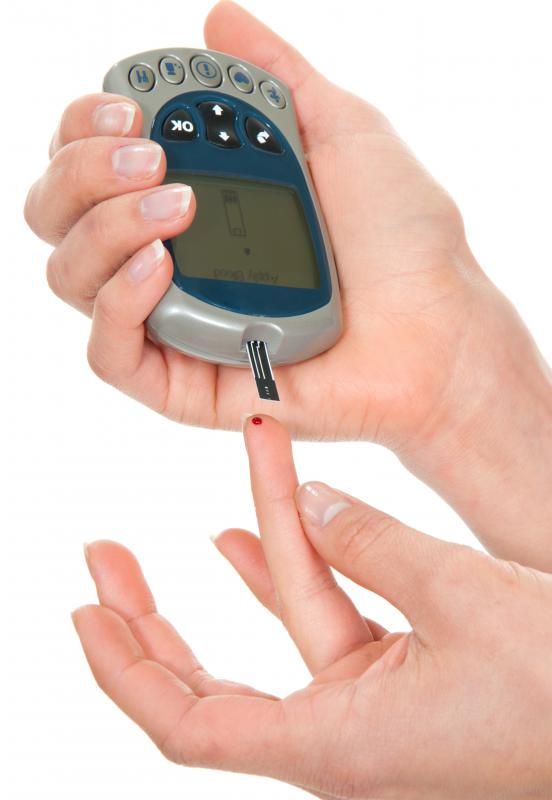
![Hyperglycemia can be detected with urine and blood tests.]() By: jcreaxionHyperglycemia can be detected with urine and blood tests.
By: jcreaxionHyperglycemia can be detected with urine and blood tests. -
![Dry mouth may be a symptom of hyperglycemia.]() By: BenicceDry mouth may be a symptom of hyperglycemia.
By: BenicceDry mouth may be a symptom of hyperglycemia. -
![Hyperglycemia, if severe, can be treated by regular insulin injections.]() By: KuruanHyperglycemia, if severe, can be treated by regular insulin injections.
By: KuruanHyperglycemia, if severe, can be treated by regular insulin injections.



Discussion Comments
I've recently noticed that after drinking a ton of pop over time (two or three cans a day), I started to develop dry mouth then a numbness around my lips that would last for days. This really concerns me and I wonder if I am suffering from hyperglycemia. I am not diabetic and my regular check ups show me to be in good health with no issues with cholesterol or high blood pressure. What do you think it is?
It's really interesting that people who have hyperglycemia from Type II diabetes don't always respond to insulin shots. I guess I thought that insulin was the usual treatment for both kinds of diabetes. But it seems that's not the case!
Personally, I hate needles, so I would rather take an oral medication and exercise to treat an illness. I mean, I would rather not have diabetes at all, but if I ever develop it, I hope to get the kind that responds to oral medication!
@Monika - That's interesting that your cat was basically showing the same symptoms a diabetic human might complain of. I wonder if he had dry mouth, too? Of course a cat couldn't tell you if he was suffering from that symptom.
Although I don't suffer from hyperglycemia, hypoglycemia is a problem I do have occasionally. Hypoglycemia is basically the opposite of hyperglycemia: your blood sugar gets too low instead of too high.
When it happens to me I get very dizzy and shaky, but if I eat something right away, that usually clears it up. I usually carry a snack bar in my purse in case of emergencies.
A lot of people don't know this, but animals can get hypoglycemia of hyperglycemia also. I have a diabetic cat, and the reason I knew to take him to the vet was that he was showing symptoms of hyperglycemia. Of course, I didn't know that at the time.
He was drinking tons and tons of water, and going to the litter box very, very frequently. I actually thought there might be something wrong with his kidneys!
However, when I took him to the vet the vet thought it sounded like diabetes and did a blood sugar check. Sure enough, it was high, and the vet put him on medicine. He's doing well now though.
@ddljohn – I know what you mean about your tastes changing. Though it was hard to cut out sweets after I first experienced hyperglycemia and learned I was diabetic, it is now hard for me to eat them at all, which is a good thing.
What tasted wonderful before now turns my stomach. A sugary soda used to hit the spot, but now, it tastes like drinking pure sugar, and I can't stand it.
This is a good reaction for our bodies to have. I think it may be a way of the body protecting itself from things that would do it harm.
@cloudel – You should go now! Seriously, don't play around with hyperglycemia. It isn't going to go away on its own, and waiting can only lead to worse things.
My grandmother had these symptoms, and she refused to see a doctor. She wound up getting really confused and dizzy, and we thought she had dementia. She passed out, and we seized the opportunity to take her to the hospital, because she never would have gone on her own.
She found out she had diabetes, and she has held this against us ever since. She hates having to take medication for it, and she said we should have just let her die. That is a horrible attitude to have, and since you are actually worried, I can tell that you would rather take the treatment than end up dead.
I am a little concerned that I may have hyperglycemia. Lately, I have been urinating much more than usual and drinking a lot of water, but those aren't the only things that worry me.
I have been tired for months, and it seems I can never get rested. I sometimes become nauseated for no reason, and my breath kind of smells and tastes like fruit.
My best friend told me that these are signs of hyperglycemia. I am really scared to go to the doctor, because I don't want to hear that I'm diabetic. I know that I need to, and I probably will if this gets worse.
My friend's parents are both diabetic, and they frequently suffer from hyperglycemia. The whole family is overweight, and I know how hard it can be to resist sweet temptations, but in their case, giving in is dangerous.
My overweight friend is not yet diabetic, but I have a feeling she is headed in that direction. Even seeing what her parents have to go through hasn't been enough to motivate her to develop healthier habits.
She told me that when her dad becomes hyperglycemic, he gets really angry all of a sudden. He says things that don't make sense, and the reason he is angry is often ridiculous and totally imagined. She knows exactly what is going on when he starts behaving this way.
I know several people who have chronic hyperglycemia. Some of them take medications for this and others don't, but I am usually surprised when I find out they have been diagnosed with this.
The reason is because most of the time, they are eating a lot of sweets and junk food. I have never been diagnosed with this and have worked at cutting most of the sugar out of my diet.
I can understand those people who don't know they have high blood sugar eating this way, but if they know they have hyperglycemia, I think they would be more mindful of it.
We went out to eat with some friends and he has diabetes and takes medication for it. After his meal he ordered a huge piece of rich chocolate cake with ice cream on it.
I thought if he eats like that all of the time, it is not surprising that he has to continue to take medication and monitor his hyperglycemia.
At my last two annual physicals, I was told my blood sugar levels were in the pre-diabetic level. There is not history of diabetes in my family and I wasn't having any symptoms, so was a little surprised by this.
One of my co-workers was diagnosed with diabetes and she said she had to run to the bathroom all the time and felt like she was always thirsty, no matter how much water she drank.
I wasn't noticing any of these problems, but it has made me much more aware of the type of food I am eating. My doctor told me there was a good chance I could change this if I cut out food with a lot of sugar and began exercising.
I do love to drink pop, and am overweight, and know both of these things are contributing to my problem. I have been working hard at it, and hopefully when I return next time, my blood sugar levels will be much lower.
Receiving a hyperglycemia diagnosis isn't a death sentence, but it certainly can place restrictions on your life.
My aunt wasn't diagnosed with this until later in life. She has a little unit she carries with her all the time to keep track of her glucose readings.
She checks this many times throughout the day. I have seen her check her blood sugar before she eats food, and again after she eats something.
Many times she has a good idea of where it will be by the way she feels, but she can't rely on this. There are many times when she feels just fine, but her readings will be much higher than they should be.
She has made a lot of changes in her diet, and exercises on regular basis, but still has to take medication and constantly watch her blood sugar.
One of my nephews has diabetes and has to take insulin shots. Treatment of hyperglycemia can be difficult for anyone to follow, but it is especially hard for young people.
It it hard for him to understand the complications he will have if he doesn't follow his diet and keep his blood sugar levels steady.
When he sees all of his friends drinking sugary drinks and eating junk food, naturally, he wants to eat like that too.
It has always been a battle to keep his hyperglycemia under control because of this. He is now a teenager and it has become even more difficult for him.
He was diagnosed with this when he was about 5 years old. There have been a few scary times since then when his blood sugar levels were extremely high.
As he gets older I hope he will realize how serious this is and will work harder at keeping his hyperglycemia under better control.
@anon5829-- I agree with @anon63197's reply that it depends. Like the article said, there are different methods being used to manage type 1 and type 2 diabetes.
Type 2 diabetes is a bit easier to manage since it only requires taking a tablet medication and type 2 require insulin which is harder to administer and measure.
However both need to check their blood glucose levels regularly because glucose levels can go up too high or fall too low which is dangerous. And obviously, both have to follow a strict hyperglycemia diet and need to exercise regularly.
The diets can be a little different too. I know type 1 diabetics who are allowed sweets in moderation but type 2 are not allowed at all.
@ddljohn-- You described me exactly! I also have diabetic hyperglycemia.
The unusual symptom I had that made me go to the doctor was frequent hunger. I would have a full and balanced breakfast and head out for work. After half an hour I felt extremely hungry as if I didn't eat anything. I would start to shake and felt like fainting. I would grab a muffin or a smoothie and eat it so quickly.
I realized that no one else around me felt this way after eating and that's what made me see the doctor. Since taking my medications I've never had this happen. I can go on for 3-4 hours without problems after eating now.
I have hyperglycemia (type 2 diabetes) and I'm on a diabetic diet and taking oral medications.
The hyperglycemia signs and symptoms mentioned in the article first appeared 2-3 years ago for me. I started to gain weight because I didn't exercise and I was under a lot of stress because I was working three jobs and had financial problems.
Soon after, I started craving a lot more carbohydrates and sweets than usual. I was drinking water constantly and obviously urinating a lot as a result. My mouth felt dry all the time and sometimes after eating a large meal with carbohydrates, it felt like my mouth was full of sugar. I would resort to bottles and bottles of water and tea to get rid of that feeling.
Finally several months ago, I went to the doctor for a glucose tolerance test. I was diagnosed with hyperglycemia and put on medications. I changed my diet as well. I don't eat sugar anymore except for 1-2 portions of fruit a day. I'm eating complex carbohydrates only and lots of veggies.
I drink much less water than I used to and I feel like my tolerance for many foods has reduced. I tried eating sweets the other day and it tasted horrible and made me nauseated.
It depends on the severity of the glucose levels.
what is the nursing management of hyperglycaemia if the client is able to swallow?
what is the nursing management of hyperglycemia?
Post your comments