
At DelightedCooking, we're committed to delivering accurate, trustworthy information. Our expert-authored content is rigorously fact-checked and sourced from credible authorities. Discover how we uphold the highest standards in providing you with reliable knowledge.
What is Homogenized Milk?
 Tricia Christensen
Tricia Christensen
Tricia Christensen
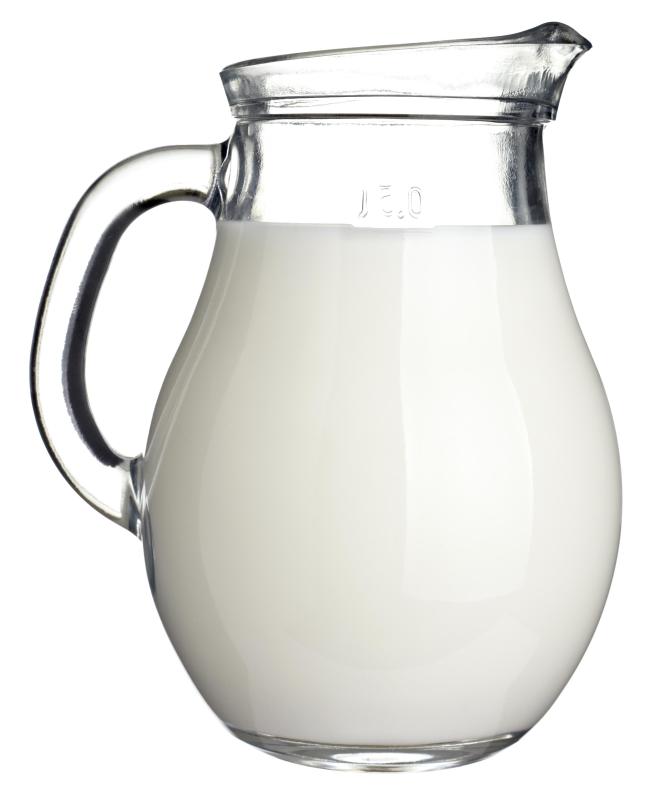
Homogenized milk is any sort of milk that has been mechanically treated to ensure that it has a smooth, even consistency. The homogenization process typically involves high temperatures, agitation, and filtration, all aimed at breaking down milk's naturally occurring fat molecules. Once broken, these molecules stay suspended in the milk and resist separation. The process makes fat filtration much easier for manufacturers, and lengthens milk's shelf life.
Why Milk Is Homogenized

Milk is a combination of fats, proteins, and water. When raw milk is left to stand for any length of time, the fat molecules typically float to the top. This creates a layer of cream that many farmers and raw milk aficionados use as a measure of the milk's quality: the thicker the cream, the better the milk. Many find the separation distasteful, however, if not an impediment to actually drinking the liquid.
The Process

Homogenization allows milk manufacturers to combine the cream and milk so that it does not separate. The process is purely mechanical, and involves no additives or chemical treatments. The main goal behind milk homogenization is to reduce the size of the fat molecules in milk because smaller molecules tend to stay suspended in the body of the liquid. Only large globules float to the top.

The process typically starts with agitation. Milk is placed in a large drum or barrel that is spun at high speeds. Warm fat molecules disintegrate more easily than cold ones, so heat is often applied as well. The turbulence caused by the agitation starts breaking down the fat.
Next, the milk is pressed through narrow sieves or filters. This forces the fats to break apart even more to fit through the microscopic holes. Modern homogenization techniques can reduce fat molecules by a factor of nearly 500.
History and Early Iterations

The first homogenized milk was made by Frenchman Auguste Gaulin. His machine, which was a three-piston thruster outfitted with tiny filtration tubes, was patented in 1899. Modern agitation and thrusting mechanisms have improved upon this model, and today's tools are able to achieve much smaller fat molecules than Gaulin could have imagined. Still, the basic idea remains the same.
Manufacturing Benefits

Customer preference is usually only one of the reasons dairy farmers and manufacturers homogenize their milk. On larger farms, this process allows milk from many different herds to be blended together more easily. Simply combining milk from two cows or goats into a single container doesn't always produce a uniform result. Milks with different chemical make-ups often do not blend well, and the liquid may separate and doesn't always taste the same. When homogenized, however, even very different batches can form one unified whole.
Homogenized milk also has a longer shelf life because the cream cannot rise to the top and clump together; this allows it to be transported over greater distances. Large-scale dairies often find this to be an advantage, as it means they can do business with buyers in more places. Consumers, too, often appreciate longer-lasting milk. Homogenized milk will often last for a week or more once opened, whereas separated milk must usually be consumed within a few days.
The filtration part of the process also makes it very easy for dairy farmers to remove a certain percentage of the fat. In whole milk, all of the sifted fats are added back in. For 2%, 1%, and nonfat versions, different percentages of fat are removed and discarded, or else used for other applications like making ice cream or butter. It is possible to get the same results by skimming off measured percentages of separated cream, though the homogenization process makes the calculations much more efficient and precise.
Relationship to Pasteurization
Most milk products sold in grocery stores in the United States are both pasteurized and homogenized. Though these terms tend to go together, they represent very different processes. In pasteurization, milk is heated to very high temperatures, then rapidly cooled in order to kill off microbial growth. Pasteurization tends to alter the taste of milk, but is considered by many to be essential in ensuring that the milk is safe for people to drink.
Homogenization has nothing to do with safety, but is usually driven by aesthetics and taste preferences. It is entirely possible to have milk that has been homogenized but not pasteurized, or pasteurized but not homogenized. If both processes are to be performed, however, homogenization typically comes last, since the heat of the pasteurization tends to make the fat breakdown easier.
Homogenization Requirements
Governments do not usually require milk to be homogenized, in part because it is a strictly non-chemical process. Milk is so frequently treated in this way that some governments have intervened in the labeling process, however. In the United States, for instance, the government's definition of "milk" assumes that it has been subjected to this process. This means that manufacturers do not have to say that their milk is homogenized — but they do need to say something if it is not.
Health Controversy
Homogenized milk is generally considered safe, and has long been thought to be more easily digestible than natural cream-on-top milk. Still, there remain some experts who question whether forcing milk fats to separate might have negative effects on people's health.
One of the biggest challenges to homogenized milk concerns heart disease and arterial plaque buildup. Some medical researchers believe that the smaller, agitated milk fat molecules that result from homogenization may bind more easily to the walls of the heart's arteries, clogging them and potentially leading to heart disease and other ailments. Although this theory has gained a lot of attention, an equally large body of research would seem to refute it, and there does not seem to be enough information available to draw a universal conclusion.
Tricia Christensen
Tricia has a Literature degree from Sonoma State University and has been a frequent DelightedCooking contributor for many years. She is especially passionate about reading and writing, although her other interests include medicine, art, film, history, politics, ethics, and religion. Tricia lives in Northern California and is currently working on her first novel.
Learn more...
Tricia Christensen
Tricia has a Literature degree from Sonoma State University and has been a frequent DelightedCooking contributor for many years. She is especially passionate about reading and writing, although her other interests include medicine, art, film, history, politics, ethics, and religion. Tricia lives in Northern California and is currently working on her first novel.
Learn more...AS FEATURED ON:
AS FEATURED ON:


-
![The fat molecules in homogenized milk are reduced in size and dispersed to prevent cream from settling on the surface of the milk.]() By: picsfiveThe fat molecules in homogenized milk are reduced in size and dispersed to prevent cream from settling on the surface of the milk.
By: picsfiveThe fat molecules in homogenized milk are reduced in size and dispersed to prevent cream from settling on the surface of the milk. -
![Milk contains a blend of proteins, fats and water.]() By: efiredMilk contains a blend of proteins, fats and water.
By: efiredMilk contains a blend of proteins, fats and water. -
![The majority of milk products sold in the United States are both homogenized and pasteurized.]() By: seqoyaThe majority of milk products sold in the United States are both homogenized and pasteurized.
By: seqoyaThe majority of milk products sold in the United States are both homogenized and pasteurized. -
![Homogenization allows milk from many different herds to be combined.]() By: pisotckiiHomogenization allows milk from many different herds to be combined.
By: pisotckiiHomogenization allows milk from many different herds to be combined. -
![Dairy processing plants are responsible for pasteurization and homogenization of milk to specific standards before it is bottled.]() By: Budimir JevticDairy processing plants are responsible for pasteurization and homogenization of milk to specific standards before it is bottled.
By: Budimir JevticDairy processing plants are responsible for pasteurization and homogenization of milk to specific standards before it is bottled.




Discussion Comments
Why does this homogenized milk crisis exist? I discovered it back in the year 2005. Homogenized milk works like a laxative in the human body, and the lack of calcium for our bones is also terrible. The USDA needs to fix this problem immediately! America needs regular, non-homogenized milk with 100% calcium back! Save lives!
God did not design the size of the cream molecules by accident.
They were large enough to float to the top for a reason and that reason is that they are too large to be digested through the intestine and therefore are not adding calories or harm to the body.
Instead, God designed cream molecules size so the cream will go all the way through the system and serve as a natural lubricant for excretion.
A double whammy of kind design. Not digested and lubricant for the toilet.
That's the God I know.
What milk is pus free? How do we know the cows are treated right?
The cream on top of the milk is called qemaq in Farsi. I'm from Afghanistan and we all ate that qemaq with some sugar on it with our warm Afghan bread. It tasted so good. The milk was fresh and we would boil it and add sugar in a glass and drink it. I miss all of that.
Now, we get organic milk. It doesn't taste anything like that. Countries in Asia and the Middle East all drink unpasteurized/homogenized milk. Most are skinny people and doesn't affect them. I love raw milk but can't find it in Virginia.
@anon73499: According to your theory of smaller fat cells being bad for heart health, then goat's milk should be far worse for our health since goat's milk does not need to be homogenized due to it having very small fat globules.
I don't see masses of people dying from drinking it. My advice is to live your life and enjoy. Don't overthink things. Life is pretty simple.
Does homogenized milk have cream?
Large scale milk producers i.e., CAFOs, have to pasteurize their milk because they treat the cows so poorly by giving them hormones so that they can milk them 24/7, then they end up giving the cows antibiotics for the infections this constant milking causes which in turn, basically produces milk full of pus. And pasteurization, by the way, does not remove this pus; you are drinking it.
Raw milk, on the other hand, from organic dairy farms that do not treat their cows this way, is not contaminated. There has never been one raw milk sample that has yielded any pathogenic bacteria whatsoever!
All this "raw milk is bad for you" hype is just big agriculture trying to scare you into not drinking raw milk so that Big Ag does not go out of business!
It's all about money people, not your health and well-being! Take care of yourself and do your homework (whoever wrote this article!)
What happens to "homogenized milk" when it is boiled? Does it get restored to pre-homogenized/natural state?
In Southern California, Trader Joes sell non-homogenized milk labeled 'Cream Top.' It's so delicious, better than homogenized. And you can see the thick cream layered on the top. Scoop it out with a knife, add a little sugar and hmmmm-mmm! I always get Cream Top, it's thicker and tastes better. A little fattening though, just a little but worth it.
help me by giving me examples of pasteurized, homogenized and sterilized milk.
Where can I buy unhomogenized milk in Southern California? Or, where can I buy whole cream to add to the milk to give it some flavor? bsk
I used to work weekends on a farm and discovered 'real' milk as well. Ever since then I only buy milk directly from farms.
A previous commenter has mentioned trying to find a small holding and buying your milk directly from there and I have to agree. Commercialisation of the milk industry, while necessary to meet demand, has totally destroyed the taste. Milk now is effectively just a whitener for coffee and tea, which is a real shame.
The milk I buy, direct from a local farm just north of Canberra, has taste that changes over the year. I can tell when the cows are eating new pasture grass, or hay, even if they are having to eat more protein/molasses (usually during winter). In short, it has flavor. When I'm drinking 'standardised' milk (i.e., coffee in a cafe) I can tell - it is tasteless and just makes the coffee white.
I asked Stonyfield why they discontinued their wonderful plain whole milk yogurt, that had the cream settled on the top. They said, it was debated, and was a toss-up, so they decided to change it. (Why, if it was a toss-up?) I asked how they kept the cream from rising to the top. They said they homogenized it. I will not buy their yogurt anymore.
I was raised on family owned dairy farm, don't drink any milk from stores. Find a small dairy, 30-50 cows mainly grass fed.
If pastuerization and homogenization apparently make the milk safer, why has every single milk recall in America been on pasteurized and homogenized milk, with not a single recall or sickness coming from raw milk?
@Críona: The globules found in non-homogenized milk are larger and more readily digested. When milk is homogenized, those globules are broken down into spheres small enough to pass directly through the walls of the stomach, into the blood stream. This creates small holes in the vessels and other surfaces. These holes are then patched by cholesterol.
The only reason for breaking them down to this size is so that they'll stay suspended in the milk, instead of floating on top (cream on top). You can find this information in Healing with Whole Foods (pg. 19) by Paul Pitchford, with excellent in-text references.
Why doesn't milk easily stay mixed together?
Milk has been ruined by homogenization. The milk ultra heated, fine fat particles are detrimental to humans, and we wonder why there's now so much type 2 diabetes in young people! anon
What is the average shelf life of "ultrahomogenized" (UHT processed) milk? Also, is there a difference in shelf life if stored unrefrigerated as to refrigerated? Need this information for a research paper, thanks!
Before homogenization and pasteurization people drank milk raw, and there is no problem as long as the cow is clean and healthy. The reason for pasteurization in our foods is due to the disgusting state of our FDA regulated dairy farms.
Drinking raw milk from a local farmer is perfectly safe if the conditions are clean and promote health and low stress among the cows. The problem becomes the mass production of a needless substance like milk in a small plot of land. Thousands of cows are set in tiny plots where they walk around in feces and are regularly given antibiotics until "X" amount of time before slaughter. All this is irrelevant however if the consumer becomes educated.
Visit the actual farm where your buying milk from and see it for yourself. If they don't let you bring cameras onto the grounds then get a clue as to what is going on. Disease is caused by poor food choices made by a society of people who do not think for themselves. -Dan
In reply to anon73499: Ultra pasteurized means the milk is pasteurized at a hotter temp for a shorter period of time.
Homogenization breaks the cream break down so that your body cannot absorb it as the way nature intended and it ends up in your bloodstream because it is broken down--which does cause heart problems. The shelf life has to do with the temperature it is heated.
For example, Hartzler's Dairy in Ohio (where I buy all of my milk) uses a low temperature vat pasteurization process and does not homogenize their milk. The Hartzler's heat their milk to 145 degrees in a vat for 30 minutes instead of heating it to more extreme temperatures of 160 for 15 seconds (HTST) or even higher to over 200 degrees for less than two seconds (UHT) and because they do it this way, the milk only has a shelf life of 18 days. But the health benefits are certainly worth it. Enzymes are protected and your body is able to digest the milk better because the milk is in a more natural state.
"has resulted in longer lasting milk"
That part isn't true. While the milk can travel farther without significant separation, breaking up the fat globules makes it easier for the fat molecules to combine with other things, making them turn rancid more quickly once the package of milk is opened.
Milk that has not been homogenized will last longer after it has been opened, but the cream will separate, so it needs to be shaken.
I think many species would consume other species' milk if or when they get a chance (but since they can't milk an animal or suckle their breasts,they eat them instead).
i think only babies adopted by another species like we see on tv sometimes or things like cats given milk by human owner etc. are more possible.
Many species also consume others' eggs. This is why mothers usually try to protect them.
Why do people insist on eating the milk of other species? No other life forms do this. Milk is intended for babies and then they are weaned off the milk. In the natural order of things, that should be the end of it. Very crafty marketing.
Is homogenized milk a whole milk?
The homogenization process alters the shape of the lactose molecule. Since we only have one enzyme to digest lactose, we now have a problem digesting homogenized milk.
No wonder we now have men in their 60's suffering from osteoporotc fractures, let alone the general epidemic of osteoporosis among women!
well, to all of you out there in India, we buy cow's/buffalo's milk from the local farmer and boil it well. The cream forms a layer on top. Milk is used for drinking after removing this cream.
To sour the milk for yogurt we use the cream too. Later the cream is removed form the yogurt (sour cream) and churned to make butter, so we drink a kind of de-creamed milk and those interested can consume butter otherwise.
anon73499; Your comment is absolute science fiction. Cream does not come packaged in cells in milk (or at all for that matter). Cream is composed of a variety of fats, proteins, carbohydrates and other factors. The fats tend to gather into tiny droplets referred to as globules. These globules are not absorbed across the gut whole, they are broken down and each individual molecule of fat is absorbed separately. Whether milk is homogenized or not has absolutely no impact on the occurrence of heart disease. -Críona.
Homogenization is the cause of the huge heart disease problem. The smaller cream cells go directly into our arteries where the natural cream cells do not fit.
If I had the choice, I would never by homogenized milk! I shop at natural food stores, and still have a problem finding nonhomogenized milk or half and half.
I have been buying heavy whipping cream because it doesn't say it is homogenized; although, it does say ultra pasteurized. Does ultra pasteurized mean that it has been homogenized?
When the cream separates, does the milk become non-fat?
If you have a Braums Ice Cream and Dairy Store (they also sale few market items and our combined with a fast food restaurant) located near you, they sale unhomogenized, pasterized, hormone free milk. It's yummy! Or you can also check at any type of whole foods type of market. Good luck.
I manage a retail store for a small creamery in NE Iowa that produces non-homogenized milk. We have customers daily who report that our milk better and has a much longer shelf life than "conventional" brands.
Shelf life is related to bacteria levels in milk which has little or nothing to do with homogenization. High bacteria levels= more organisms living, producing waste, and dying in your milk. Higher bacteria levels are a result of transferring milk from vat to vat which occurs in larger producers who receive milk from multiple farms.
We have an ongoing list of over 500 people who are lactose intolerant who are able to drink our milk without having to take Lactaid or similar medications. They say they still suffer ill effects if they drink homogenized milk.
The debate over whether homogenization is detrimental or not is ongoing. I stand to believe, based on my experience, that drinking non-homogenized milk is generally in a person's best interest. It is a more natural product than its counterpart which your body is therefore more readily able to process and receive only the enzymes, nutrients, and fat it truly needs.
how do I dispose of homogenized milk?
Could boiling milk could undo homogenization?-- Margarita
We buy unhomogenized milk sometimes from Highland Farms in Canada (supermarket) and the cream that forms on top is so good, unlike anything I've tasted before.
I grew up on a small dairy farm. I don't remember the milk being boiled. I remember skimming cream off the top of the milk can for house use. I remember butter being made at home. We made whipped cream using the old hand beaters. If a cow had an udder problem, we did not drink that milk. This took place in the late 40's and early 50's in central Michigan.
We would use the cream from the top of the cooled boiled milk to spread on our toast, in India. It was delicious. My brother would bribe us, sisters, for our share in exchange for comic books. The cream was called "milai."
where can i buy homogenized milk?
Before there was homogenized and pasteurized milk, people would boil their milk, to kill any bacteria. Of course since the milk was not homogenized, some of the cream would collect on the top of the milk, while cooling.
The cream would be then collected with a spoon, and eaten either like that or spread on a slice of bread with a little sugar, it was usually meant for children. What a delicacy. This was not done often, and the amounts were rather small, but it was so delicious.
Post your comments