
At WiseGEEK, we're committed to delivering accurate, trustworthy information. Our expert-authored content is rigorously fact-checked and sourced from credible authorities. Discover how we uphold the highest standards in providing you with reliable knowledge.
What is Holy Communion?
 Tricia Christensen
Tricia Christensen
Tricia Christensen
Holy Communion refers to the Eucharist and the wine that some Christians take as a symbol of the body and blood of Christ, during a portion of a church service. In the Roman Catholic Church, the Eucharist is not simply symbolic of the body of Christ, but it is also the body of Christ. It is a sacrament. A sacrament in Catholicism is described as the symbol of the thing and the thing itself.
This means when practicing Catholics take Holy Communion, it has been transformed through prayer into the physical body of Christ. They are thus taking Christ within themselves. Other Christian denominations do not practice the Eucharist, or refer to it only as symbolic of the body of Christ as he referred to it at the Last Supper.

In Catholicism, practicing Catholics make their first Holy Communion at the age of seven or eight. This is considered the age of reason in Catholicism. Thus children making their first sacrament must understand exactly what they are doing when they first accept the host. In other Christian denominations, bread and wine may be passed to all members of a church.

If an adult joins the Catholic Church, he or she will participate in a ceremony which may include baptism, if the person has not already been baptized; first Holy Communion; and Confirmation or baptism by the spirit. Other churches may also require baptism prior to offering the sacrament to new church members. Many churches do not differentiate between baptism by one denomination or another.

Most churches ask that non-believers or those of other denominations not take Holy Communion (also called the Lord's Supper). While visitors are welcome to be in fellowship with church members, taking the Lord's Supper is a conscious act requiring belief.
Not all people who take the sacrament also drink the wine or grape juice offered. Alcoholics, for example, seldom drink the wine. Also, those who are concerned about illness may not drink since the wine is often shared from a mutual cup. Wine or juice offered at the Lord's Supper is optional. In general, a person is considered to have taken Holy Communion if he or she has eaten the "host", or bread. Churches differ on what constitutes the bread. Sometimes the Lord's Supper begins as just plain bread.

In Catholic churches, the Host is a round white wafer made of wheat. Toward the end of the mass, the priest consecrates the Host, and then people make their way toward the priest to receive the host. The Priest holds up the host momentarily and says "The Body of Christ." Those receiving the Host respond by saying "Amen."
The Host is then placed on the tongue, or in the upturned palms of the receiver, and is consumed immediately. Parishioners then make their way back to their seats and several moments of silent reflection are then observed.

Consecrated Host may be sent with those authorized by the church to administer the Lord's Supper, to take to those who cannot attend church, such as those who are ill. Either a man or woman may administer the Eucharist, but only a priest may consecrate Holy Communion. Before its consecration, the Host is simply bread.
Taking Holy Communion is a part of virtually all masses, and every other sacrament. For example, a baptism offers the Eucharist to all attending who are practicing members of that particular sect of Christianity. Marriages, even when they do not include a Mass, usually include the Eucharist. Holy Communion is also offered at every daily Mass in the Catholic church.
Tricia Christensen
Tricia has a Literature degree from Sonoma State University and has been a frequent WiseGEEK contributor for many years. She is especially passionate about reading and writing, although her other interests include medicine, art, film, history, politics, ethics, and religion. Tricia lives in Northern California and is currently working on her first novel.
Learn more...
Tricia Christensen
Tricia has a Literature degree from Sonoma State University and has been a frequent WiseGEEK contributor for many years. She is especially passionate about reading and writing, although her other interests include medicine, art, film, history, politics, ethics, and religion. Tricia lives in Northern California and is currently working on her first novel.
Learn more...AS FEATURED ON:
AS FEATURED ON:









-
![A Roman Catholic priest administers Holy Communion during mass.]()
A Roman Catholic priest administers Holy Communion during mass. -
![Priest giving the Holy Communion to a young girl.]()
Priest giving the Holy Communion to a young girl. -
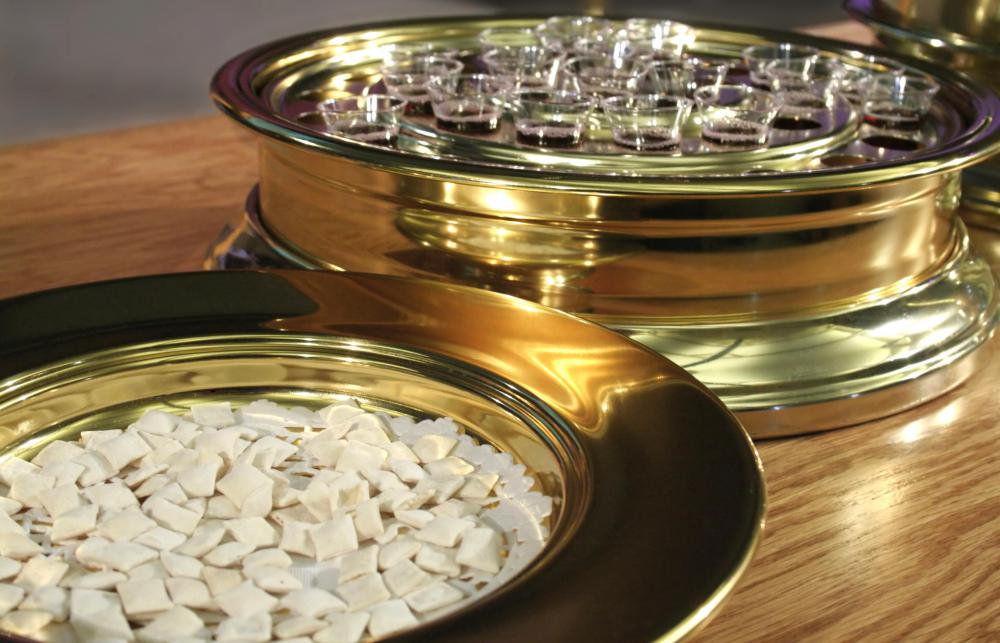
![Communion wafers and wine.]() By: Gary ScottCommunion wafers and wine.
By: Gary ScottCommunion wafers and wine. -
![Children are often given a rosary, a certificate, and a small bible after their first communion.]() By: teressaChildren are often given a rosary, a certificate, and a small bible after their first communion.
By: teressaChildren are often given a rosary, a certificate, and a small bible after their first communion. -
![The blood and flesh of Jesus are believed by Roman Catholics to take edible form in Holy Communion.]() By: poco_bwThe blood and flesh of Jesus are believed by Roman Catholics to take edible form in Holy Communion.
By: poco_bwThe blood and flesh of Jesus are believed by Roman Catholics to take edible form in Holy Communion.




Discussion Comments
amypollick explains it fairly well in detail. Basically, a small amount of bread (preferably without yeast if you're getting technical/legalistic) and a sip or mouthful of wine (Red). Prayed over and blessed, usually during a Church service and consumed by Christians as a memorial to the death of our Lord and Savior Jesus Christ.
But there is slightly more to it. It was a memorial he requested of us. The Bible says, "by his stripes we are healed" and the "bread of life" Communion bread, being representative of his body (or supernaturally his actual body after consumption, for the Roman Catholics) can bring about healing. But it is only to be consumed by those who believe, and not taken in an unworthy manner. Which is why many Churches ask only those who have been baptized and therefore publicly confessed their faith, consume Communion.
Those who eat "flesh (bread)" of Jesus must take the "blood" of Jesus. There is a truth in the "last supper," which Jesus did during the feast of passover. The passover should be celebrated that the things used in the celebration should not contain, old yeast and sour taste. This shows Jesus used grape juice not wine and bread without old yeast. Today, the Catholic Church uses strong wine (contains strong spirit/alcoholic), and this is totally a different idea from what Jesus taught us.
Some denominations use the bread which contains yeast. As Paul also said in 1 Corinthians 5:8, "Therefore let us keep the festival, not with old yeast, the yeast of malice and wickedness, but with bread without yeast, the bread of sincerity and truth."
The Lutheran Church Missouri Synod also believes that the body and blood of Christ are delivered in and under the bread and wine. We are not so foolish to believe that if the blessed bread and wine were submitted to chemical analysis that flesh and blood would appear. This is a form of the miracle of God's love for his people
@Anon118981: I can't guarantee one-syllable words, but maybe I can help you understand.
Nearly every Christian church has some form of the Holy Communion ritual. A ritual is a holy practice done on a regular basis.
Holy Communion remembers the sacrifice Jesus Christ made when He died on the cross. Christians believe He is God and came to earth to teach us to be like Him and so we could merit eternal life. No, he is not the god Bacchus, in any shape or form.
God's law specified in the Old Testament that blood atonement had to be made for sin, because we couldn't simply continue going on and screwing up in His eyes. A price had to be paid and before Jesus, that price was an animal, usually a lamb, goat, or pigeon or dove.
When Jesus came to earth, He became the perfect, voluntary sacrifice for our sins.
The night before He was crucified, he celebrated the Passover meal with his disciples. This always included breaking bread and drinking a ceremonial cup of wine. He said, "Do this in remembrance of me." So Christians have a ritual that remembers that holy night.
Communion is celebrated a little differently, depending on the church. In Catholic churches, it is celebrated every Sunday and is the center of the service. Scriptures are read, prayers are said, the priest offers a brief homily, or sermon, and the people recite the Communion responses. They then go to the altar and receive the bread and wine.
I'm a Methodist, and we do it a bit differently. We have it once a month in my church and go through our service as usual until the end. We then go to the worship section of our hymnals and begin by praying group prayers of confession and pardon. After we have said our responses, we go to the altar and receive the juice and bread. The prayers and responses are meant to prepare our hearts for the ritual and to help us get into a right place spiritually, because Holy Communion is the most sacred moment of time in any Christian church.
You can research communion rituals and can see the prayers and instructions. They are not secret or mysterious, and maybe reading them will help you better understand what is going on.
I hope this helps.
As a non-Catholic, this article does not explain what "Holy Communion" is. Is it a ritual form of prayer perhaps? Is it endorsing the notion of transubstantiation? (Is Jesus really a Jewish form of Bacchus the wine god? hence turning water to wine, and the blood thing) Would someone please explain in words of one syllable? thanks.
Sunny27- That is so true. My kids take CCD (catechism) classes on Tuesday afternoon. My daughter already completed her first communion and this upcoming year, my son will. It is really a huge milestone in a child’s life.
Little girls wear white gowns with veils and little boys where white suits and tie. The children really look like angels. It is such a moving experience. I cried at my daughter’s first communion ceremony. Then afterward we had a reception at a really nice oceanfront restaurant and enjoyed the beautiful day.
Great article- I just want to add that for Catholics going to confession is a ritual often done before receiving communion.
The purpose of this is to confess the sins and ask for forgiveness. Once the priest absolves your sins then it is acceptable to receive Holy Communion because it is at that point that you are truly sorry for your sins.
Most Catholic children receiving communion for the first time prepare for confession and actually go to confession a few months before. The act of communion usually comes at the end of the second year after two consecutive years of religious study.
Is there a difference between the round and triangle communion host? As long as I have known there isn't. a friend told me the triangle means something special.I believe it is part of the broken host. Your reply is greatly appreciated.
jo
Post your comments