
At TheHealthBoard, we're committed to delivering accurate, trustworthy information. Our expert-authored content is rigorously fact-checked and sourced from credible authorities. Discover how we uphold the highest standards in providing you with reliable knowledge.
What is Herpes?
 Niki Foster
Niki Foster
Niki Foster
A variety of diseases caused by viruses in the Herpesveridae family fall under the name herpes. Different types affect both animals and humans. In humans, Herpesveridae cause oral and genital herpes, chickenpox and shingles, cytomegalovirus, infectious mononucleosis, and Kaposi's sarcoma and other cancers. Eight viruses in this family can cause disease in humans, and all produce life-long infections, though they may produce symptoms only sporadically or be asymptomatic.
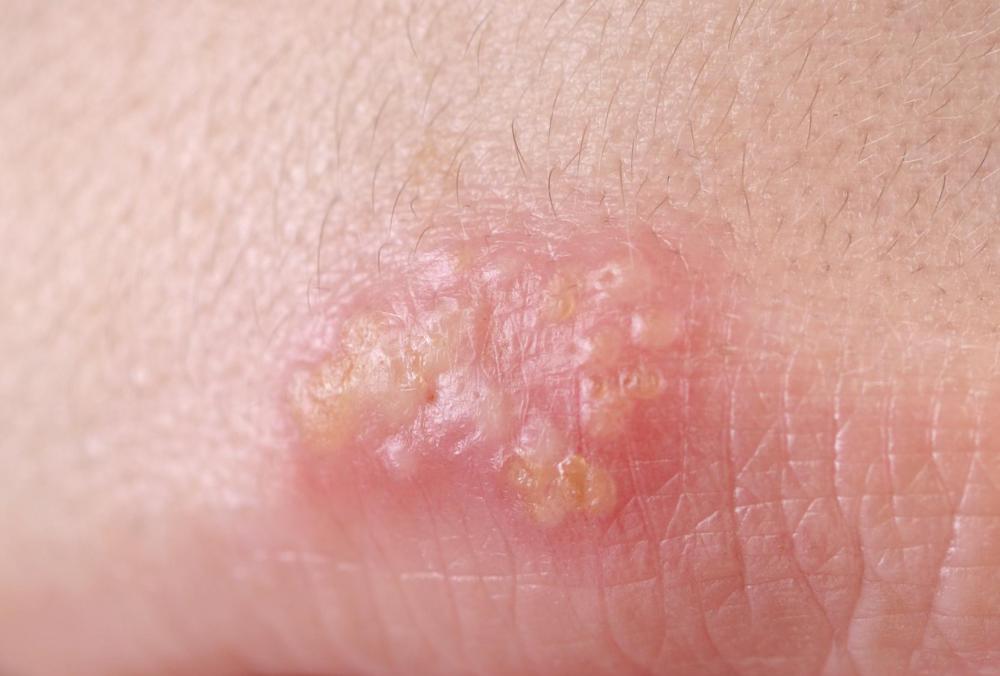
Herpes simplex virus (HSV) I and II are responsible for oral and genital infections, with HSV-I more likely to cause orofacial symptoms and HSV-II more likely to cause genital symptoms. Both viruses infect the nervous system. If symptomatic, they produce small painful blisters on the affected area that become scabs as they heal. Both types are transmitted through skin-to-skin contact with an infected person.

Varicella zoster virus (VZV) causes chickenpox and shingles, and it is also called herpes zoster. Chickenpox begins as a rash, which is followed by the formation of small, itchy blisters on the body and scalp. It is contagious and remains in the nervous system for life, though it rarely has serious complications. VZV infection is typically more serious in adults than in children, and it may progress to shingles, which is characterized by headache, malaise, fever, and pain, in addition to blisters. In severe cases, the patient may develop postherpetic neuralgia, characterized by long-lasting, severe pain that is often difficult to manage.

Epstein-Barr virus (EBV) is extremely common, but usually asymptomatic. It most often causes infectious mononucleosis (mono), which presents as sore throat, fever, and fatigue. Infectious mononucleosis is spread via saliva and is self-limiting, meaning it can usually be resolved without treatment. Rare and potentially fatal complications occur in 5% of all cases. EBV and Kaposi's sarcoma-associated herpesvirus (KSHV), which causes Kaposi's sarcoma and other tumors, both affect the immune system and remain in the B-cells while latent.

Cytomegalovirus (CMV) causes symptoms similar to infectious mononucleosis, and is spread through bodily fluids. It is treated with an immunoglobulin injection, sometimes in combination with an antiviral. Roseolovirus, also spread through bodily fluids, is the cause of the childhood disease rolseola, characterized by rash, high fever, respiratory symptoms, irritability, and decreased appetite. Roseola usually resolves on its own. Both CMV and roseolovirus reside in the T-cells of the immune system when latent, and both can be life-threatening in infants and patients with compromised immune systems.
Niki Foster
In addition to her role as a TheHealthBoard editor, Niki enjoys educating herself about interesting and unusual topics in order to get ideas for her own articles. She is a graduate of UCLA, where she majored in Linguistics and Anthropology.
Learn more...
Niki Foster
In addition to her role as a TheHealthBoard editor, Niki enjoys educating herself about interesting and unusual topics in order to get ideas for her own articles. She is a graduate of UCLA, where she majored in Linguistics and Anthropology.
Learn more...AS FEATURED ON:
AS FEATURED ON:


-
![Chickenpox is caused by Varicella zoster virus, which is one form of the herpes virus.]() By: hartphotographyChickenpox is caused by Varicella zoster virus, which is one form of the herpes virus.
By: hartphotographyChickenpox is caused by Varicella zoster virus, which is one form of the herpes virus. -
![A blister caused by herpes type 1.]() By: uwimagesA blister caused by herpes type 1.
By: uwimagesA blister caused by herpes type 1. -
![Herpes simplex 1 causes sores to form on the lips and area around the mouth.]() By: Marco2811Herpes simplex 1 causes sores to form on the lips and area around the mouth.
By: Marco2811Herpes simplex 1 causes sores to form on the lips and area around the mouth. -
![The herpes virus may reappear during periods of high stress.]() By: Ermolaev AlexandrThe herpes virus may reappear during periods of high stress.
By: Ermolaev AlexandrThe herpes virus may reappear during periods of high stress. -
![Herpes blisters can cause a sore throat.]() By: LsantilliHerpes blisters can cause a sore throat.
By: LsantilliHerpes blisters can cause a sore throat.



Discussion Comments
@TreeMan - I remember having chicken pox, and it was miserable. I don't have any kids, but I have heard that now the Varicella vaccine is given to everyone just like the vaccines for mumps and whooping cough. If that's the case, I don't know if I agree with it. I tend to think that since chicken pox isn't normally serious that kids should just be forced to get it like in the past.
I would much rather my child have to deal with some discomfort as a kid rather than have to get shots for the rest of their life and risk getting shingles.
I am one of the few people around who never got chicken pox. When I was younger, parents used to have "chicken pox parties" once one of the kids got it, so that everyone could get it out of the way at the same time. I could never catch it, though.
Now that I am older, I have to get the Varicella vaccine, since chicken pox as an adult can easily turn into shingles, which is much more serious. Luckily, the vaccine lasts for 10 years, so it's not like it's a huge pain to deal with over the course of my life.
@KaBoom - As JessicaLynn said, most people actually do get a fever at some point before a cold sore starts. Maybe it is a regional thing, but where I am from a lot of people call them fever blisters instead of cold sores. I would have to assume that that name came about because people in the past linked fevers to those sores showing up shortly after.
I used to get cold sores a lot, but I haven't had one for several years now that I think about it. I don't recall ever having a fever before one showed up. I doubt you really think much about the fever at the time, especially if it is minor.
@sunnySkys - I had also forgotten that chickenpox was a type of herpes. I knew it was a virus, but didn't know it was related to things like cold sores.
I agree with you about herpes having a bad connotation. Obviously, some people understand that there can be different types of herpes viruses that cause completely different things. On the other hand, you have some people that hear herpes and automatically assume they are all the same and that someone with a cold sore also has and STD.
@KaBoom - I think I actually read somewhere that some people who contract genital herpes actually do get a fever when they're initially infected. It seems like all the herpes viruses really aren't all that different!
That being said, it is really scary that any herpes virus, from herpes type 1 to chicken pox, stays in your system forever. So if you had chicken pox as a child, you're always at risk for developing shingles, because the virus is still in your system. It's even scarier because there's really not much you can do about it!
I'm amazed at all the different symptoms a herpes infection can cause. I always thought the biggest thing with any kind of herpes was the rash, but it sounds like there are a lot of other possible symptoms too! I wonder why people who get genital herpes don't get a fever like some of the other kinds cause?
Honestly, I think STDs are still very stigmatized, although they are common. So that's probably why you rarely hear anyone call chicken pox and shingles "herpes zoster" or hear anyone refer to a cold sore as the herpes virus. No one wants to admit to having any kind of herpes for fear of being labeled "dirty" or something.
I'm always surprised when I remember just how many different kinds of herpes viruses there are. The only kind I feel like I hear about frequently is STD herpes, but as the article said, there are actually eight different kinds of herpes!
@doppler - You are very correct in that a herpe outbreak can be dormant for years. I'm not sure how long the dormancy lasts, though, that would be something to research. Also, your thoughts on herpes transmission is right on as well in that it can be transferred through kissing.
I have actually been reading up on this subject recently on wiseGEEK and there are several other helpful articles around here. You should check some of them out - I don't want to write a book here.
@anon45739 - That really is very strange, I agree with doppler. What do you think is in pork that would make you break out? Are there ANY herpes symptoms that have developed after you quit eating pork - even remotely?
@anon45739 (Lee?) - That is very strange, but herpes sores come and go, especially if it's mouth herpes or "cold sores" as they are most often referred to. This disease can lie dormant for years and years, so I wouldn't be surprised. I used to always get them after kissing my husband which is where I believe I contracted it. They hurt every now and then, but are only just sore really. I rarely have an oral herpes outbreak now even when we kiss, so I'm not sure what happened to mine either.
I had been fighting cold sores for 20 years. I quit eating pork and never had another cold sore. Lee
Post your comments